Visualizzazione post con etichetta value investing. Mostra tutti i post

martedì 13 novembre 2012

Aggiornamento del portafoglio Benjamin Graham

Oggi ribilanciamo il porafoglio Benjamin Graham descritto in questo post. Il portafoglio è al suo quindicesimo ribilanciamento: i precedenti sono stati nel 2011 il  25 febbraio, il 31 marzo , il 29 aprile, il 30 maggio il primo luglio, il 22 agosto,  il primo ottobre, il 12 novembre e il 17 dicembre e nel 2012 il 4 febbraio, il 24 marzo,  il 29 maggio, il 16 luglio e il 3 ottobre.

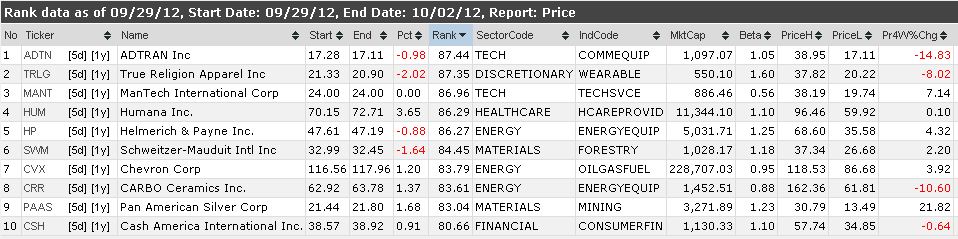
I 10 titoli selezionati da www.stockscreen123.com alla data del 9 novembre scorso, secondo i criteri descritti nel post del 3 ottobre scorso,  sono:


Escono dunque dal portafoglio ADTN (con un rendimento pari al +9,3% in sei settimane) e CRR (+14,6% nello stesso periodo), sostituiti da WDC e CF.
Il rendimento del portafoglio dall'ultimo ribilanciamento (3 ottobre scorso ) a oggi è stato pari  al 4%, molto migliore dell'indice SP500 che nello stesso periodo ha avuto un rendimento negativo (-4,7%).

Dalla sua nascita all'inizio del 2011 ad oggi è stato del 26,4%,  superiore al rendimento dell'indice di riferimento che dal 1 gennaio 2011 ad oggi ha guadagnato circa  il 13,9% (sia per l'indice che per il portafoglio i rendimenti tengono conto dei dividendi).

 Il portafoglio ha avuto rendimenti molto migliori dell'indice nell'ultimo semestre.Qui sotto potete vedere in un grafico il rendimento del portafoglio (in rosso) negli ultimi dodici mesi, confrontato con quello dell'indice SP500 (in azzurro). Il valore in dollari USA del portafoglio è pari a 12640 USD con un rendimento totale dalla data di creazione (31 dicembre 2010) di circa +2640 dollari.


Appuntamento alla fine di dicembre.

mercoledì 3 ottobre 2012

Aggiornamento del portafoglio Benjamin Graham


Con circa un mese di ritardo oggi ribilanciamo il porafoglio Benjamin Graham descritto in questo post. Il portafoglio è al suo quattordicesimo ribilanciamento: i precedenti sono stati nel 2011 il  25 febbraio, il 31 marzo , il 29 aprile, il 30 maggio il primo luglio, il 22 agosto,  il primo ottobre, il 12 novembre e il 17 dicembre e nel 2012 il 4 febbraio, il 24 marzo,  il 29 maggio e il 16 luglio.

Da oggi introduciamo anche una novità: anzichè utilizzare lo stock screener disponibile sul sito del Nasdaq
selezionerò 10 titoli utilizzando il sito (a pagamento) www.stockscreen123.com. Oltre a individuare le azioni utilizzando dei criteri value (che descriverò qui sotto) richiederò anche una liquidità minima giornaliera di 1 milione di dollari. I dieci titoli sono selezionati imponendo i seguenti criteri (per una descrizione generale vi invito a leggere questo post).

- current ratio almeno pari a 1,5. Il current ratio è il rapporto tra attività correnti e passività correnti e misura in un certo senso la solvibilità e la solidità finanziaria (a breve termine) dell'azienda.

- il debito di lungo termine non può superare il capitale circolante (working capital) più del 10%. Il capitale circolante è la differenza tra le attività correnti e le passività correnti.

- gli utili per azione (earnings per share, EPS) devono essere positivi negli ultimi quattro trimestri così come in ciascuno degli ultimi cinque anni fiscali

- gli EPS negli ultimi 12 mesi non devono essere inferiori agli EPS dell'ultimo anno fiscale e neppure a quelli di cinque anni fa

- il titolo ha pagato un dividendo negli ultimi 12 mesi

A questo punto si impone il vincolo minimo di liquidità e si ordinano i titoli ottenuti secondo una graduatoria ottenuta impiegando un metodo di valutazione che impiega in parte criteri di valutazione e in parte criteri di qualità per gli utili: a ogni azione viene attribuito un punteggio calcolato a partire dai multipli prezzo/utili, prezzo/valore di libro, prezzo/ valore di libro tangibile, prezzo / utili operativi e dalla crescita storica degli utili negli ultimi 5 anni combinata con la stabilità degli utili stessi (deviazione standard degli utili trimestrali).

Un portafoglio equipesato investito nei 10 titoli così individuati e ribilanciato alla chiusura di borsa ogni 6 settimane ha prodotto un rendimento spettacolare dal 1999 ad oggi:


I titoli selezionati in questo modo alla data del 30 settembre sono


Il rendimento del portafoglio dalla sua nascita all'inizio del 2011 ad oggi è stato del 21,54%, leggermente superiore al rendimento dell'indice di riferimento che dal 1 gennaio 2011 ad oggi ha guadagnato circa  il 19% (sia per l'indice che per il portafoglio i rendimenti tengono conto dei dividendi). Il portafoglio ha avuto rendimenti migliori dell'indice nell'ultimo semestre.Qui sotto potete vedere in un grafico il rendimento del portafoglio (in rosso) negli ultimi sei mesi, confrontato con quello dell'indice SP500 (in azzurro). Il valore in dollari USA del portafoglio è pari a 12154 USD con un rendimento totale dalla data di creazione (31 dicembre 2010) di circa +2154 dollari.


Appuntamento a metà novembre.

martedì 29 maggio 2012

Aggiornamento del portafoglio Benjamin Graham


Con circa un mese di ritardo ribilanciamo il porafoglio Benjamin Graham descritto in questo post. Il portafoglio è al suo dodicesimo ribilanciamento: i precedenti sono stati nel 2011 il  25 febbraio, il 31 marzo , il 29 aprile, il 30 maggio il primo luglio, il 22 agosto,  il primo ottobre, il 12 novembre e il 17 dicembre e nel 2012 il 4 febbraio e il 24 marzo.

Secondo lo screener del Nasdaq la composizione aggiornata con i prezzi i chiusura di venerdì 25 maggio vede 23 titoli in portafoglio:


Value Investor Either Interest Level

Based on our analysis of the book by Benjamin Graham
Guru(s) StrongGuru(s) SomeSymbolCompanyPrevious CloseMkt Value $(Mil)Rel. StrengthP/EP/E/GProj P/E 12 mo.
21  ALG ALAMO GROUP, INC.  30.61 365 88 11.04 45.05 11.55
20  AFAM ALMOST FAMILY, INC.  20.91 195 38 9.76 -30.83 10.18
20  CHEUY CHEUNG KONG (HOLDINGS) LIMITED (ADR)  11.4 27192 43 4.45 71.62 
10  CDEVY CITY DEVELOPMENTS LIMITED (ADR)  7.7 7071 54 14.07 -26.04 14.53
10  CW CURTISS-WRIGHT CORP.  31.68 1486 62 11.87 9.62 12.05
21  FRX FOREST LABORATORIES, INC.  33.33 8850 62 9.33 -0.56 33.7
21  GES GUESS?, INC.  26.7 2402 36 9.87 -10.92 10.26
10  HP HELMERICH & PAYNE, INC.  45.83 4923 41 9.9 42.43 9.37
21  KNM KONAMI CORP (ADR)  22.54 3234 82 10.77 72.31 
11  FSTR L.B. FOSTER COMPANY  27.7 280 46 11.12 32.74 10.08
30  LIWA LIHUA INTERNATIONAL INC  5.32 160 40 3.07 23.28 2.57
11  MKTAY MAKITA CORPORATION (ADR)  33.31 4681 48 11.18 9.06 
21  MLR MILLER INDUSTRIES, INC.  14.72 163 55 9.9 5.92 8.66
20  MOS MOSAIC CO  48.74 20737 40 10.44 -7.68 11.04
21  DCM NTT DOCOMO INC (ADR)  15.88 69239 55 11.28 -5.13 10.75
30  PLPC PREFORMED LINE PRODUCTS COMPANY  55.79 297 52 9.36 10.7 
31  SEB SEABOARD CORPORATION  1976.87 2385 50 7.71 -7.41 
20  SUHJY SUN HUNG KAI PROPERTIES LIMITED (ADR)  11.31 29496 41 4.68 35.26 10.01
11  UNF UNIFIRST CORP  57.95 1155 80 14.17 5.81 13.82
10  USTR UNITED STATIONERS INC.  25.34 1031 40 10.78 -2.35 9.57


Guru(s) StrongGuru(s) SomeSymbolCompanyPrevious CloseMkt Value $(Mil)Rel. StrengthP/EP/E/GProj P/E 12 mo.
11  WCSTF WESCAST INDUSTRIES INC. (USA)  4.43 29 13 12.27 -89.68 11.09
13  YHGG YASHENG GROUP  0.6 93 0.81 12.96 
12  YONG YONGYE INTERNATIONAL INC  2.98 151 44 1.79 48.11 


Esce dal portafoglio di marzo LPH mentre si aggiungono AFAM, .CW, GES, HP, KNM, LIWA, MKTAY, MOS, PLPC, UNF, USTR, WCSTF, YHGG, YONG.

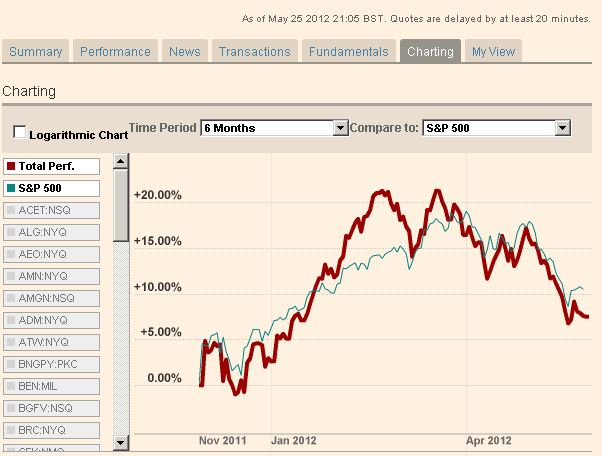
Qui sotto potete vedere in un grafico il rendimento del portafoglio (in rosso) negli ultimi sei mesi, confrontato con quello dell'indice SP500 (in azzurro). Il valore in dollari USA del portafoglio è pari a 10187 USD con un rendimento totale dalla data di creazione (31 dicembre 2010) di circa +187 dollari pari al
+1,87%, inferiore al rendimento dell'indice di riferimento che dal 1 gennaio 2011 ad oggi ha guadagnato circa il 7,7% (sia per l'indice che per il portafoglio i rendimenti tengono conto dei dividendi). Il portafoglio ha avuto rendimenti in linea con l'indice nell'ultimo semestre.


Ecco la composizione attuale del portafoglio:


Name  Symbol: Exchange  Last Price  Quantity  Current Value
Yasheng Group YHGG:QBB 0,55 904 497,2
Helmerich & Payne Inc HP:NYQ 46,25 10 462,5
Sun Hung Kai Properties Ltd SUHJY:PKC 11,13 40 445,2
Preformed Line Products Co PLPC:NSQ 55,51 8 444,08
City Developments Ltd CDEVY:PKC 7,79 57 444,03
NTT Docomo Inc DCM:NYQ 15,83 28 443,24
Wescast Industries Inc WCSTF:PKC 4,43 100 443
L. B. Foster Co FSTR:NSQ 27,66 16 442,56
Miller Industries Inc MLR:NYQ 14,72 30 441,6
Lihua International Inc LIWA:NAQ 5,32 83 441,56
Yongye International Inc YONG:NSQ 2,94 150 441
Cheung Kong (Holdings) Ltd CHEUY:PKC 11,29 39 440,31
Konami Corp KNM:NYQ 21,97 20 439,46
Almost Family Inc AFAM:NSQ 21,88 20 437,6
Mosaic Co MOS:NYQ 48,45 9 436,05
Curtiss-Wright Corp CW:NYQ 31,1 14 435,4
Forest Laboratories Inc FRX:NYQ 33,38 13 433,94
United Stationers Inc USTR:NSQ 25,52 17 433,84
GUESS? Inc GES:NYQ 27,11 16 433,76
Seaboard Corp SEB:ASQ 1.964,06 0,22 432,09
Alamo Group Inc ALG:NYQ 30,55 14 427,7
Makita Corp MKTAY:NSQ 32,68 13 424,84
UniFirst Corp UNF:NYQ 57,6 7 403,2
dividends 63,37 63,37


Appuntamento alla fine di giugno (più o meno...)..

martedì 3 aprile 2012

Lo stock-picking secondo Keynes

In un recente articolo David Chambers (Cambridge) ed Elroy Dimson (LSE) analizzano la filosofia e le strategie di investimento impiegate da Keynes come gestore dell'endowment del King's College a Cambridge.

Keynes made a major contribution to the development of professional asset management. Combining archival research with modern investment analysis, we evaluate John Maynard Keynes’s investment philosophy, strategies, and trading record, principally in the context of the King’s College, Cambridge endowment. His portfolios were idiosyncratic and his approach unconventional. He was a leader among institutional investors in making a substantial allocation to the new asset class, equities. Furthermore, we decipher a radical change in Keynes’s approach to investment which was to the considerable benefit of subsequent performance. Overall, Keynes’s experiences in managing the endowment remain of great relevance to investors today.

La ricerca di Chambers e Dimson ha attirato l'attenzione di Jason Zweig che ne ha scritto sabato scorso sul WSJ: la reputazione di Keynes come gestore è assolutamente dovuta. Battere di oltre l'8% il benchmark per più di venti anni è un track-record che pochissimi possono vantare. Il risultato è ancora più sorpredente se si pensa che la principale attività di Keynes era un'altra!
...Keynes's returns were extraordinary. How he achieved them was even more remarkable.
From 1924 through 1946, while writing numerous books and overhauling the global monetary system, Keynes also found time to run the endowment fund of King's College at Cambridge.
Over that period, according to Messrs. Chambers and Dimson, Keynes outperformed the U.K. stock market by an average of eight percentage points annually, adjusted for risk.
Such great investors as Benjamin Graham, Peter Lynch, John Templeton and Warren Buffett beat the market by an annual average of three to 13 percentage points over their careers. Most of them, however, didn't have to cope with the Great Depression or World War II.
How did Keynes do it?
Flexibility, resilience and independence.
Keynes began as what we would today call a "macro" manager, relying on monetary and economic signals to rotate in and out of stocks, bonds and cash. He traded foreign currencies and commodities. As a director of the Bank of England, Keynes was privy to inside information about interest-rate changes, although there isn't evidence that he traded on it.
But Keynes wasn't a very good macro manager. He lagged behind the British stock market miserably until 1928, and he had 83% of his primary portfolio in stocks going into the fall of 1929.
"It's hard to time the markets," Mr. Chambers says. "Keynes struggled with it, and then he missed the 1929 crash—even with an unrivaled network of information sources."

So Keynes made a series of radical changes: He switched from being a "top down" asset allocator to a "bottom up" stock picker. He tilted sharply toward undervalued small and midsize companies.
Keynes also made titanic bets on industries he thought were cheap; by 1936, he had 66% of his portfolio in mining stocks and not a farthing in bank or energy shares. South African gold companies, he correctly foresaw, would benefit from falling currency values.
Keynes wasn't only a pioneer in owning stocks when most big investors favored bonds. He also relished risk, concentrating as much as half of his assets on his favorite five holdings or, as he called them, his "pets." Keynes clung to his typical stock for more than five years at a time. Only partly in jest, he had proposed making "the purchase of an investment permanent and indissoluble, like marriage." (Today, the average U.S. stock fund has only 19% in its five biggest positions and hangs on to its typical stock for just 15 months.)
The "tracking error" of Keynes's portfolio—the extent to which it behaved differently from the market as a whole—ran nearly four times higher than is typical at institutional funds today, report Messrs. Chambers and Dimson.
Keynes was no mere contrarian. He was the epitome of his own definition of a long-term investor: "eccentric, unconventional and rash in the eyes of average opinion." To emulate Keynes, "you have to be idiosyncratic," Mr. Chambers says. "That's easy to say but much harder to execute."
One of Keynes's biggest advantages, say Messrs. Chambers and Dimson, was that the board of King's College gave him uncontested authority to invest as he wished.
Today, such latitude can be found only in smaller investment boutiques—Fairholme, FPA, Longleaf and Yacktman, to give a few examples—that operate independently and don't kowtow to their clients. That latitude, of course, comes at the risk of horrific returns in the short run and the chance that the best talent might bolt.
At most larger investment firms, meanwhile, portfolio managers must invest in narrow "style boxes" and sheepishly shadow the performance of their peers. The prime directive at today's weak-kneed asset-management companies is to ensure that their portfolios never deviate much from average results. That discourages clients from fleeing and enables firms to keep earning fat fees—maximizing their own returns while minimizing those of the clients.
Even more than in Keynes's day, it is worth hiring an active money manager only if you have the confidence that he or she is a free spirit who will have a completely free hand.
Otherwise, with Keynes no longer available, you might as well buy an index fund.
Nel video qui sotto Jason Zweig discute insieme a David Chambers le caratteristiche di Keynes come investitore