Visualizzazione post con etichetta HFT. Mostra tutti i post

mercoledì 24 ottobre 2012

I mercati instabili su YouTube: dall'HFT al contagio del debito sovrano

Il simposio su Instabilities in Financial Markets è stato interamente videoregistrato e lo potete vedere sia sul sito della Scuola Normale (per la precisione qui) sia sul canale YouTube della SNS (ecco il link). Io mi sono molto divertito, ho imparato molto e ho avuto l'occasione di approfondire la conoscenza di alcuni colleghi davvero molto bravi. Dai modelli di instabilità finanziaria alla Minsky alla analisi delle bolle finanziarie, passando per l'analisi della microstruttura dei mercati, la discussione del trading ad alta frequenza e diversi metodi per analizzare il rischio sistemico e prevenire i fenomeni di contagio non ci siamo fatti mancare davvero nulla. Come bonus qui sotto potete vedere l'intervento di Loriana Pelizzon, dedicato alla misura del contagio nel debito sovrano. Buon divertimento!

ore 15.30: Loriana Pelizzon, 
Measuring Sovereign Contagion


sabato 6 ottobre 2012

I mercati instabili: un flash crash a Mumbai e un convegno a Pisa

Dal Financial Times di ieri: un flash crash indiano!

October 5, 2012 10:45 am

Indian shares suffer $60bn ‘flash crash’


Almost $60bn was wiped from the stock market value of India’s biggest companies on Friday when a “flash crash” on the country’s stock exchange triggered a near 16 per cent slide in the main index.
India’s National Stock Exchange, Asia’s fourth largest bourse based in Mumbai, was forced to halt trading briefly after 59 erroneous orders from a basket of trades caused the so-called “Nifty Fifty” index to drop as much as 15.6 per cent within minutes.
The index recovered after mistaken orders were cancelled but the huge swing is the latest in a string of such moves on global exchanges and comes as regulators are stepping up their scrutiny of new trading technology and its impact on market stability. It follows a glitch this week on New York’s Nasdaq when shares in Kraft Foods soared as much as 28.9 per cent in the first minute of trading...


Il crash di Mumbai, così come il lunedì nero del 1987, e il flash crash del 6 maggio 2010, sono solo alcuni esempi tra i tanti di eventi nei quali i mercati si muovono di oltre 20-25 deviazioni standard!

Ne parleremo il 18 e il 19 ottobre prossimi in un simposio alla Scuola Normale Superiore, nel 202esimo anniversario della sua fondazione...e anche in occasione del 25esimo anniversario del lunedì nero.

mercoledì 4 aprile 2012

Quante farfalle nei giardini dell'HFT! La S.E.C. apre un'inchiesta sul trading ad alta frequenza

Il dibattito sulle tecniche utilizzate nel trading algoritmico ad alta frequenza (HFT) e sulla loro legittimità diventa sempre più acceso: il WSJ oggi dà la notizia di una investigazione della S.E.C. ad ampio raggio. Secondo il quotidiano


[SECPROBE]
One such area under SEC scrutiny is the use of routing and trading instructions, known as order types. Many investors use relatively simple order types, such as limit orders, which specify a price at which an investor is willing to buy or sell a stock.
But exchanges also offer more sophisticated order types commonly used by rapid-fire traders that could potentially give them an edge over other investors, according to industry experts. Some allow computer-driven traders to hide orders and prevent them from routing to other exchanges, where the traders may have less control over the order execution.
One order type, called "Hide Not Slide" and offered by the exchange operator Direct Edge Holdings LLC, is among those being scrutinized by the SEC, according to people familiar with the matter. The agency is also looking at a similar order type offered by computerized stock exchange BATS Global Markets Inc., the people said.
Other exchanges also offer order types that share similar characteristics. Representatives of Direct Edge and BATS declined to comment.
The SEC is examining whether such order types unfairly allow high-speed traders to jump ahead of other investors in an exchange's "order book," or the queue of buy and sell orders that are typically ranked by price and when they were received, according to people familiar with the matter.
Another area of focus for the SEC are the rebates some traders earn from exchanges even as other investors pay fees to complete trades, say people familiar with exchange operations and the SEC probes.
The SEC stepped up its scrutiny of these high-speed trading firms and exchanges after the May 6, 2010 "flash crash," when computerized trading triggered a 9% selloff within minutes.
Some aspects of the SEC's inquiry are tied to at least one whistleblower, according to people familiar with the matter.
One of the most prominent lines of inquiry involves BATS, which last month pulled its initial public offering after halting trading due to what it described as a software glitch. On the morning BATS shares began trading, The Wall Street Journal disclosed details of the SEC's investigation into whether superfast-trading firms have exploited their links to BATS and other exchanges to gain an unfair advantage over other investors.
Il livello dello scontro è tale che il WSJ pubblica simultaneamente alle notizie (dovute) riportate nell'articolo precedente una difesa a spada tratta dell'HFT  dal titolo eloquente:

Can We Live With High-Speed Trading? The alternative is to place politics above innovation.


Dopo una difesa di BATS l'autore entra nel merito di alcune delle accuse specificatamente mosse all'HFT.  

High-speed trading exacerbates volatility. But lately volatility appears to have subsided and the high-speed traders are still around, which suggests the vast uncertainties associated with the mortgage meltdown and global debt crisis are a better explanation of yo-yoing markets in the last few years.

The latest accusation is that electronic trading corrupts the major indexes. Because so much trading takes place in off-exchange "dark pools" and matching engines, one estimate holds that only 30% of trades end up reflected in the Dow Jones industrial Average and the S&P 500 index.

But the question has to be, So what? Wasn't the gripe that high-speed trading is noise trading, conveying no real information to prices? And the very arbitrage that high-speed traders engage in keeps prices in lockstep between the visible and invisible trading venues.

In all that humans do, errors and snafus are endemic. Most innovations are of little real value in the long run, and shaving thousandths of a penny off transaction costs certainly isn't curing cancer. Against these modest expectations, electronic trading at least has disproved the idea that trading in a given stock is a natural monopoly because of the benefits of concentrating liquidity. Cheap, fast electronic trading, by arbitraging away price differences, allows us to benefit from competition among exchanges while still getting good price discovery.

Nostalgists and reactionaries, even when they have a case, need to keep in mind the cost when politicians and regulators are licensed to decide which innovations will be permitted. Powerful institutions like the New York Stock Exchange and Nasdaq have been forced to adapt. Perhaps the real miracle is that the American political system still allows a new fat cat to come along and knock down an old fat cat.

The 1987 crash was also blamed on computerized trading strategies. For the retail investor, the thing to keep in mind is that you don't have to buy or sell until you see a price you like. Market volatility, especially volatility caused by passing computer glitches, meanwhile is just spectacle. 

Alcune osservazioni sono comprensibili e forse condivisibili ma la conclusione è francamente ridicola e ignora decenni di ricerche di finanza ed economia comportamentali. Dire che il piccolo investitore può felicemente ignorare la volatilità dei mercati è una chiara ammissione di non aver fatto nemmeno uno sforzo per capire la frustrazione di quanti il 6 maggio 2010 si sono visti chiudere posizioni perchè stop orders venivano eseguiti in un momento di "yo-yoing" (costoso questo yo-yo...). 

Rispondere So what? a chi si preoccupa della mancanza di trasparenza della struttura che i mercati mobiliari 
hanno assunto sarebbe forse ammissibile (anche se personalmente non sono d'accordo) se non si continuasse nello stesso articolo a insistere sul contributo che l'HFT darebbe all'efficienza dei mercati. Efficienza questa che richiede trasparenza dei prezzi e rendicontabilità delle transazioni. Infine il punto più importante è sistematicamente eluso: è davvero desiderabile un mercato nel quale le asimmetrie tecnologico-informative siano esacerbate? Ribadisco qui le conclusioni dell'articolo che abbiamo scritto (Fabrizio Lillo ed io) sul Sole 24 Ore circa un anno fa


Benchè l'HFT non abbia direttamente causato il flash crash, è stato senz'altro complice del contagio e ha contribuito a generale lo stato di instabilità del mercato. Ricerche empiriche mostrano che grandi fluttuazioni di prezzo sono ben più frequenti in anni recenti. In questa situazione una perturbazione relativamente modesta può essere amplificata da feedback positivi e avere un effetto devastante su un sistema di mercati altamente interconnessi, richiamando alla memoria la metafora dell'effetto farfalla popolarizzata dalla teoria del caos deterministico. Il ruolo dell'HFT nella stabilità dei mercati non è completamente chiarito. L'industria, la comunità accademica e i regolatori dovrebbero rivolgere i loro sforzi verso la comprensione e la regolamentazione di questa importante componente dei mercati finanziari. 

sabato 31 marzo 2012

I mercati intermittenti....

Dal New York Times:

Stock Market Flaws Not So Rare, Data Shows

Stock market disruptions like the ones last week that temporarily shut down part of the nation’s third-largest exchange and briefly halted the trading of Apple shares are more common than investors may think.

Although traders and the public were stunned by the problems on the BATS Global Markets stock exchange on Friday, a review of industry data shows that market disruptions large and small are a daily occurrence. The frequency of the problems has rattled the confidence of some investors and companies raising money through supercharged electronic markets.

The communication breakdown that blocked trading on parts of the BATS exchange for more than an hour has been seen in at least 110 instances across the nation’s 13 stock exchanges over the last year, a review of data from Nasdaq shows. That number has gone up every year since 2007.

In one instance in January, BATS said it was unable to trade with the New York Stock Exchange for nearly 30 minutes.

Meanwhile, exchanges have halted trading in company shares after sudden spikes or falls, as happened Friday with Apple, at least 265 times over the last year — more than one for every day of trading, according to data analyzed by the Tabb Group, a market research firm. These circuit breakers kick in after stocks experience 10 percent swings in a short period of time and can be caused by a technical error or waves of electronic trading on news developments. (...)

In addition, minor events at one exchange risk spiraling out through other exchanges and setting off a severe flash crash, like the one seen in May 6, 2010, when major markets fell more than 8 percent in a matter of minutes.

Blame for the market disturbances has fallen on the growing complexity and speed of the nation’s 13 official stock exchanges — three of which are owned by the New York Stock Exchange — and dozens of less official platforms for trading. A decade ago there were only two major trading platforms, and transaction times were measured in seconds.

A regulatory change in 2007 threw open the floodgates of competition by forcing stock trades to be routed to the exchange with the best price, as long as the exchange could act immediately. The proliferation of exchanges since then has lowered the price of trading for investors, and trade times are now measured in milliseconds. In the race for speed, however, some industry experts say reliability has been sacrificed. (...)

The S.E.C. and other regulators have been examining the vulnerabilities of the market, and the impact of high-speed trading, since the flash crash in May 2010. A new committee for the Commodity Futures Trading Commission examining the issue was set to meet for the first time on Thursday.

The S.E.C. has already taken several steps to head off moments of market chaos, including the circuit-breaker measures for 10 percent swings.

The circuit breakers have also provided a new window into how often such extreme market moves happen. During periods of calm trading, like January of this year, circuit breakers were used infrequently: 14 times, according to data analyzed by Tabb. In contrast, they were used 51 times in December. The figures do not indicate how often the problems were because of the exchanges rather than other factors.

Christopher Nagy, the head of order routing at the retail broker TD Ameritrade, compared circuit breakers to brakes on a car. They are important, he said, but they become less effective as the car goes faster, as the market has in recent years.

“When you see any sort of market strife, you see chaos erupt,” he said.

The S.E.C. is considering introducing other measures to monitor the markets, like a new system, known as limit up-limit down, to halt extreme trades before they can be executed. But some market watchers say the agency has not been able to keep up with the increasing speed and complexity of the markets.

“We’ve managed over the past few years to equip the traders with Ferraris,” said Richard Bentley, the vice president for capital markets at Progress Software, which provides the industry with technology, “and the regulators are trying to keep up with them on bicycles.”

martedì 27 marzo 2012

L'I.P.O. di BATS: una discesa di nove secondi nell'abisso

Piccola rassegna stampa sul fallimento dell'I.P.O. di BATS:

Dal Wall Street Journal:
Trading Firm IPO Fizzles in Seconds
Apple Shares Also Affected as Glitch Mars Debut of BATS Global Markets
La S.E.C. ha detto di essere intenzionata a  capire cosa è successo:

The Securities and Exchange Commission said Friday it was looking at the BATS situation. "SEC staff has been and will continue to be in discussions with BATS to determine the cause and extent of the incident and steps BATS is taking to remedy the situation," an SEC spokesman said.

The day's events may rekindle questions about the reliability of the stock-market's plumbing, questions that came into sharp focus almost two years ago when the broader market plunged hundreds of points within minutes in what came to be known as the "flash crash."

"This shows the flaws in the current market structure," said Tim Quast, managing director of ModernIR LLC, a Denver company that advises public companies on market-structure issues. It demonstrates how fragile the market structure is" and highlights how vulnerable companies and investors are to computer glitches.

Trovate la cronaca del crash per esempio sul blog Deal Journal ospitato dal sito del WSJ
BATS Initial Public Tease: Nine Seconds of Free Fall

For BATS Global Markets, it took all of nine seconds for its IPO to crash.
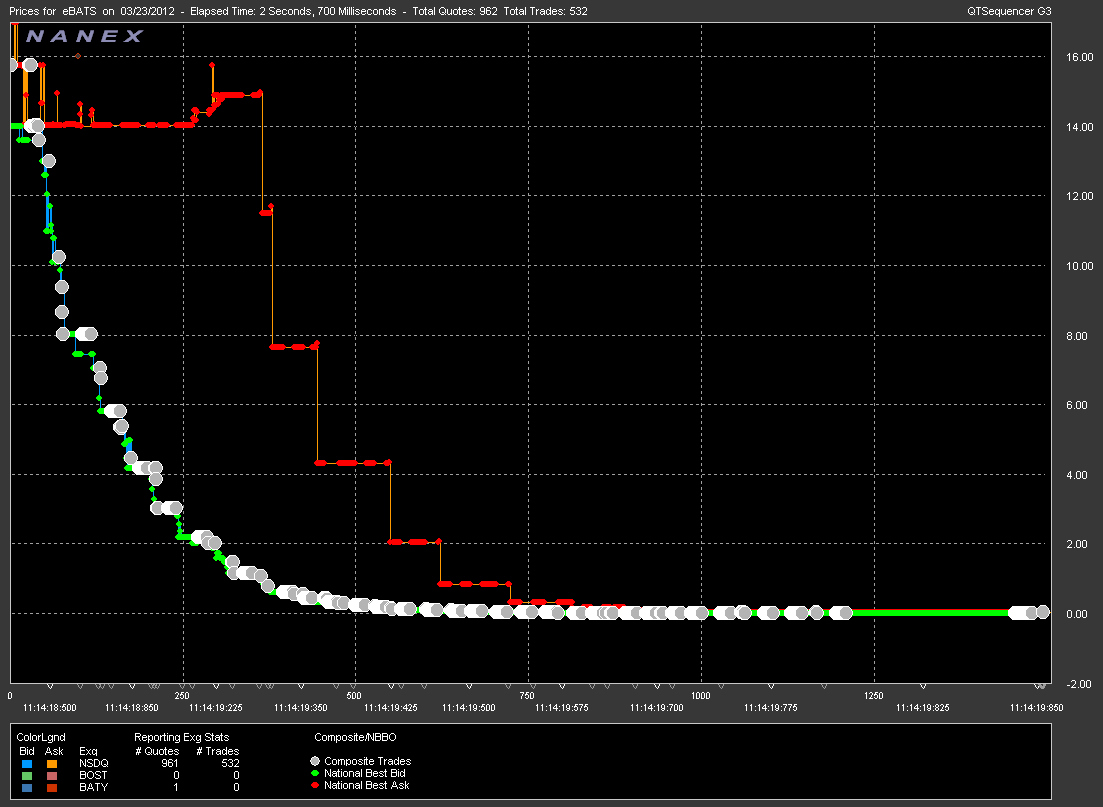
The exchange operator stepped into the public’s view on Friday, March 23 at 11:14 and 18 seconds a.m. ET.
According to FactSet Research, the stock was trading at $15.25 with 1.2 million shares moving hands on the BATS exchange. That was down 4.7% from its pricing of $16, which had already been at the low end of its expected range of $16 to $18.
Within nanoseconds, the picture actually looked brighter.
Five trades, for a total of 800 shares, moved at $15.75 each, all of them on the Nasdaq exchange, according to the FactSet data.
Then the stock started dropping, falling to $14 then to $13 before the bottom dropped out. The stock went quickly to $10.23, to $8.03 to $5.79 to $4.17 to $3.01 all before that first second of life was over.
In that time the difference between offers to buy and offers to sell spread from being a relatively close 50-cent spread to a difference of $11.23 as holders continued to look to sell at $14.90 a share.
The second second of life was not much better: $2.17 quickly became $1.15 which fell to 76 cents before plunging all the way down to 0.0002 cents. In total, 444 trades, all of 100 shares a piece, were made in that one second, everyone on the Nasdaq.
The sellers started dropping their asking prices though nowhere near as quick as the trading prices fell. The asks fell from above $14 to $11.50 to $7.64 to $4.31 to $2.05 before capitulating and falling below a dollar.
After that fall there appeared a slight breath of comparatively rationale thought: the next trade was made at 11:14 a.m. and 21 seconds for 3 cents a share.
Shares eventually climbed back to 4 cents at 11:14 a.m. and 27 seconds, the price that first appeared on some screens this morning and the last trade made.
At 11:14 a.m. and 33 seconds the stock was first listed as halted, back at $15.25.
But all that history will now be wiped out. BATS said the opening auction will be cancelled. On FactSet the company is back to $16.
Then the IPO was officially withdrawn.
It is unclear as of this time if mulligans do exist in IPOs, but BATS is going to try.


Nanex ha dedicato un post all'analisi dell'I.P.O. di BATS, e alla simultanea "transazione erronea" su Apple:


Nanex ~ The BATS IPO and halt in AAPL
The March 23, 2012 IPO of BATS was brief. The stock began trading at  11:14:18.475 with an initial price of $15.25. Within 900 milliseconds from opening the stock price had fallen to $0.2848. Within 1.5 seconds the price bottomed at $0.0002. 567 trades were executed before the stock was halted (532 are shown below).

Another curiosity: we found that starting around 10:45 and ending around 11:20, quotes from BATS stopped updating in all NYSE and Nasdaq symbols within a specific alphabetical range: between "A  " and "BECN ". The symbol BATS falls into this range.

venerdì 23 marzo 2012

Un crash che cancella un'I.P.O.

Dal WSJ: BATS Withdraws IPO


BATS Global Markets just announced it has withdrawn its initial public offering. Here’s the short statement from the company:

BATS Global Markets, Inc. (“BATS”) today announced it has withdrawn its planned initial public offering (IPO), which was scheduled to close on March 28, 2012.

“Although our affected market has reopened, in the wake of today’s technical issues, which affected the trading of certain stocks, including that of BATS, we believe withdrawing the IPO is the appropriate action to take for our Company and our shareholders,” said Joe Ratterman, chairman, president and CEO of BATS Global Markets.


E ancora, dal New York Times: 


3:46 p.m. | Updated It should have been a day of celebration for BATS Global Markets.
The seven-year-old stock exchange was set to start selling its shares on the public market, marking its evolution from a tiny upstart to a serious alternative to NYSE Euronext and Nasdaq OMX.
Then disaster struck. Shortly after going public on Friday, shares of BATS were halted, after a series of technical glitches and system errors that affected trading in Apple and other companies. Several hours later, BATS pulled its public offering, a rare move for a company.
The Securities and Exchange Commission is currently looking into the technical snafus and dealing directly with exchange officials on the issues.
Even before problems emerged on Friday, investors had been wary of BATS, the third-largest exchange. BATS — founded in 2005 as an alternative to its larger rivals, Nasdaq OMX and NYSE Euronext — has experienced a decline in trading volumes this year, even as the major stock markets recovered.
In 2011, BATS posted $23.5 million in net income in 2011, a 19 percent gain from the previous year. But analysts and investors have expressed concern that lower volumes on both the New York Stock Exchange and Nasdaq were most likely to hurt exchange profits across the board.

Il flash crash di Apple e le indagini della SEC

Meno 9% in qualche secondo! Oggi Apple ha passato un brutto momento


Apple Flash Crash: Stock Halted After Trade Causes 9% Plunge


Shares of Apple, the world's most valuable company, plunged 9 percent on a single trade, causing it to be halted by the single stock circuit breaker rule because of volatility.
A single trade of 100 shares at a price of $542.80 hit the tape at 10:57 coming from the BATS Exchange. The previous trade seconds earlier was at a price of $598.26.
"It looks like a fat finger mistake," said Joe Terranova, chief market strategist for Virtus Investment Partners.
But there could be other factors involved. Nine minutes before the way out of market trade took place, BATS sent an alert stating, "Please be advised that BATS is currently investigating system issues trading in symbols range A through BF."
L'episodio viene proprio al momento giusto:  proprio in questi giorni si sta svolgendo l'I.P.O. di BATS ma la S.E.C. ha annunciato di voler capire un po' meglio cosa sta succedendo nel mondo dell'HFT
Federal securities regulators are examining whether some sophisticated, rapid-fire trading firms have used their close links to computerized stock exchanges to gain an unfair advantage over other investors, people familiar with the matter say.

The wide-ranging probe, being handled by the enforcement staff of the Securities and Exchange Commission, is focusing on the computer-driven trading platforms of exchanges, including BATS Global Markets Inc., the people said.
[BATSTRADE]

The SEC probe illustrates a bigger push by regulators to examine less-transparent parts of the securities markets, such as the fast-growing area of so-called high-frequency trading. High-speed trading firms use powerful computer systems for rapid-fire trades, in which they often hold stocks for only fractions of seconds. They benefit by being able to move quicker than less technologically proficient investors.

Computer-driven exchanges operated by firms such as BATS are the favored venue of high-speed trading firms. BATS has moved up to third in U.S. share-trading volume behind exchanges run by NYSE Euronext and Nasdaq OMX Group Inc., with about 11% of average daily volume.

BATS declined to comment.

The SEC probe stems partly from a broad look at computer trading that regulators initiated after the "flash crash" in May 2010, when stocks fell and rebounded sharply within minutes, following glitches in computer-trading systems.

As part of this effort, the SEC is looking at communications between exchanges and high-frequency trading firms. Investigators are examining whether firms collude to limit competition or manipulate markets, according to a person familiar with the matter.

venerdì 16 marzo 2012

for i=1 to 10000 write 'il trading ad alta frequenza fa bene ai mercati' end for

Il dibattito sull'Economist ha visto una vittoria di misura dei sostenitori dell'utilità dell'HFT: in netta minoranza le sorti del sondaggio sono cambiate in meno di 24 ore... ecco il commento ufficiale del moderatore...

Dear Reader, Our debate has now come to a close and those supporting the motion have carried the day with a slight majority. This house does—if only just—believe "high-frequency trading contributes to the overall quality of markets". A late swing in the voting has occasioned comments from the floor. From quote-stuffing to vote-stuffing, is the accusation of some. There is no evidence that we can see of dodgy behaviour. But our practice in these debates is to police the voting lightly: this is a forum for discussion, not a legislature. Indeed, although voting is now over, the floor remains open for your comments until midnight tonight. Our debate has framed the arguments around high-frequency trading as well as any I have seen and I would like to thank our debaters, Jim Overdahl and Seth Merrin, for their thoughtful contributions. Thanks also to our readers for their many excellent and lively comments. I hope you will join us for our next debate, beginning next week. We will be in touch soon with details.

Moderator Andrew Palmer Finance Editor, The Economist
Published with Blogger-droid v1.7.4

martedì 13 marzo 2012

HFT sì HFT no?

Ancora due giorni di dibattito sul sito dell'Economist sull'high frequency trading (è possibile votare fino a domani, e la discussione rimarrà aperta fino a venerdì): la tesi di partenza This house believes that high-frequency trading contributes to the overall quality of markets al momento riscuote solo il 42% dei consensi, in leggero recupero dopo una partenza decisamente in salita (solo il 39% nei primi due giorni). Ma al di là del divertimento di vedere le due tesi fronteggiarsi lo scambio di idee e di opinioni è stimolante: buona lettura.

martedì 13 dicembre 2011

Un bid-ask poco affidabile...

Il Wall Street Journal torna sul tema del trading ad alta frequenza e su come la struttura poco trasparente e troppo fragile dei mercati rischi di allontanare sempre di più i piccoli investitori (oltre al flash crash si sono anche visti ordini che sono capaci di viaggiare nel tempo ...). Scrive Jason Zweig:

For small investors, buying or selling a stock has never been cheaper or easier; the vast majority of the time, small trades cost next to nothing to complete and occur within the blink of an eye.
But every so often, a trade turns into a costly, convoluted nightmare for investors who aren't vigilant to the point of obsessive.
On Thursday, at 2:00:07 p.m., the stock of United Continental Holdings, the airline, was quoted at $19.85 bid, $19.86 ask—meaning that potential buyers were willing to pay $19.85 and potential sellers would part with shares for $19.86.
Within 25 thousandths of a second, however, 142 trades went off in UAL stock, nearly all outside that one-penny "spread," according to Eric Hunsader of Nanex, which analyzes trading data. Someone ended up selling 800 shares of UAL for just $19.54, or 32 cents below the ask price that traditionally marked the maximum point at which a sale would go off.
Such blips, Mr. Hunsader says, happen "dozens of times a day." 
With billions of shares trading hands a day, that makes such events fairly rare. But they are devastating to the confidence of investors. After all, most of us wouldn't want to play Russian roulette even with a pistol that has 999 empty chambers and one chamber with a bullet in it. That is how buying and selling a stock has come to feel for many retail investors.

I problemi sono ancora più seri per quanti utilizzano stop-loss per proteggersi da ribassi improvvisi. Zweig cita il caso di un investitore che ha visto un proprio investimento liquidato automaticamente senza che tuttavia il prezzo abbia mai raggiunto la barriera di protezione. Cosa è successo? Boh!
Nell'attesa che si riesca a dare ai mercati una struttura più stabile Zweig ha alcuni consigli e raccomandazioni che mi sembra opportuno riportare:

So what can you do to trade more safely?
First, avoid open-ended buy and sell orders. The UAL trade was a market order, or an instruction to sell at the best available price. "Rule No. 1 for the small investor is never, ever put in a market order," says Joe Saluzzi, a partner at Themis Trading in Chatham, N.J. Instead, use a limit order that stipulates either the price below which you won't sell or above which you won't buy.
A traditional stop-loss order, as Dr. Penn found, has become dangerous. A "stop-limit" order, combining a stop-loss with a limit below which you won't sell, is a safer approach.

venerdì 30 settembre 2011

Si scrive Tobin, si legge Robin ma è da Dustbin?

L'Economist appena uscito dedica un articolo abbastanza critico alle proposte di riforma dell'auditing e all'introduzione di una tassa sulle transazioni finanziarie.

Sullo stesso argomento potete anche leggere il commento di Buttonwood che allarga il discorso cercando di contestualizzare un po' le scelte che si presentano ai governi, anche se in una prospettiva abbastanza Londracentrica:

Let me start with the proposition that the financial sector has grown to dominate the Anglo-Saxon economies in ways that are unhealthy, particularly as the best and brightest have been lured to finance by high salaries. In my view, however, this outcome is the result of easy credit policies that fuelled a series of asset booms, accompanied by the gearing up of balance sheets and the willingness of central banks to rescue the markets whenever they faltered. The result for 25 years was a one-way bet on asset prices that the finance sector took advantage of. This was not a free market, but a rigged game.(...)

In the long run, moves to force banks to have higher capital will reduce the scope for leveraged returns, and thus reduce those big bonuses. Banks can go back to being rather dull utilities. But even this process is fraught with problems. The Bank of England's financial policy statement this week said that


banks should take any opportunity they had to strengthen their levels of capital and liquidity so as to increase their capacity to absorb flexibly any future shocks, without constraining lending to the wider economy. This could include raising long-term funding whenever possible and ensuring that discretionary distributions reflected any reduction in profits.


That is a tough combination to pull off, and so far lending has suffered. On the first part of the proposal, bank shares have underperformed this year, making it hard to raise new equity. The second part sounds good; cut back on bonuses rather than cut back on bank lending. But the banks are likely to say to one another; after you. If one bank cuts bonuses, and the others don't, the "good" bank will lose a lot of staff. Maybe this is something regulators have to decree, not just suggest.

So why not try a transactions tax instead? EU governments need the money, after all, and there is evidence that excessive trading can lead to volatility. Some will argue that the existence of stamp duty on UK equity transactions shows it can be done. But who pays the duty? Anyone who has ever bought shares in the UK will know that it is passed straight through to the retail investor or to pension funds, insurance companies and mutual funds (which are the aggregated savings of private investors). The duty has done nothing to slow the rapid rise in bankers' bonuses, which are generated elsewhere. Such taxes are just passed straight through to clients. Hedge funds often get round the duty, by trading in contracts for difference, a kind of leveraged bet on share prices that are exempt from the tax.

But what about all those derivative deals that are "socially useless"; wouldn't the tax catch them? It might if it were worldwide. But the bulk of European financial trading occurs in London, and the the bulk of that trading is conducted by non-UK firms. It would take little effort to switch the business to New York or Geneva or Singapore. Note that an impact assessment of the tax (which the EU commission undertook) says it willreduce GDP by 0.5%. Let Europe sign up for a financial transactions tax when the Republican party votes in favour of it (but don't hold your breath).

Indeed, this idea is so anti-London that the UK government is bound to veto it. Which makes one wonder why it was proposed; was it a smokescreen to divert the attention of EU voters from the mess that leaders are making of the debt crisis?

Qualcuno dei lettori mi sa indicare un link con una buona spiegazione di come sia aggirata la stamp duty tax dello 0.5% (!!) in vigore al LSE che gli investitori retail come me pagano ma che evidentemente non affligge i trading desk di banche, hedge funds, ecc? Davvero solo mediante i CFD? Peraltro in questo modo non si finisce con l'incoraggiare proprio quell'eccesso di leveraging che rende il sistema più instabile? Non ci sono esenzioni per chi dichiara (a torto o a ragione) di prendere posizioni sul sottostante per scopi di hedging su contratti derivati?

E' inutile e dannoso introdurre tasse sulle transazioni finanziarie se sono immediatamente e facilmente aggirabili (tranne naturalmente dal parco buoi).

mercoledì 28 settembre 2011

Tobin no? Tobin sì!

Dal Financial Times di oggi un editoriale a favore dell'introduzione di una tassa sulle transazioni finanziarie. Scrive John Plender:


More and more trading, meantime, is being driven by high-frequency traders. There are grounds for thinking that their activities, which now account for a majority of the trading volumes on exchanges, are not good for the integrity of the markets. While HFTs claim they have brought about a narrowing of spreads and greatly increased liquidity, the liquidity can vanish in an instant, as it did in the notorious “flash crash” of May 2010. Unlike market makers, the HFTs make no commitment to remain active under all circumstances during all trading hours. So the liquidity is illusory and the risk that HFTs will cause liquidity to implode makes them systemically dangerous.
Note, too, that the ability of these traders to deal in microseconds gives them an asymmetric information advantage. For example, they initiate great quantities of “flash orders” to find out the depth and breadth of the market and establish whether there are willing buyers at a level above the most recent trades. Such small “execute or cancel” orders, carried out in millionths of a second, are designed to ferret out buyer limits to prepare for trades that are the equivalent of front running. (...)

James Tobin’s original intention was to throw sand in the wheels of what he called “excessively efficient” markets. Today’s markets are excessively fast, but their claim to be efficient is highly questionable. So the case for throwing sand in the wheels is that much greater. A tax on financialisation might well kill off high-frequency trading. Or it could be tapered on a sliding scale related to volume and holding periods. The important thing is that the rates should not be pitched too high, as in the Swedish experiment. If this reduces employment a bit in the City of London, so be it – it will release people into more socially useful activities.
It is a paradoxical result of increased competition from off-exchange trading platforms and from regulatory developments such as Europe’s Markets In Financial Instruments Directive that long-term investors are being disadvantaged. A financial transactions tax might help redress the balance.

martedì 27 settembre 2011

Traders più veloci dei neutrini!

Mentre i governi europei, trainati dalla Francia e dalla Germania, insistono per l'introduzione di una qualche forma di Tobin Tax continua il dibattito sul trading ad alta frequenza. Negli ultimi due mesi l'alta volatilità ha certamente favorito l'HFT. Secondo il WSJ in agosto


High-frequency traders have roughly tripled their stock trades this month, estimates Tabb Group, a markets-research firm in New York. That has boosted their share of overall U.S. stock trading volume to about 65%, up from about 53% during the months before the August turmoil, according to the research firm.


That increase has come amid unusually heavy trading; on Aug. 8, as the Dow Jones Industrial Average sank 635 points, New York Stock Exchange composite volume saw its fourth-biggest trading day on record.


On that same day, high-frequency traders made record profits of about $60 million in U.S. stock markets alone, Tabb estimates. That doesn't sound like a huge amount in the context of global markets, but that daily profit-while likely not sustainable, analysts and traders say-would translate into an annual gain of about $15 billion.


Tabb estimates profits for other days that week ranged from about $40 million to $56 million. By comparison, it estimates that high-frequency traders made $7.2 billion in U.S. stock markets in 2009, the highest on record; the firm previously projected total profit of the high-frequency trading industry of less than $5 billion this year.


La polemica sul trading ad alta frequenza e sugli aspetti manipolativi di alcune strategie impiegate è molto accesa.


Nella sua ultima lettera settimanale John Mauldin cita un post recente di Nanex relativo ad alcune trades che sembrano essere state effettuate viaggiando nel tempo (nel futuro, ovviamente...):


Heads up, you Junior Rocket Man Kids (remember those days?). Physicists are doingamazing things. My son Trey and I got a private tour this summer of CERN, the great physics lab in Geneva. Very cool. But Wall Street is also legendary for the number of physicists it hires to work on high-frequency trading programs. Evidently, they have figured out how to get trades done 190 milliseconds in the future. Is the race on to see who can cross the one-day mark? What is the speed of light when compared to the speed of money?


"Nanex: On September 15, 2011, beginning at 12:48:54.600, there was a time warp in the trading of Yahoo! (YHOO) stock. HFT has reached speeds faster than the speed-of-light,allowing time travel into the future. Up to 190 milliseconds into the future, or 0.19 fantaseconds is the record so far. It all happened in just over one second of trading, the evidence buried under an avalanche of about 19,000 quotes and 3,000 individual trade executions. The facts of the matter are indisputable. Based on official UQDF/UTDF exchange timestamps, there is unmistakable proof that YHOO trades were executed on quotes that didn't exist until 190 milliseconds later!" (http://www.nanex.net/Research/fantaseconds/fantaseconds.html)


Going forward in time is cool, and the same day I got the above notice I read that the physicists at CERN and in Italy have found subatomic particles that move slightly faster than the speed of light, making it possible to travel back in time (only a few nanoseconds, but it's a start):


"But now it seems that researchers working in one of the world's largest physics laboratories, under a mountain in central Italy, have recorded particles travelling at a speed that is supposedly forbidden by Einstein's theory of special relativity.


"Scientists at the Gran Sasso facility will unveil evidence on Friday that raises the troubling possibility of a way to send information back in time, blurring the line between past and present and wreaking havoc with the fundamental principle of cause and effect.


"Researchers on the Opera (Oscillation Project with Emulsion-tRacking Apparatus) experiment recorded the arrival times of ghostly subatomic particles called neutrinos sent from Cern on a 730km journey through the Earth to the Gran Sasso lab."


( http://www.guardian.co.uk/science/2011/sep/22/faster-than-light-particlesneutrinos?newsfeed=true )


Now, just in case you buy this (and if you did, contact me about a bridge I have), let meattempt to disappoint. First, as my curmudgeon PhD from MIT and VC friend Bart Stuck writes, "I think they both had time-stamp errors." I can't vouch for the Swiss and Italians, but I would bet the keys to the kingdom that there is a computer glitch at the NYSE. High-frequency trading (HFT) is distorting the markets. It is enriching a few pockets (and that of the exchange), and I simply do not see how it is in the interest of the public to allow it.


I also know that fighting HFT is spitting into the wind, as faster tech comes along every few months. If you force the HFT funds to put their servers across the street (losing the time advantage of not being co-located with the exchange servers - milliseconds count!), it will only be a few years until technology has given the edge back to them. In ten years, when artificial intelligence and connection speeds are far more advanced, how will human traders compete?


Hire yet another AI to fight back? Wire yourself into the system (already being done, by the way, in rudimentary ways)?


The only way to effectively end HFT is for the exchanges to stop giving incentives for such trading. I can see the profits for the traders and the exchanges. I just don't see the benefit to the rest of us. The SEC should step in and settle some hash over missed time stamps. If a small broker-dealer has a wrong time stamp, they are all over us, and you can bet there are fines.


Something is wrong here. If one trade can go "back to the future" then how many more? Really?


E' necessario fare qualcosa per garantire che i mercati siano un ecosistema sano nel quale agenti con prospettive e scale temporali di investimento diverse possono coesistere senza distorsioni ed eccessive "asimmetrie tecnologiche". La Tobin Tax proposta da Merkel e Sarkozy non è però il modo corretto di affrontare i problemi: questa almeno è l'opinione di Jason Zweig nel video qui sotto (e anche in questo articolo sul WSJ di qualche settimana fa)
venerdì 16 settembre 2011

HFT como una charla entre amigos

Il Quantitative Finance Club è un blog e un club di professionisti, studenti e cultori della finanza quantitativa argentini. Il QFC ha realizzato una serie di Video intitolati Fun & Finance, ormai alla quattordicesima puntata.
Come si legge nel blog (in spagnolo) i temi sono seri ma lo stile è colloquiale e simile a una chiacchierata tra amici: La serie de videos Fun & Finance nace en enero de 2011 con la idea de trasmitir conocimientos y sembrar inquietudes en relación a finanzas. Siendo el objetivo de largo plazo, ayudar a mitigar la falta de cultura financiera en Argentina y la región. Los videos duran entre 4 y 10 minutos, y se plantean como una charla entre amigos.
Nel video che vi propongo qui sotto Marco Avellaneda, un celebre collega Quant del Courant Institute a New York, parla di trading algoritmico, HFT, flash crash, ecc.


Charla sobre Trading Electrónico from Estudio de TV Diario del Viajero on Vimeo.

martedì 2 agosto 2011

Un secondo in un minuto

Il video Non Carbon Based Life Forms dilata un secondo di dinamica dell'order book in un minuto di video


NON_CARBON BASED LIFE FORMS from arc w on Vimeo.


Qui sotto invece potete vedere Jim Cramer, il più famoso commentatore dei mercati statunitensi, prendersela
con la S.E.C. (la Consob americana) per essere troppo compiacente con il trading ad alta frequenza

giovedì 19 maggio 2011

Il calcolo della velocità?

Si parla di high frequnecy trading e di flash crash oggi su Nova , il supplemento di scienza e tecnologia del Sole 24 Ore. L'icona scelta per il servizio e' la farfalla dell'attrattore di Lorenz...sono contento che i sistemi dinamici contribuiscano alla costruzione dell'immaginario collettivo! Qui potete leggere l'articolo di Lops e Larizza dedicato al trading ad alta frequenza. Del flash crash invece ci occupiamo Fabrizio Lillo ed io in un articolo di cui vi riproduco l'incipt...

«Noi affermiamo che la magnificenza del mondo si è arricchita di una bellezza nuova; la bellezza della velocità»: così scriveva Marinetti nel «Manifesto del Futurismo», all'alba del XX secolo. L'esaltazione della tecnica e della velocità oggi caratterizza più la finanza che l'arte. Nel primo decennio del XXI secolo i mercati finanziari hanno infatti abbracciato piattaforme tecnologiche che consentono agli scambi di avvenire migliaia di volte al secondo. Per poter sfruttare sofisticate strategie di trading ad alta frequenza (Hft, acronimo di high frequency trading) è necessaria la collocazione fisica dei computer in prossimità dei mercati e impiegare algoritmi ad altissime prestazioni per identificare piccole anomalie nei prezzi ed eliminarle il più rapidamente possibile. Il profitto ottenuto da ogni singola transazione è di solito assai magro, ma l'enorme numero di compravendite rende il business molto profittevole. È raro che una posizione sia mantenuta per tempi superiori ai pochi minuti: secondo alcune analisi negli Usa un'azione viene rivenduta in un tempo medio di 22 secondi. Anche se l'Hft è usato solo dal 2% delle società mobiliari Usa, queste sono tuttavia responsabili di oltre il 70% del volume azionario negli Usa e del 40% in Europa. Questi numeri sono inferiori ma in forte crescita su altri beni finanziari.

...il resto lo trovate qui.

mercoledì 11 maggio 2011

I mercati instabili e il trading ad alta frequenza

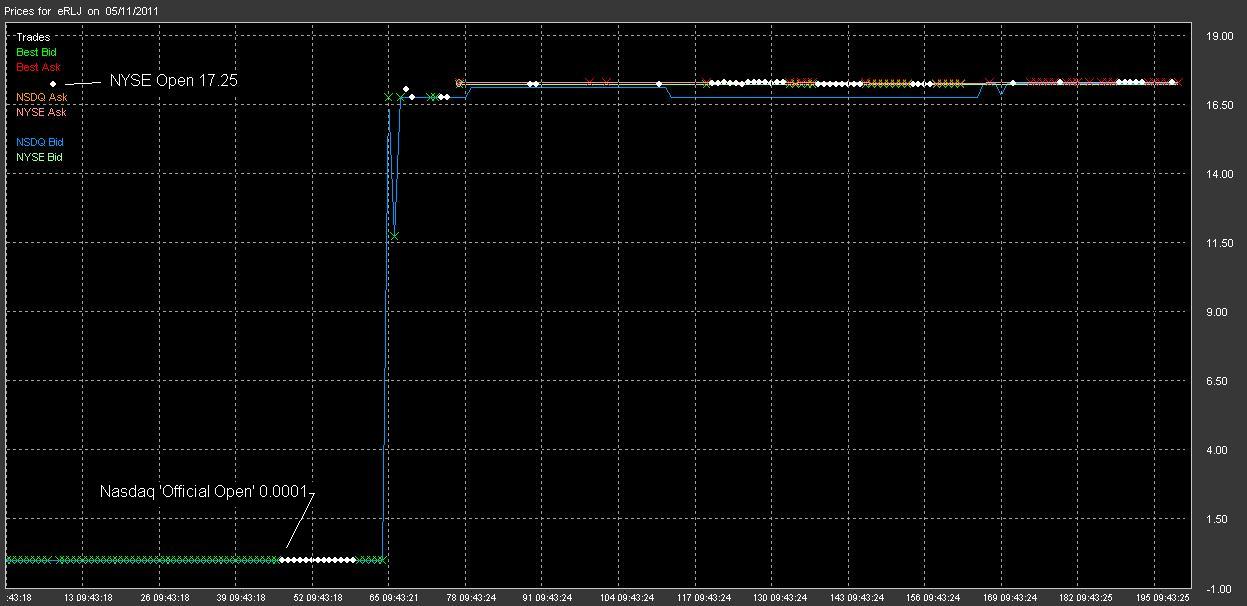
Continuano le sorprese: oggi, al suo primo giorno di quotazione sul New York Stock Exchange, RLJ ha 
aperto a 17 dollari ma poi è stata ripetutamente scambiata a 1 centesimo (!!!)


Le transazioni sono state cancellate un paio di ore dopo.

Se vi interessano questi argomenti e volete approfondirli un buon punto di partenza potrebbero essere le presentazioni della giornata di studio che alla Scuola Normale abbiamo dedicato al flash crash del 6 maggio 2010: potete trovarle a questi link:


STEFANO MARMI
Scuola Normale Superiore, Pisa

FULVIO CORSI
Università della Svizzera Italiana, Lugano

FABRIZIO LILLO
Scuola Normale Superiore, Pisa, Università di Palermo e Santa Fe Institute, Santa Fe

GIACOMO BORMETTI
Scuola Normale Superiore, Pisa e INFN, Pavia

Wednesday May 11 2011, 14.00 - 16.00 Aula Bianchi

martedì 10 maggio 2011

Come evitare un nuovo flash crash ?

Dal sito del Financial Times, due video sul flash crash (ringrazio Andrea Pirino per la segnalazione) che prensentano due punti di vista autorevoli ma forse un po' troppo rassicuranti, ricordando a tutti la giornata di studio che dedicheremo all'argomento domani alla Scuola Normale:


Flash crash 'was best possible thing'

May 5 2011  A year on from the precipitous plunge of the Dow Jones that wiped $1,000bn from the US stock market in a matter of minutes, Jeremy Grant, FT Trading Room editor, talks to the FT's Seb Morton-Clark about the causes of the crash and the measures that have been taken to prevent a repeat of events.  (6m 2sec)

Year later trader says 'flash crash' addressed
May 5 2011  Jose Marques, the global head of electronic equity trading at Deutsche Bank tells the FT's Telis Demos that regulators have addressed many deficiencies in market structure since the 'flash crash' on May 6th of last year. But Mr Marques says more controls are needed to stop unforeseen future disruptions before they occur  (6m 22sec)
Su come prevenire instabilità come quelle del 6 maggio 2010 vi segnalo inoltre questo articolo sul New York Times che lancia accuse molto circostanziate sulla S.E.C.. Infine un altro video, dal WSJ, nel quale si osserva correttamente come massive stock slumps such as the "flash crash" can't be prevented and remain a rare, but consistent feature of all stock markets.


"Incidenti" simili al flash crash sono in realtà diventati relativamente frequenti anche in mercati diversi da quello azionario. Secondo il WSJ The U.S. dollar sank 5% against the Japanese yen within minutes on March 16, one of its biggest moves ever. Also that month, cocoa-futures prices dropped 13% in just seconds on the IntercontinentalExchange Inc. before rebounding almost as quickly. In February, the sugar market took a dive of 6% in just one second.
Like the stock market "flash crash," which occurred a year ago on Friday, these big moves are the unintended consequences of an influx of high-frequency and algorithmic traders into markets that aren't equipped to deal with them.(...)
The timing of some of these mini crashes shows the impact of computerized trading. The dollar tumbled against the yen at 5 p.m. in New York on March 16, right as several major banks had shut down their electronic-trading programs as part of a routine handoff to colleagues in Asia, when a barrage of buy orders for the currency stormed the market. With few traders around, the orders, combined with forced buying linked to options, were set loose into a void.
Cocoa's flash crash came at about 10:30 a.m. New York time on March 1, after orders to sell hundreds of cocoa contracts flooded the market. Too few buy orders were there to soak up the sale. Cocoa plunged $450 in one minute, to a low of $3,217 a metric ton. The sell orders were unusually large for the cocoa futures market, which typically handles about 20,000 contracts a day.