Visualizzazione post con etichetta IPOs. Mostra tutti i post

sabato 31 marzo 2012

I mercati intermittenti....

Dal New York Times:

Stock Market Flaws Not So Rare, Data Shows

Stock market disruptions like the ones last week that temporarily shut down part of the nation’s third-largest exchange and briefly halted the trading of Apple shares are more common than investors may think.

Although traders and the public were stunned by the problems on the BATS Global Markets stock exchange on Friday, a review of industry data shows that market disruptions large and small are a daily occurrence. The frequency of the problems has rattled the confidence of some investors and companies raising money through supercharged electronic markets.

The communication breakdown that blocked trading on parts of the BATS exchange for more than an hour has been seen in at least 110 instances across the nation’s 13 stock exchanges over the last year, a review of data from Nasdaq shows. That number has gone up every year since 2007.

In one instance in January, BATS said it was unable to trade with the New York Stock Exchange for nearly 30 minutes.

Meanwhile, exchanges have halted trading in company shares after sudden spikes or falls, as happened Friday with Apple, at least 265 times over the last year — more than one for every day of trading, according to data analyzed by the Tabb Group, a market research firm. These circuit breakers kick in after stocks experience 10 percent swings in a short period of time and can be caused by a technical error or waves of electronic trading on news developments. (...)

In addition, minor events at one exchange risk spiraling out through other exchanges and setting off a severe flash crash, like the one seen in May 6, 2010, when major markets fell more than 8 percent in a matter of minutes.

Blame for the market disturbances has fallen on the growing complexity and speed of the nation’s 13 official stock exchanges — three of which are owned by the New York Stock Exchange — and dozens of less official platforms for trading. A decade ago there were only two major trading platforms, and transaction times were measured in seconds.

A regulatory change in 2007 threw open the floodgates of competition by forcing stock trades to be routed to the exchange with the best price, as long as the exchange could act immediately. The proliferation of exchanges since then has lowered the price of trading for investors, and trade times are now measured in milliseconds. In the race for speed, however, some industry experts say reliability has been sacrificed. (...)

The S.E.C. and other regulators have been examining the vulnerabilities of the market, and the impact of high-speed trading, since the flash crash in May 2010. A new committee for the Commodity Futures Trading Commission examining the issue was set to meet for the first time on Thursday.

The S.E.C. has already taken several steps to head off moments of market chaos, including the circuit-breaker measures for 10 percent swings.

The circuit breakers have also provided a new window into how often such extreme market moves happen. During periods of calm trading, like January of this year, circuit breakers were used infrequently: 14 times, according to data analyzed by Tabb. In contrast, they were used 51 times in December. The figures do not indicate how often the problems were because of the exchanges rather than other factors.

Christopher Nagy, the head of order routing at the retail broker TD Ameritrade, compared circuit breakers to brakes on a car. They are important, he said, but they become less effective as the car goes faster, as the market has in recent years.

“When you see any sort of market strife, you see chaos erupt,” he said.

The S.E.C. is considering introducing other measures to monitor the markets, like a new system, known as limit up-limit down, to halt extreme trades before they can be executed. But some market watchers say the agency has not been able to keep up with the increasing speed and complexity of the markets.

“We’ve managed over the past few years to equip the traders with Ferraris,” said Richard Bentley, the vice president for capital markets at Progress Software, which provides the industry with technology, “and the regulators are trying to keep up with them on bicycles.”

martedì 27 marzo 2012

L'I.P.O. di BATS: una discesa di nove secondi nell'abisso

Piccola rassegna stampa sul fallimento dell'I.P.O. di BATS:

Dal Wall Street Journal:
Trading Firm IPO Fizzles in Seconds
Apple Shares Also Affected as Glitch Mars Debut of BATS Global Markets
La S.E.C. ha detto di essere intenzionata a  capire cosa è successo:

The Securities and Exchange Commission said Friday it was looking at the BATS situation. "SEC staff has been and will continue to be in discussions with BATS to determine the cause and extent of the incident and steps BATS is taking to remedy the situation," an SEC spokesman said.

The day's events may rekindle questions about the reliability of the stock-market's plumbing, questions that came into sharp focus almost two years ago when the broader market plunged hundreds of points within minutes in what came to be known as the "flash crash."

"This shows the flaws in the current market structure," said Tim Quast, managing director of ModernIR LLC, a Denver company that advises public companies on market-structure issues. It demonstrates how fragile the market structure is" and highlights how vulnerable companies and investors are to computer glitches.

Trovate la cronaca del crash per esempio sul blog Deal Journal ospitato dal sito del WSJ
BATS Initial Public Tease: Nine Seconds of Free Fall

For BATS Global Markets, it took all of nine seconds for its IPO to crash.
The exchange operator stepped into the public’s view on Friday, March 23 at 11:14 and 18 seconds a.m. ET.
According to FactSet Research, the stock was trading at $15.25 with 1.2 million shares moving hands on the BATS exchange. That was down 4.7% from its pricing of $16, which had already been at the low end of its expected range of $16 to $18.
Within nanoseconds, the picture actually looked brighter.
Five trades, for a total of 800 shares, moved at $15.75 each, all of them on the Nasdaq exchange, according to the FactSet data.
Then the stock started dropping, falling to $14 then to $13 before the bottom dropped out. The stock went quickly to $10.23, to $8.03 to $5.79 to $4.17 to $3.01 all before that first second of life was over.
In that time the difference between offers to buy and offers to sell spread from being a relatively close 50-cent spread to a difference of $11.23 as holders continued to look to sell at $14.90 a share.
The second second of life was not much better: $2.17 quickly became $1.15 which fell to 76 cents before plunging all the way down to 0.0002 cents. In total, 444 trades, all of 100 shares a piece, were made in that one second, everyone on the Nasdaq.
The sellers started dropping their asking prices though nowhere near as quick as the trading prices fell. The asks fell from above $14 to $11.50 to $7.64 to $4.31 to $2.05 before capitulating and falling below a dollar.
After that fall there appeared a slight breath of comparatively rationale thought: the next trade was made at 11:14 a.m. and 21 seconds for 3 cents a share.
Shares eventually climbed back to 4 cents at 11:14 a.m. and 27 seconds, the price that first appeared on some screens this morning and the last trade made.
At 11:14 a.m. and 33 seconds the stock was first listed as halted, back at $15.25.
But all that history will now be wiped out. BATS said the opening auction will be cancelled. On FactSet the company is back to $16.
Then the IPO was officially withdrawn.
It is unclear as of this time if mulligans do exist in IPOs, but BATS is going to try.


Nanex ha dedicato un post all'analisi dell'I.P.O. di BATS, e alla simultanea "transazione erronea" su Apple:


Nanex ~ The BATS IPO and halt in AAPL
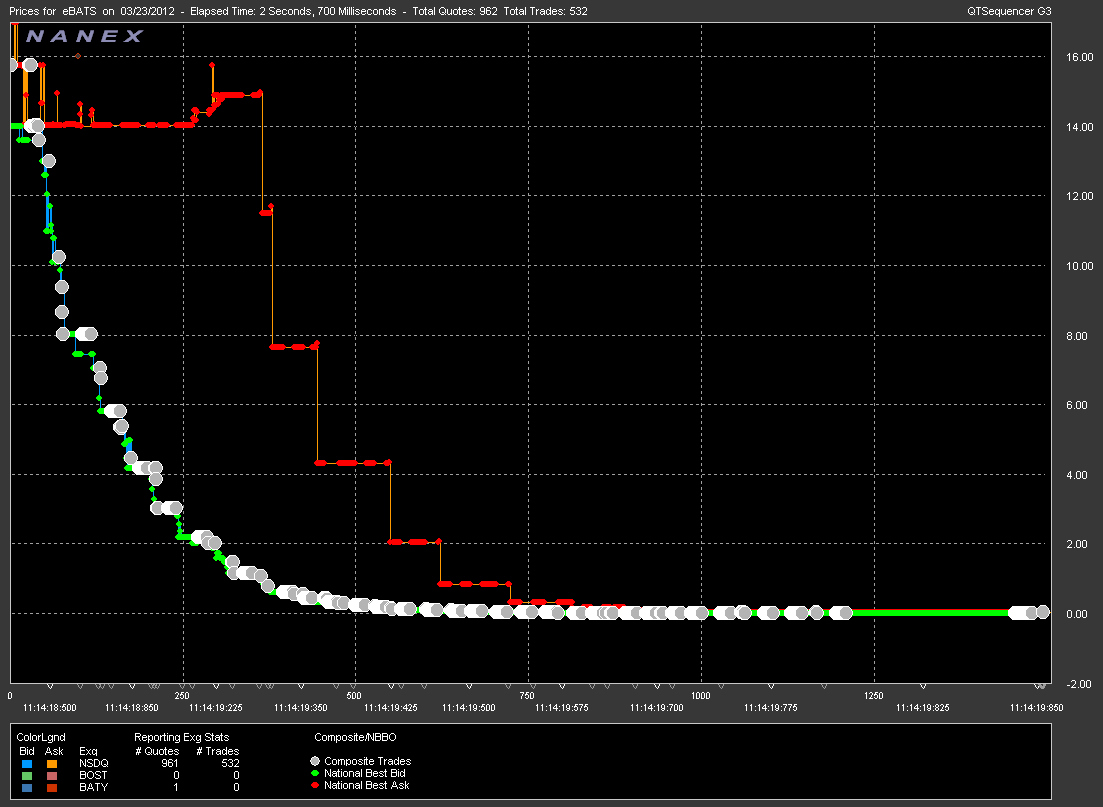
The March 23, 2012 IPO of BATS was brief. The stock began trading at  11:14:18.475 with an initial price of $15.25. Within 900 milliseconds from opening the stock price had fallen to $0.2848. Within 1.5 seconds the price bottomed at $0.0002. 567 trades were executed before the stock was halted (532 are shown below).

Another curiosity: we found that starting around 10:45 and ending around 11:20, quotes from BATS stopped updating in all NYSE and Nasdaq symbols within a specific alphabetical range: between "A  " and "BECN ". The symbol BATS falls into this range.

venerdì 23 marzo 2012

Un crash che cancella un'I.P.O.

Dal WSJ: BATS Withdraws IPO


BATS Global Markets just announced it has withdrawn its initial public offering. Here’s the short statement from the company:

BATS Global Markets, Inc. (“BATS”) today announced it has withdrawn its planned initial public offering (IPO), which was scheduled to close on March 28, 2012.

“Although our affected market has reopened, in the wake of today’s technical issues, which affected the trading of certain stocks, including that of BATS, we believe withdrawing the IPO is the appropriate action to take for our Company and our shareholders,” said Joe Ratterman, chairman, president and CEO of BATS Global Markets.


E ancora, dal New York Times: 


3:46 p.m. | Updated It should have been a day of celebration for BATS Global Markets.
The seven-year-old stock exchange was set to start selling its shares on the public market, marking its evolution from a tiny upstart to a serious alternative to NYSE Euronext and Nasdaq OMX.
Then disaster struck. Shortly after going public on Friday, shares of BATS were halted, after a series of technical glitches and system errors that affected trading in Apple and other companies. Several hours later, BATS pulled its public offering, a rare move for a company.
The Securities and Exchange Commission is currently looking into the technical snafus and dealing directly with exchange officials on the issues.
Even before problems emerged on Friday, investors had been wary of BATS, the third-largest exchange. BATS — founded in 2005 as an alternative to its larger rivals, Nasdaq OMX and NYSE Euronext — has experienced a decline in trading volumes this year, even as the major stock markets recovered.
In 2011, BATS posted $23.5 million in net income in 2011, a 19 percent gain from the previous year. But analysts and investors have expressed concern that lower volumes on both the New York Stock Exchange and Nasdaq were most likely to hurt exchange profits across the board.

martedì 31 maggio 2011

Ancora polemiche sull'IPO di Linkedin

Dal Financial Times di oggi:

Wall Street ‘mispriced’ LinkedIn’s IPO
A prominent Facebook investor and director accused Wall Street of undervaluing the LinkedIn initial public offering,contributing to the doubling of its shares on opening day


http://link.ft.com/r/NA70KK/26GWVD/I51J0/5CBJ5D/9ZCRVZ/YT/h? a1=2011&a2=5&a3=31
Published with Blogger-droid v1.6.9

giovedì 26 maggio 2011

Se il mercato è efficiente Facebook vale più di Apple. E le banche di investimento avevano ragione...

Ho trovato la lettura di questo articolo su seekingalpha davvero divertente (forse anche perchè mi ha fatto sentire più giovane di almeno una dozzina d'anni)....L'autore parte da questo articolo del 1998 per valutare Linkedin, Facebook, Yahoo e Apple utilizzando le metriche in auge in piena internet-mania (e bolla...). Il risultato? Eccolo qui: basandosi sui pageviews...

Pageview Valuation Methodology
TickerAnnualized Pageviews (B per year)Equity Market Cap ($B)Value per Pageview
YHOO circa September 199852.612.8$0.24
LNKD circa May 201128.48.8$0.31
YHOO circa September 1999140.547.2$0.34
YHOO circa March 2000228.197.2$0.43
Source: Yahoo!Finance, Yahoo earnings press releases, Yahoo 10-Q filings, LNKD S-1 filings, Author Calculations
...LNKD è valutata in modo grosso modo equivalente a Yahoo nel 1999. C'è quindi spazio per un ulteriore rialzo del 20-30% prima di....


....una correzione di circa il -95% in diciotto mesi (vedi il grafico di Yahoo dal 1999 ad oggi) e di circa il -85% in undici anni! Yahoo raggiunse un prezzo massimo di 120 dollari nel 2000, per poi crollare a 5 dollari nel 2001-2002 e ancora oggi quota meno di 20 dollari.

Ma veniamo ora a Facebook. L'autore ricorre alla legge di Metcalfe per valutare Linkedin e di conseguenza anche Facebook: l'idea è che  "L'utilità e il valore di una rete sono pari ad n^2 - n dove n è il numero degli utenti". Siccome Facebook ha circa 6 volte il numero di utenti di Linkedin il suo valore (dimenticando per un attimo che utilità e valore sono due concetti assolutamente distinti, diciamo che siamo risk-neutral e buonanotte...) Facebook dovrebbe valere 36 volte Linkedin, ovvero

Using Metcalfe's Law Valuation Methodology
StockUsers (100 million)(N)N^2Enterprise Value Estimated($B)Equity Value Estimated ($B)
LNKD1.021.048.58.8
Facebook6.0036.00294.1304.5
Source: Author estimates, LNKD S-1. Note that 294.1 = 36/1.04 x 8.5
Lasciamo spazio all'autore per i commenti, ho solo evidenziato il confronto tra l'EV di Apple e quello stimato per Facebook ammettendo come "efficiente" la valutazione che il mercato ha messo su Linkedin. Il risultato è che Apple vale meno di Facebook!!!

The first and obvious comment is, why should this make any sense anyways? The notion of Metcalfe's law is that the value of the network is proportional to the square of the users. This draws in people, and hopefully through clever business models, the company can capture that value. In this case, I would wager that Facebook is a lot more sticky than LinkedIn and pulls in more people for longer periods. Simply applying the ratio to just users would suggest that Facebook is worth $52.8 billion. However, I would argue it is worth more for the previously mentioned notion of stickiness; perhaps that is worth a 45% premium to get to the $80 billion valuation noted in the beginning. Also, the $52.8 billion is consistent with the price that Goldman Sachs (GS) paid for its stake ($50 billion) earlier this year.

The next note is that the Metcalfe's Law Valuation approach puts Facebook's Enterprise Value higher than Apple's (AAPL) based upon LinkedIn's current valuation. The equity value is comparable between Facebook and Apple. Does this make any sense whatsoever? In my opinion, absolutely not. However, at the rate that Facebook's valuation is climbing, it might be the only plausible methodology to use.


A proposito di Linkedin: Andrew Ross Sorkin, l'editore di Dealbook sul New York Times, indubbiamente uno dei massimi esperti mondiali del mondo della finanza corporate, contesta la tesi di Joe Nocera, riportata e in parte condivisa da Alfa o Beta? qualche giorno fa, che le banche di investimento hanno volontariamente sottoprezzato l'IPO. Dunque avrebbe ragione l'opinione di un lettore (rara avis) che ha commentato il post. Ecco qui un ampio stralcio dell'articolo di Ross Sorkin:


The basic premise was that the bankers that underwrote LinkedIn’s I.P.O. badly underpriced the offering since the stock zoomed from $45 a share to over $120 on the first day of trading. Worse, Joe posits that the bankers did this on purpose to line the pockets of their clients at the expense of the company, which could have used the money to grow.
Before diving into this, let’s stipulate at the outset that the current I.P.O. system is not perfect and that other more innovative approaches — like a Dutch auction in which the buyers set the price — may be a better alternative.
Let’s also stipulate that the bankers behind the offering, Morgan Stanley, Bank of America Merrill Lynch and JPMorgan Chase, could have gotten a higher price for LinkedIn, from which they collected significant fees. At the same time, however, it must be noted that the banks have clients in the form of investors, so clearly the banks are playing both sides.
While we’re at it, let’s also stipulate that many people on Wall Street and elsewhere are rightly worried that a bubble is forming around social networking. LinkedIn made only $15.4 million in 2010 and is now valued at more than $8 billion.
With that context, here is another way to think about the LinkedIn I.P.O: the offering price was generous — and maybe even too high.
If you believe that LinkedIn’s stock price is part of a bubble and that it may fall back to earth, how should the underwriters’ pricing be judged in the future? If the banks had priced the offering at about $94 — the price it closed at in its first day — and it subsequently fell to $45 a share, the public (and perhaps Mr. Nocera) would be up in arms that Wall Street had foisted a lousy deal on its unsuspecting clients, who were clamoring for a supposedly hot deal.
Note, too, that Goldman Sachs, which was an early investor in LinkedIn before the offering, sold its entire stake at $45 a share at the open, leaving some $30 million in missed profit on the table. Goldman clearly did not believe that LinkedIn’s stock price — even at $45 a share — was sustainable. What do they know that the rest of the world does not?
None of this is to suggest that Morgan Stanley, Bank of America and JPMorgan got the pricing right; they clearly could have done better.
But unless we learn that the low price was determined, in part, to help themselves through kick-back schemes with favored clients, it is hard to argue the banks purposely “scammed” their client. (It is, however, something we should watch out for in this latest I.P.O. mania.)

lunedì 23 maggio 2011

Un etf per investire in IPOs

Il superboom dell'IPO di Linkedin è venuto proprio al momento giusto per fare un po' di pubblicità di un ETF negoziato a New York che investe in IPOs. The ETF, the First Trust US IPO Index (FPX), holds the stock of theoretically newly minted shares. To get the low-down on this and other ETFs, Breakout brought in Tom Lydon, the editor of ETFTrends.com.
Lydon explains the IPO ETF as "an index based on 100 IPOs." Alas, "it's cap-weighted, meaning a small number" of stocks will have an unusually large impact on the ETF. Translated into human-being, that means a $10 billion (and dropping) company such as LinkedIn will have a much greater influence on the ETF than the vast majority of newcomers. Add to that the fact that "new" is a relative term in the long moribund IPO market, and you've got an ETF selling itself as a vehicle to invest in new and sexy shares, but actually holding companies such as Visa (V), a $62 billion juggernaut public since 2008.


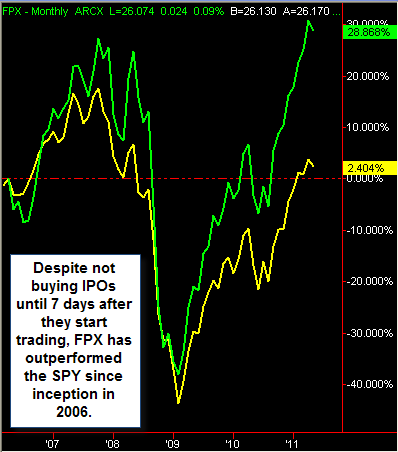
FPX ha avuto un grande successo negli ultimi 8 mesi, con un rendimento che sfiora il 30% e sovraperformando l'indice S&P500 dalla sua prima quotazione nel 2006 ad oggi.  Attenzione però: ovviamente non è detto che continui ad andare altrettanto bene in futuro. Più informazioni nel video qui sotto:

sabato 21 maggio 2011

Preferite un rendimento del 200% al giorno o del 100% al mese?


La copertina dell'Economist della settimana scorsa era dedicata alla nuova bolla internet. Il settimanale inglese ha colpito nel segno ancora una volta: oggi tutti commentano i primi due giorni di contattazione di Linkedin (LNKD) che dopo un'IPO a 45 dollari nel primo giorno di contrattazioni hanno visto il prezzo quasi triplicare fino a chiudere con un modesto (si fa per dire) raddoppio (giovedì ha chiuso a 94,25 dollari, ieri a 93,09). I lettori di Alfa o beta? erano senz'altro preparati: ne avevamo parlato già il 29 gennaio.
Sull'IPO di Linkedin il NYTimes pubblica oggi un Op-Ed piuttostro severo:
The fact that the stock more than doubled on its first day of trading — something the investment bankers, with their fingers on the pulse of the market, absolutely must have known would happen — means that hundreds of millions of additional dollars that should have gone to LinkedIn wound up in the hands of investors that Morgan Stanley and Merrill Lynch wanted to do favors for. Most of those investors, I guarantee, sold the stock during the morning run-up. It’s the easiest money you can make on Wall Street.
As Eric Tilenius, the general manager of Zynga, wrote on Facebook: “A huge opening-day pop is not a sign of a successful I.P.O., but rather a massively mispriced one. Bankers are rewarding their friends and themselves instead of doing their fiduciary duty to their clients.”
There is nothing wrong with a small “pop” in the aftermath of an I.P.O.; investors, after all, don’t want to buy a stock that is going to go down immediately. But during the Internet bubble of the 1990s, the phenomenon of investment bankers wildly underpricing I.P.O.’s so that money could be diverted to favored investors got completely out of hand — stocks would sometimes rise 500 percent on the first day. It was obscene.(...)
Ever since the financial crisis, investment bankers have been constantly questioned about whether they have any larger social purpose besides making money. What they invariably say is that they play a critical role in capital formation, meaning that they help companies raise the money they need to grow and prosper.
The LinkedIn deal suggests something darker. The crisis hasn’t changed them a bit. They’re still just in it for themselves.

Ma quanto vale davvero Linkedin? Secondo alcuni decisamente molto meno di quanto non sia al momento valutata in borsa: un multiplo di 39 volte i ricavi (non i profitti!) sembra decisamente un po' ottimista...

Looking at the stock price, investors seem to have high expectations for the professional networking site. Shares of LinkedIn are now trading at nearly $100. That’s up 122 percent from the company’s offering price and 6 percent from the close on Thursday, the first day of trading.
At that level, LinkedIn is trading at just under 39 times last year’s sales. The valuation puts LinkedIn nearly on par with Facebook. On a secondary market, the social networking behemoth, which last year made $2 billion, has been valued as high as $80 billion — and that was before LinkedIn had its boffo debut.
Compared with another social networking stock, LinkedIn actually looks relatively cheap. At a recent $13, Renren, the Facebook of China that went public on the New York Stock Exchange in early May, is trading slightly below its offering price of $14. Even so, the company’s price-to-sales ratio is more than 70.
But LinkedIn trades at a significant premium to some technology stalwarts like Google. The search giant trades at less than 6 times sales. On some levels, that makes sense. After all, Google is a more mature business, and investors are often willing to pay more for younger, faster-growing companies.
Still, the metrics do give pause. Google’s market value is around $170 billion. But if the company traded at the same valuation at LinkedIn, it would be worth around $1.3 trillion — yes, trillion.

Anche guardando al rapporto prezzo/utili sembra logico aspettarsi che nei prossimi mesi le azioni di Linkedin non diano molte soddisfazioni a chi sta comprando su questi livelli: Let’s play with some numbers and assume $LNKD will grow at a phenomenal rate and will give it a PE ratio of 50 times earnings. What has to happen? For $LNKD to keep its $9B valuation and garner a 50PE, it has to grow earnings to 180M. Can it? Well, lets consider it’s best year ever was 2010 when it earned $15M…..yes, $15M.
We also have to note the company has said it will lose money in 2011.

Chi ha certamente guadagnato molto dall'IPO di Linkedin, oltre ai banchieri e ai clienti che hanno avuto la fortuna di vedersi assegnare le azioni a 45 dollari al mattino per poi venderle al triplo alla pomeriggio, sono 
gli investitori che avevano comprato le azioni sui mercati secondari, un fenomeno al quale avevamo dedicato alcuni post (uno, due e tre):

Newly public LinkedIn, which is now pulling down something like 130 percent more than when it first became available, was until recently traded as a private company on secondary markets like SharesPost and SecondMarket. It’s the first actively traded company to make that transition.
This morning SecondMarket, which usually doesn’t disclose much in the way of details of its business, published LinkedIn pricing dating back to April 2010. LinkedIn most recently traded for $35 on SecondMarket in March. It was one of the most actively traded companies on SecondMarket, accounting for 7 percent of transactions in the fourth quarter of 2010.
That looks teensy now! LinkedIn priced its IPO shares at $45 and now is selling for more than $100.
As I wrote last night, the most recently disclosed price for shares of LinkedIn on SharesPost was $30.79 earlier this year.
SecondMarket offered the following statement:
“This is very good news for LinkedIn and a much-needed boost for the IPO market. It’s great to see a company go public when it makes strategic sense for the business, and we’re pleased that trading on SecondMarket helped contribute to a successful IPO. This IPO also underscores the point that even for an exciting, innovative company like LinkedIn, it can take nearly a decade before the time is right to go public.”
And here are the prices:
April 2010 – $14.50/share
May 2010 – $17
June 2010 – $17
July 2010 – $21.50
August 2010 – $23
September 2010 – $25
October 2010 – $23
November 2010 – $25
December 2010 – $25
January 2011 – $34
February 2011 – $35
March 2011 – $35


Chi ha comprato in marzo e ha venduto il primo giorno di quotazione non ha realizzato un rendimento del 200% in un giorno ma può comunque consolarsi con un 100% al mese...
Tra i nuovi milionari infine si contano sicuramente molti dipendenti di Linkedin: secondo il Wall Street Journal
In February 2009, LinkedIn felt the need to re-price employee share options. Those with exercise prices above $2.32 a share were repriced to that level, with no modifications to the vesting schedule.
The social-media website's prospectus says "2,429,750 unexercised options originally granted to purchase common stock at prices ranging from $2.50 to 5.56 per share were repriced."
A U.S. fiscal stimulus and several rounds of quantitative easing later, LinkedIn shares closed on the first day of trading at $94.25.
The extraordinary shift in fortunes will no doubt keep LinkedIn talent from walking out the door, at least until their options vest. But, with the shares up so much, so fast, it hasn't left much on the table for new hires. Attracting the next generation of wannabe tech millionaires to LinkedIn may prove a harder sell.

Qui sotto potete vedere un video che commenta la prima giornata di contrattazioni di Linkedin!