Secondo gli analisti di Nomura i mercati si avviano alla fine dell'anno con un sentimento generale depresso (un po' meno nelle ultime 5 sedute): ai prezzi attuali i mercati scontano previsioni di crescita al ribasso ma non disastrose, come quelle che si realizzerebbero in caso di una crisi confrontabile a quella dell'autunno del 2008.
Se l'economia mondiale non sarà colpita una seconda volta da un fulmine (non proprio a ciel sereno ma pur sempre un fulmine) come il fallimento di Lehman Brothers nel 2008 i mercati azionari potrebbero persino prendersi una rivincita, soprattutto nei paesi emergenti, in Asia e in Europa.
Qui sotto potete leggere il report, grazie a scribd.com
NMA - 2012 - Global Strategy Outlook - 4 Dec 2011
Visualizzazione post con etichetta mercati emergenti. Mostra tutti i post
Visualizzazione post con etichetta mercati emergenti. Mostra tutti i post
lunedì 5 dicembre 2011

sabato 22 gennaio 2011
Aspettative razionali: REM o R.E.M.?
Dal Wall Street Journal un bell'esempio di razionalità dei mercati: l'effetto dei R.E.M!
Losing its religion? London's AIM-listed Rare Earth Minerals—ticker REM—surged as much as 340% in December after adopting a new name on the first day of the month. Previously, the company was called Zest Group, which invested in music publishing rights. But after losing money in music, REM jumped on the rare-earth bandwagon and announced it would invest in minerals. Unfortunately, the company has since suffered alongside more established rare-earth stocks like Molycorp in the last few weeks. REM shares are down 12% so far this year. Sometimes, everybody hurts.


Sono mercati con valutazioni basse e che si avvicinano solo adesso alla pista di decollo.Per figurarci le borse dei prossimi due anni non dobbiamo più pensare alla montagna da scalare ma a una spirale che accompagna la rotazione su se stessa a un lento movimento ascendente. La difficile arte della rotazione richiede di cogliere non solo il momento di uscita da un titolo o da un settore, ma anche quello di rientro. Non è raro individuarne correttamente uno, ma non è facile coglierli entrambi. Entrino in scena gli analisti, è arrivato il loro momento.
Losing its religion? London's AIM-listed Rare Earth Minerals—ticker REM—surged as much as 340% in December after adopting a new name on the first day of the month. Previously, the company was called Zest Group, which invested in music publishing rights. But after losing money in music, REM jumped on the rare-earth bandwagon and announced it would invest in minerals. Unfortunately, the company has since suffered alongside more established rare-earth stocks like Molycorp in the last few weeks. REM shares are down 12% so far this year. Sometimes, everybody hurts.

I meno fortunati, che non hanno avuto la brillante idea di investire in REM al momento giusto, possono consolarsi con Chartoftheday.com che osserva come l'indice S&P400 delle azioni a media capitalizzazione U.S.A. ha raggiunto, prima della correzione di questa settimana, il suo massimo storico.

E mentre l'Economist ci ricorda come molti hedge funds stiano scommettendo su un crollo della borsa cinese, altri rivolgono il loro sguardo (e il loro portafogli) altrove e c'è addirittura chi suggerisce di puntare su Vietnam, Bulgaria e Romania:
Sono mercati con valutazioni basse e che si avvicinano solo adesso alla pista di decollo.Per figurarci le borse dei prossimi due anni non dobbiamo più pensare alla montagna da scalare ma a una spirale che accompagna la rotazione su se stessa a un lento movimento ascendente. La difficile arte della rotazione richiede di cogliere non solo il momento di uscita da un titolo o da un settore, ma anche quello di rientro. Non è raro individuarne correttamente uno, ma non è facile coglierli entrambi. Entrino in scena gli analisti, è arrivato il loro momento.
martedì 19 ottobre 2010
Quanto renderanno le azioni nei prossimi 10 anni?
IL New York Times si interroga su quali siano le prospettive del mercato azionario U.S.A. per il prossimo decennio. Il decennio appena trascorso è stato molto negativo, alimentando le aspettative per una mean reversion dei rendimenti azionari nei prossimi dieci anni. Ma se invece di analizzare gli ultimi dieci anni si analizzano gli ultimi venti anni le prospettive sono meno chiare:
Sam Stovall, chief investment strategist at Standard & Poor’s, points out that over 20-year periods since 1919, the average annual price gain for stocks has been 6.8 percent. And even with the market’s losses from 2000 to this year, the S.& P. 500-stock index has still appreciated 7.8 percent a year, on average, in the most recent 20-year stretch. When you factor in dividends, the market has performed even better: up around 10 percent a year, on average.
“On a 20-year basis, we’re only now getting back to the mean,” Mr. Stovall said.
L'effetto dello straordinario mercato toro degli anni Ottanta e Novanta si fa dunque sentire e alcuni analisti osservano come il decennio negativo appena trascorso sia - questo sì - un modo di riavvicinare i rendimenti azionari alle loro medie di lungo periodo, drogate dal ventennio 1980-2000. Scrive ancora il NYTimes:
In theory, stocks could revisit their long-term historical total return of around 10 percent a year, going back to 1926. But several market strategists and historians say domestic stocks will have a hard time producing such returns in the coming years.
For example, stock performance over the past century includes the time when the United States market was evolving from an emerging player in the global economy to the world’s economic superpower. Elroy Dimson, a finance professor at the London Business School, argues that because this early period of growth can’t be replicated, investors ought to brace for more modest returns.
At the same time, some market strategists worry that using more recent averages — for instance, the nearly 11 percent annualized total returns for stocks since 1980 or the 9 percent since 1990 — is also misleading.
That’s because those returns reflect a historic drop in interest rates and inflation, both of which served as major tail winds for stocks.
Il modo probabilmente più sensato di tenere conto dell'ambiente economico nel quale si muovo le azioni è di utilizzare la valutazione del mercato attraverso il rapporto prezzo/utili cyclically adjusted promosso da Robert Shiller, cioè calcolato utilizzando gli utili reali (deflazionati) degli ultimi 10 anni e mediando su di essi: in questo post potete vedere meglio come questo metodo di valutazione funzioni e permetta delle previsioni dei rendimenti azionari di lungo periodo (10-20 anni) ragionevolmente accurate. Cosa ci aspetta dunque da qui al 2010 o al 2020? Beh niente di eccezionale:
Despite the market’s recent troubles, its P/E ratio, based on this method, currently stands at 21. That’s significantly higher than the long-term average of 16 for domestic stocks. Until that changes, stocks are likely to be in store for below-average returns, Mr. Arnott argues. In fact, since 1900, whenever P/E ratios have ranged from 16 to 24, stocks have gained about 7 percent, annualized, on a nominal basis — or 4 percent after inflation — in the following 10-year stretch.
Robert Arnott, analista finanziario tra i più importanti negli U.S.A. e fondatore di Research Affiliates, è un po' più prudente: he thinks that stocks are likely to produce total returns of about 6 percent a year. He comes to that figure by taking the current 2 percent dividend yield for the S.& P. 500 and adding it to the long-term earnings growth rate of around 4 percent.
Arnott non è il solo a essere prudente: la previsione dei rendimenti fatta qualche giorno fa dagli analisti di GMO, la società di asset management fondata nel 1977 dai value investors Jeremy Grantham, Richard Mayo e Eyk Van Otterloo non è più ottimista: ecco come vedono i rendimenti annualizzati reali dei diversi asset per i prossimi 7 anni. Per il calcolo dei rendimenti reali viene utilizzato un'ipotesi di inflazione di lungo termine pari al 2.5%, che dunque va sommato ai valori riportati qui sotto se volete avere una stima dei rendimenti nominali:
azioni U.S.A. (large caps) + 1.7%
azioni internazionali (large caps) + 3.5%
azioni dei mercati emergenti + 5.1%
Se non vi sembrano prospettive troppo eccitanti, specialmente se confrontate con il rendimento storico reale di lungo periodo delle azioni U.S.A., pari a circa il 6.5%, potete consolarvi con quelle degli investitori in obbligazioni, sempre secondo gli analisti di GMO
obbligazioni governative U.S.A. -0.4%
obbligazioni internazionali -1.3%
obbligazioni paesi emergenti +0.7%
Sam Stovall, chief investment strategist at Standard & Poor’s, points out that over 20-year periods since 1919, the average annual price gain for stocks has been 6.8 percent. And even with the market’s losses from 2000 to this year, the S.& P. 500-stock index has still appreciated 7.8 percent a year, on average, in the most recent 20-year stretch. When you factor in dividends, the market has performed even better: up around 10 percent a year, on average.
“On a 20-year basis, we’re only now getting back to the mean,” Mr. Stovall said.
L'effetto dello straordinario mercato toro degli anni Ottanta e Novanta si fa dunque sentire e alcuni analisti osservano come il decennio negativo appena trascorso sia - questo sì - un modo di riavvicinare i rendimenti azionari alle loro medie di lungo periodo, drogate dal ventennio 1980-2000. Scrive ancora il NYTimes:
In theory, stocks could revisit their long-term historical total return of around 10 percent a year, going back to 1926. But several market strategists and historians say domestic stocks will have a hard time producing such returns in the coming years.
For example, stock performance over the past century includes the time when the United States market was evolving from an emerging player in the global economy to the world’s economic superpower. Elroy Dimson, a finance professor at the London Business School, argues that because this early period of growth can’t be replicated, investors ought to brace for more modest returns.
At the same time, some market strategists worry that using more recent averages — for instance, the nearly 11 percent annualized total returns for stocks since 1980 or the 9 percent since 1990 — is also misleading.
That’s because those returns reflect a historic drop in interest rates and inflation, both of which served as major tail winds for stocks.
Il modo probabilmente più sensato di tenere conto dell'ambiente economico nel quale si muovo le azioni è di utilizzare la valutazione del mercato attraverso il rapporto prezzo/utili cyclically adjusted promosso da Robert Shiller, cioè calcolato utilizzando gli utili reali (deflazionati) degli ultimi 10 anni e mediando su di essi: in questo post potete vedere meglio come questo metodo di valutazione funzioni e permetta delle previsioni dei rendimenti azionari di lungo periodo (10-20 anni) ragionevolmente accurate. Cosa ci aspetta dunque da qui al 2010 o al 2020? Beh niente di eccezionale:
Despite the market’s recent troubles, its P/E ratio, based on this method, currently stands at 21. That’s significantly higher than the long-term average of 16 for domestic stocks. Until that changes, stocks are likely to be in store for below-average returns, Mr. Arnott argues. In fact, since 1900, whenever P/E ratios have ranged from 16 to 24, stocks have gained about 7 percent, annualized, on a nominal basis — or 4 percent after inflation — in the following 10-year stretch.
Robert Arnott, analista finanziario tra i più importanti negli U.S.A. e fondatore di Research Affiliates, è un po' più prudente: he thinks that stocks are likely to produce total returns of about 6 percent a year. He comes to that figure by taking the current 2 percent dividend yield for the S.& P. 500 and adding it to the long-term earnings growth rate of around 4 percent.
Arnott non è il solo a essere prudente: la previsione dei rendimenti fatta qualche giorno fa dagli analisti di GMO, la società di asset management fondata nel 1977 dai value investors Jeremy Grantham, Richard Mayo e Eyk Van Otterloo non è più ottimista: ecco come vedono i rendimenti annualizzati reali dei diversi asset per i prossimi 7 anni. Per il calcolo dei rendimenti reali viene utilizzato un'ipotesi di inflazione di lungo termine pari al 2.5%, che dunque va sommato ai valori riportati qui sotto se volete avere una stima dei rendimenti nominali:
azioni U.S.A. (large caps) + 1.7%
azioni internazionali (large caps) + 3.5%
azioni dei mercati emergenti + 5.1%
Se non vi sembrano prospettive troppo eccitanti, specialmente se confrontate con il rendimento storico reale di lungo periodo delle azioni U.S.A., pari a circa il 6.5%, potete consolarvi con quelle degli investitori in obbligazioni, sempre secondo gli analisti di GMO
obbligazioni governative U.S.A. -0.4%
obbligazioni internazionali -1.3%
obbligazioni paesi emergenti +0.7%
martedì 5 ottobre 2010
Una bolla nei mercati emergenti?
Il commento settimanale di Buttonwood sull'Economist è dedicato ai mercati emergenti e al rischio di una bolla. Buttonwood giustamente osserva come
Developing countries offer higher economic-growth rates, have younger, more dynamic populations and are under-represented in the global stockmarket. Buying a stake in emerging markets is like buying a stake in the future.
 Non occore neppure spingersi troppo nel futuro: secondo le previsioni di Goldman Sachs la capitalizzazione totale delle borse emergenti salirà al 55% della capitalizzazione mondiale nel 2030, ma comunque oggi è già pari al 31% del totale. Il rendimento annualizzato implicito in queste stime è del 9.3%, contro un ben più anemico 4% per i mercati sviluppati. Ma Buttonwood invita alla prudenza, appoggiandosi a uno studio di Elroy Dimson, Paul Marsh e Mike Staunton (discusso nel secondo capitolo del loro eccellente Global Investment Returns Yearbook, la cui edizione 2010 potete scaricare gratuitamente qui, grazie alla sponsorizzazione di Credit Suisse) che mostra come la correlazione tra la crescita del prodotto interno lordo e i rendimenti degli investimenti azionari sia praticamente inesistente (guardate la figura qui accanto). Inoltre c'è il rischio che i mercati emergenti si comportino come le azioni growth e incorporino nelle loro valutaizoni un eccesso di ottimismo che inevitabilmente penalizzerà i rendiementi futuri:
A second answer is that growth countries may behave like growth stocks. A period of strong performance leads to overvaluation, from which subsequent returns are inevitably disappointing. Has that stage arrived? The old rule of thumb was that emerging markets were pricey when they traded at a higher multiple of profits than their developed counterparts, as they did in 1999 and 2007 just before sharp falls in prices. At the moment they trade at a modest discount. But emerging markets are prone to boom-and-bust cycles. (...)
Il meccanismo che potrebbe produrre una bolla nei mercati emergenti e' quello classico, descritto da Kindleberger nel suo libro Manias, Panics and Crashes: A History of Financial Crises:
It is quite possible that another boom is on its way. Bubbles, as described by Charles Kindleberger, a financial historian, usually involve an initial displacement, followed by rapid credit creation and then a phase of euphoria. The displacement may have been the financial crisis of 2007-08 which undermined the solvency of the developed world. As governments propped up their banks, their debts soared. On average emerging-market governments now have much lower debt-to-GDP ratios than their developed peers. Economic power seems to have made a decisive shift.
The crisis was followed by the slashing of interest rates in the developed world. These have had a limited effect in reviving lending in Western economies. But they have encouraged Western investors to buy higher-yielding assets, like emerging-market equities. Emerging market equity funds have already received inflows of $45 billion this year, according to EPFR Global, a research group.
And low rates will also boost credit creation in those developing countries that import American monetary policy via managed exchange rates.
Euphoria will follow as cheap money drives up asset prices this may have already happened in parts of the Asian property market. Investors probably have no option but to ride the wave, if only because the outlook for developed markets looks so flat. There is, at least, more solidity to emerging markets than there was to dotcom stocks.
Developing countries offer higher economic-growth rates, have younger, more dynamic populations and are under-represented in the global stockmarket. Buying a stake in emerging markets is like buying a stake in the future.
 Non occore neppure spingersi troppo nel futuro: secondo le previsioni di Goldman Sachs la capitalizzazione totale delle borse emergenti salirà al 55% della capitalizzazione mondiale nel 2030, ma comunque oggi è già pari al 31% del totale. Il rendimento annualizzato implicito in queste stime è del 9.3%, contro un ben più anemico 4% per i mercati sviluppati. Ma Buttonwood invita alla prudenza, appoggiandosi a uno studio di Elroy Dimson, Paul Marsh e Mike Staunton (discusso nel secondo capitolo del loro eccellente Global Investment Returns Yearbook, la cui edizione 2010 potete scaricare gratuitamente qui, grazie alla sponsorizzazione di Credit Suisse) che mostra come la correlazione tra la crescita del prodotto interno lordo e i rendimenti degli investimenti azionari sia praticamente inesistente (guardate la figura qui accanto). Inoltre c'è il rischio che i mercati emergenti si comportino come le azioni growth e incorporino nelle loro valutaizoni un eccesso di ottimismo che inevitabilmente penalizzerà i rendiementi futuri:
 A second answer is that growth countries may behave like growth stocks. A period of strong performance leads to overvaluation, from which subsequent returns are inevitably disappointing. Has that stage arrived? The old rule of thumb was that emerging markets were pricey when they traded at a higher multiple of profits than their developed counterparts, as they did in 1999 and 2007 just before sharp falls in prices. At the moment they trade at a modest discount. But emerging markets are prone to boom-and-bust cycles. (...)
Il meccanismo che potrebbe produrre una bolla nei mercati emergenti e' quello classico, descritto da Kindleberger nel suo libro Manias, Panics and Crashes: A History of Financial Crises:
The crisis was followed by the slashing of interest rates in the developed world. These have had a limited effect in reviving lending in Western economies. But they have encouraged Western investors to buy higher-yielding assets, like emerging-market equities. Emerging market equity funds have already received inflows of $45 billion this year, according to EPFR Global, a research group.
And low rates will also boost credit creation in those developing countries that import American monetary policy via managed exchange rates.
Euphoria will follow as cheap money drives up asset prices this may have already happened in parts of the Asian property market. Investors probably have no option but to ride the wave, if only because the outlook for developed markets looks so flat. There is, at least, more solidity to emerging markets than there was to dotcom stocks.
venerdì 10 settembre 2010
Attenzione investitori: crescita non sempre vuol dire profitti!
The Short View di James Makintosh, sul Financial Times di ieri, analizza le valutazioni dei mercati emergenti,
domandandosi se siano ancora a buon mercato o se invece le quotazioni attuali non scontino già
i (notevoli) tassi di crescita previsti per il futuro prossimo. Il problema è sempre il solito:
if everyone can see the growth, strong returns will be history.
Secondo Mackintosh è possibile che i mercati scontino già pienamente le buone previsioni di
crescita futura:
Price to book value and price to sales are already higher than in developed markets and the gap has widened since March last year.
The trailing price to earnings ratio - how much is paid for a dollar of profit -
is catching up to doveloped markets, but remains slightly behind. Bulls suggest
this means that emerging markets are cheap; political risk, many suggest, is higher in
the West than in Asia or Latin America. (...) Sure political risk is lower in the developing
world as it was, but still much higher than in developed democracies.
This risk discount could be trumped by strong enough earnings growth. Developing economies
are surging, which investors hope will feed through into higher profits.
Ma proprio qui potrebbe essere nascosta la trappola:
Unfortunately, research suggests countries with stronger economic growth do not necessarily
produce better returns.
Ora il commentatore inglese conclude la sua breve analisi con un esempio tratto dall'analisi
di Dimson, Staunton e Marsh della London Business School che studiano i rendimenti dei mercati azionari
dal 1900 seguendoli fino ad oggi. Beh ... provate a indovinare che paese per mettere in guardia dalla
possibilità di deludenti rendimenti dai mercati a dispetto di una buona crescita economica, almeno se
confrontata con quella USA...
...US shares returned about three times as much each year after inflation as Italian shares (!), even though Italian gross domestic product per person grew far faster.
Non contento rincara la dose:
British equities returned much more than shares from faster-growing economies such as Japan or France. Strong capital flows suggest investors believe emerging market growth will deliver for them. They should be cautious.
domandandosi se siano ancora a buon mercato o se invece le quotazioni attuali non scontino già
i (notevoli) tassi di crescita previsti per il futuro prossimo. Il problema è sempre il solito:
if everyone can see the growth, strong returns will be history.
Secondo Mackintosh è possibile che i mercati scontino già pienamente le buone previsioni di
crescita futura:
Price to book value and price to sales are already higher than in developed markets and the gap has widened since March last year.
The trailing price to earnings ratio - how much is paid for a dollar of profit -
is catching up to doveloped markets, but remains slightly behind. Bulls suggest
this means that emerging markets are cheap; political risk, many suggest, is higher in
the West than in Asia or Latin America. (...) Sure political risk is lower in the developing
world as it was, but still much higher than in developed democracies.
This risk discount could be trumped by strong enough earnings growth. Developing economies
are surging, which investors hope will feed through into higher profits.
Ma proprio qui potrebbe essere nascosta la trappola:
Unfortunately, research suggests countries with stronger economic growth do not necessarily
produce better returns.
Ora il commentatore inglese conclude la sua breve analisi con un esempio tratto dall'analisi
di Dimson, Staunton e Marsh della London Business School che studiano i rendimenti dei mercati azionari
dal 1900 seguendoli fino ad oggi. Beh ... provate a indovinare che paese per mettere in guardia dalla
possibilità di deludenti rendimenti dai mercati a dispetto di una buona crescita economica, almeno se
confrontata con quella USA...
...US shares returned about three times as much each year after inflation as Italian shares (!), even though Italian gross domestic product per person grew far faster.
Non contento rincara la dose:
British equities returned much more than shares from faster-growing economies such as Japan or France. Strong capital flows suggest investors believe emerging market growth will deliver for them. They should be cautious.
martedì 20 luglio 2010
Gli analisti sono ancora troppo ottimisti...aspettando un ETF per investire in Bangladesh


“Exceptions to the long pattern of excessively optimistic forecasts are rare, as a progression of consensus earnings estimates for the S&P 500 shows (Exhibit 1). Only in years such as 2003 to 2006, when strong economic growth generated actual earnings that caught up with earlier predictions, do forecasts actually hit the mark.
This pattern confirms our earlier findings that analysts typically lag behind events in revising their forecasts to reflect new economic conditions. When economic growth accelerates, the size of the forecast error declines; when economic growth slows, it increases. So as economic growth cycles up and down, the actual earnings S&P 500 companies report occasionally coincide with the analysts’ forecasts, as they did, for example, in 1988, from 1994 to 1997, and from 2003 to 2006.
Moreover, analysts have been persistently overoptimistic for the past 25 years, with estimates ranging from 10 to 12 percent a year, compared with actual earnings growth of 6 percent. Over this time frame, actual earnings growth surpassed forecasts in only two instances, both during the earnings recovery following a recession. On average, analysts’ forecasts have been almost 100 percent too high.” (emphasis added)
lunedì 5 luglio 2010
Ancora sulla disoccupazione americana. L'India attraversa indenne la correzione dei mercati.
Dalle colonne del New York Times si leva un accorato appello affinchè il governo sostenga l'economia dopo i pessimi dati sull'occupazione di venerdì scorso (qui trovate l'analisi del mercato del lavoro pubblicata dal NYTimes). Scrive il NYTimes:
If the economy were a coal mine, the job market would be an 800-pound canary, warning of a recovery that is running out of oxygen.(...)
And the despair is not confined to the labor force. An array of recent indicators shows that there is no way to turn a nascent recovery into a self-sustaining expansion without plentiful good jobs. Stocks fell every day last week, as investors anticipated and then confronted the worse-than-expected jobs report. In May, factory orders for manufactured goods hit their lowest point in over a year. Home sales in May were abysmal, and retail sales fell for the first time since last fall; auto sales in June declined. Perhaps most ominous, budget cuts at the state and local level are expected to result in mass layoffs in the next year or so; in June, state and local governments cut 10,000 jobs. For all that, the biggest obstacle to recovery is not economic, it is political. The economy is limping badly as the federal stimulus and other government support are removed, obviously before the private sector is able to take up the slack. But Congress has failed to provide even the most basic support — extended unemployment benefits and bolstered aid to states.
Instead, Republicans and several Democrats have made the argument that cutting the deficit is more important than spurring the economy. The argument is wrong — jobs and the resulting tax revenue are crucial to repairing the budget. But the Democratic leadership in Congress and the White House has been incapable or unwilling to successfully rebut the deficit-mongers.
The economy has come a long way since the darkest days of the financial crisis, nearly two years ago, but it is still weak. The question now is whether it will move backward or forward.
Alcuni commentatori hanno cercato di sdrammatizzare la situazione enfatizzando come la velocità di diminuzione degli occupati stia rallentando, e confondendo un po' le carte in tavola. Le mette nuovamente in ordine Brad De Long in un post intitolato Jobs: Getting Worse More Slowly Isn't the Same as Getting Better. Il commento finale sull'uso della derivata seconda renderà felici sia i lettori economisti che quelli matematici: I remember being very proud of my seventeen-year-old last January when she was looking over my shoulder at some Obama Administration economic charts and said they appeared to "place excessive reliance on the second derivative." Seventeen is no longer a babe, but still: out of the mouths...
 Se le considerazioni sull'occupazione U.S.A. (ma non mi pare che l'Europa goda di migliore salute) vi buttano giù potete trovare qualche raggio di luce nella prolungata fase di crescita delle economie latinoamericane, che stanno per una volta ottenendo risultati di gran lunga superiori di quelli delle rispettive squadre di calcio nazionali...Se poi cercate un mercato azionario che non sia stato travolto dal pessimismo dell'ultimo trimestre, allora vi conviene indirizzarvi verso l'Asia:
l'India infatti batte la Cina e gli Stati Uniti con ampio margine.
If the economy were a coal mine, the job market would be an 800-pound canary, warning of a recovery that is running out of oxygen.(...)
And the despair is not confined to the labor force. An array of recent indicators shows that there is no way to turn a nascent recovery into a self-sustaining expansion without plentiful good jobs. Stocks fell every day last week, as investors anticipated and then confronted the worse-than-expected jobs report. In May, factory orders for manufactured goods hit their lowest point in over a year. Home sales in May were abysmal, and retail sales fell for the first time since last fall; auto sales in June declined. Perhaps most ominous, budget cuts at the state and local level are expected to result in mass layoffs in the next year or so; in June, state and local governments cut 10,000 jobs. For all that, the biggest obstacle to recovery is not economic, it is political. The economy is limping badly as the federal stimulus and other government support are removed, obviously before the private sector is able to take up the slack. But Congress has failed to provide even the most basic support — extended unemployment benefits and bolstered aid to states.
Instead, Republicans and several Democrats have made the argument that cutting the deficit is more important than spurring the economy. The argument is wrong — jobs and the resulting tax revenue are crucial to repairing the budget. But the Democratic leadership in Congress and the White House has been incapable or unwilling to successfully rebut the deficit-mongers.
The economy has come a long way since the darkest days of the financial crisis, nearly two years ago, but it is still weak. The question now is whether it will move backward or forward.
Alcuni commentatori hanno cercato di sdrammatizzare la situazione enfatizzando come la velocità di diminuzione degli occupati stia rallentando, e confondendo un po' le carte in tavola. Le mette nuovamente in ordine Brad De Long in un post intitolato Jobs: Getting Worse More Slowly Isn't the Same as Getting Better. Il commento finale sull'uso della derivata seconda renderà felici sia i lettori economisti che quelli matematici: I remember being very proud of my seventeen-year-old last January when she was looking over my shoulder at some Obama Administration economic charts and said they appeared to "place excessive reliance on the second derivative." Seventeen is no longer a babe, but still: out of the mouths...
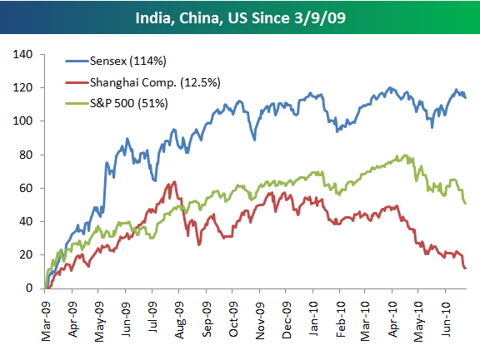 Se le considerazioni sull'occupazione U.S.A. (ma non mi pare che l'Europa goda di migliore salute) vi buttano giù potete trovare qualche raggio di luce nella prolungata fase di crescita delle economie latinoamericane, che stanno per una volta ottenendo risultati di gran lunga superiori di quelli delle rispettive squadre di calcio nazionali...Se poi cercate un mercato azionario che non sia stato travolto dal pessimismo dell'ultimo trimestre, allora vi conviene indirizzarvi verso l'Asia:
 l'India infatti batte la Cina e gli Stati Uniti con ampio margine.
Iscriviti a:
Post (Atom)


 Post
Post


