Visualizzazione post con etichetta rischio. Mostra tutti i post

mercoledì 4 aprile 2012

UPenn, MIT and Caltech sono risk-free!

Dal WSJ di oggi:


The University of Pennsylvania can add another distinction to its rich history: the cheapest borrowing rate on a century bond for any nongovernment issuer. Last week, it sold $300 million of bonds yielding 4.674% and maturing in September 2112—a date that not only its trustees but even freshmen are unlikely to see.

The financial coup is appropriate for a school that has a who's who of Wall Street, including "junk"-bond king Michael Milken, among the alumni of its Wharton School. MIT and Caltech also issued century bonds recently, but these were priced at slightly higher yields.

Perhaps the cachet of an Ivy League and America's fourth-oldest university inspires more investor trust. If so, Britain's Universities of Oxford and Cambridge, no slouches themselves and at least three times as old as Penn, should consider selling bonds maturing in the 24th century.

giovedì 15 settembre 2011

Ah questi giovani!

 Un giovane trader di UBS perde 2 miliardi con operazioni "non autorizzate": secondo il WSJ

UBS isn't yet saying how the money was lost, although a 31-year-old London-based employee has been arrested. But the mind boggles as to how it could have run up a loss equivalent to 28 times its second-quarter average daily value-at-risk via unauthorized trades. Even in the current volatile markets when large swings can trigger big losses on unhedged positions, sizable trades must have gone undetected. At least no client money was lost, but the fact the bank could become so exposed is alarming.

Gli analisti di Morningstar si affannano a spiegare come la banca possa facilmente assorbire il colpo:

the loss, while painful, will have only a marginal impact on the company's value. As of June 30, UBS had CHF 47 billion in equity and a hefty 16.1% core Tier 1 ratio, which means it will be able to absorb the loss without resorting to a capital raise or other painful measures...

...prima di osservare come un ulteriore problema sia il danno alla reputazione di UBS: we're quite concerned about the impact this will have on UBS' reputation, and therefore its future business prospects.


UBS oggi perde il 10% in borsa e viene scambiata intorno agli 11 dollari, con uno sconto di oltre il 45% sul fair value che secondo Morningstar si attesta a circa 20 dollari, benchè gli analisti ammettano che l'incertezza sulla stima è molto alta.

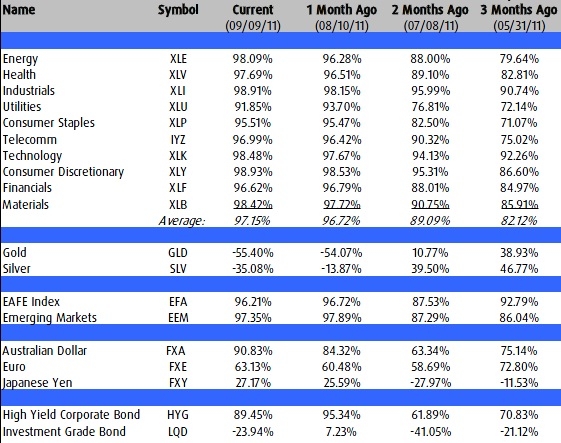
Ma ha ancora senso l'analisi fondamentale dei titoli? In un momento storico in cui le correlazioni tra i diversi settori  sono così alte da rendere quasi completamente vano ogni tentativo di diversificazione? In un post  sul blog del Financial Times Alphaville viene ripresa una analisi di ConvergEx dalla quale è tratta la tabella che riproduco qui accanto e che mostra l'aumento della correlazione tra i settori negli ultimi 3-4 mesi.
Già un anno fa in un post sullo stesso tema osservai come si era presentata una situazione di mercato analoga con la correlazione implicita calcolata dai prezzi delle opzioni put superiore all'80%.
Oggi siamo nuovamente su valori superiori all'80% come indica il grafico dell'indice KCJ qui accanto. La differenza con un anno fa è che si tratta di un fenomeno più naturale: allora l'aumento della correlazione era avvenuto in un mercato in ascesa, mentre oggi si è verificato in un mercato in discesa, e quando la volatilità aumenta è normale - entro certi limiti - che aumenti anche la correlazione tra i settori. Rimane il fatto che ormai da più di un anno è molto difficile fare selezione di titoli, lo stock picking sembra essere un'arte in via di estinzione in un mercato dominato dai temi macroeconomici e dal rischio politico. 

domenica 13 giugno 2010

Aggiornamento all'11 giugno 2010

Ecco l'aggiornamento all'11 giugno 2010.

L'ENI più sicura del Tesoro? Secondo Credit Suisse l'Italia è più sicura della Francia!

Sul Financial Times di venerdì scorso, James Mackintosh si domanda che senso abbia per il debito sovrano di un paese essere considerato più rischioso del debito di una società localizzata in quel paese. La domanda, ricorrente nel mondo accademico (ne ho spesso discusso con un amico a Siena) è ormai di attualità con i mercati che prezzano il rischio di molte imprese ben al di sotto di quello dei governi corrispondenti. Scrive Mackintosh: The market appears to be saying that companies such as Italy's Eni, Portugal Telecom, Spain's Telefonica, Greece's Hellenic Telecom and Belgium's Belgacom are less likely to default than their home countries. A naive justification is that large groups could survive a sovereign default; (...) But a more satisfactory explanation is that the flight to quality is having strange effects: investors who still want corporate bonds are flocking to the safest multinationals. Investors wanting a risk-free rate from which to calculate prices for European equities and bonds can still use German bunds. But the odd goings-on in the periphery should act as a warning. A theory built on something that does not exist (qui il riferimento è alla nozione di asset risk-free, centrale in tutta la moderna teoria del portafoglio) is bound to be hard to apply.

Vi segnalo inoltre uno studio di Credit Suisse sui rischi del debito sovrano dal quale l'Italia esce benino:
We present a framework for comparing the sustainability of government
liabilities across developed market countries. Our system goes beyond simple
debt and deficit ratios, adding a host of other less obvious but equally important
factors that ultimately affect whose debt is sustainable.
Such an approach is sorely needed, in our opinion. Past sovereign debt crises
had more to do with structural rigidities (fixed exchange rates, etc.), bad politics
(an inability to make tough decisions, etc.), and severe shocks (wars, etc.) than
with headline debt and deficits. Indeed, war is by far the most common cause
of past sovereign defaults in our developed world sample. Our attempt at
scoring yields the following conclusions about relative debt sustainability:
• The first tier of sovereign debt includes the liabilities of China, Germany,
Switzerland, Australia and Canada. More controversially it also includes the
US, Italy and Japan. In our view these countries have negligible credit risk.
These countries may (and probably do) have some unsustainable liabilities,
but for most this implies much longer-term risks of inflation (indirect default) if
action is not taken to cap or reduce long-term entitlement commitments.
• The second tier includes the UK and arguably France. Credit risk remains
very low for these two, but structural factors suggest slightly greater risks of
debt sustainability issues. For the UK these are most likely to show up in
higher inflation risks; for France the main concern is public sector rigidities
and entitlements.
• The third tier includes Greece, Portugal, Spain and Ireland. For these four the
risks of actual default are significantly greater, unless and until rules for a
more explicit fiscal and political union within the euro zone are worked out.
This process has now begun in a classic process of crisis-led reform.
• Note that the euro zone GDP-weighted average score is similar to the UK
score. Moreover, all countries in our sample – no matter what their debt level
– would be perfectly creditworthy if primary budget surpluses were the norm.
Naturally, our conclusions rely on many subjective judgements. The framework
is available in spreadsheet form on request, allowing readers to put in their own
country scores and category weightings.

venerdì 12 febbraio 2010

Chi non risica non rosica, però ...

L'ultimo numero dell'Economist contiene un approfondimento sul rischio e il ruolo che la sua sottovalutazione ha avuto nella crisi finanziaria: qui sotto potete ascoltare un'intervista al curatore dell'approfondimento su questo argomento. Vi consiglio di  seguirla fino in fondo perchè diventa più interessante man mano che ci si avvicina alle conclusioni.


Sempre l'Economist riassumendo gli avvenimenti della settimana sottolinea le voci sull bailout della Grecia e l'exit strategy dal Quantitative Easing proposta da Bernanke:

Global markets had a rocky time amid worries that the loss of confidence in Greece’s ability to tackle its debt crisis alone would spread to other euro-zone countries, particularly Spain and Portugal. Nervous investors awaited news of a possible Greek bail-out, led by Germany. See article
Ben Bernanke outlined the exit strategy the Federal Reserve would take to tighten credit once the economy recovers. He raised the possibility of using the interest rate the Fed pays banks for reserves they maintain at the central bank, which have soared, as a guide to its main operating policy, as the current federal funds rate “could for a time become a less reliable indicator…of conditions in short-term money markets”.


L'ipotesi che è stata avanzata ieri per aiutare la Grecia comprende l'acquisto delle obbligazioni del paese da parte di alcune banche dell'area euro ma anche aiuti dal FMI e anche accordi bilaterali.

La crisi greca e la lentezza dell'intervento da parte degli altri paesi dell'area euro sembra scoraggiare Lettonia ed Estonia nella loro marcia di avvicinamento all'euro. Le cifre sulla crisi in Lettonia sono spaventose:

Enthusiastic for years about adopting the euro, Latvia had undertaken painful austerity measures. Even as the global economy contracted, the government slashed spending. The program included cuts of 50 percent or more in the salaries of public-sector employees and a 40 percent reduction in hospital budgets.
The result, many economists say, has been deepening unemployment and the worst recession of any country in the 27-nation European Union.
Latvia’s gross domestic product has declined by an estimated 24 percent since the recession began — a steeper drop than America’s during the Great Depression

La discussione sui bonus alle banche continua... vi segnalo quanto scrive Brad De Long su SeekingAlpha:

I think Wall Street CEOs wealth needs to be tied to their firms: if their firms go broke--or would have gone broke in the absence of government rescue--they should go broke. Bank shareholders ought to be writing compensation contracts that enforce that, as indeed Silicon Valley VCs do.
And since bank shareholders don't write such contracts, the government needs to change the law to force such Silicon Valley compensation schemes onto the banking sector.
That said, I think Jamie Dimon deserves all the money he is getting: JPMorgan Chase (JPM) was a stabilizing speculator in the financial crisis, doing what we want it to do; he showed a great deal of guts in guiding the bank to a position short subprime before the crash, and he should be rewarded.

Concludo segnalandovi (con un mese di ritardo...) le belle interviste agli economisti di Chicago realizzate per il New Yorker da John Cassidy: per cominciare vi consiglio l'intervista a John Cochrane, che ho finalmente avuto il tempo di leggere oggi in treno. La trovo ricca di spunti importanti, specialmente nella discussione dell'ipotesi dei mercati efficienti, probabilmente finirò per usarla anche a lezione.