Visualizzazione post con etichetta USA. Mostra tutti i post

sabato 23 marzo 2013

Da Sarajevo a Nicosia...100 anni dopo

Il commento sulla crisi cipriota di Tony Barber sul Financial Times di oggi sottolinea la gravità delle implicazioni per l'Europa intera di una pessima miope gestione della situazione: ecco come conclude

But the latest crisis draws in Britain, Greece, Israel, the US and Turkey, not to mention Germany as the eurozone’s indispensable decision maker. Nearby a civil war rages in Syria and political turbulence disturbs Egypt and Iraq. Cyprus is not even immune to international tensions over Iran. The island’s economic emergency intensified in July 2011 when a cache of Iranian weapons, seized by the US navy and stored at a Cypriot base, exploded and knocked out half the island’s electricity supply. Incoming hours and days, much more will beat stake than the solvency of Cyprus’s banks or its eurozone membership. For example, any financial rescue tied to future revenues from Cyprus’s newly discovered gas reserves, tentatively valued at up to $80bn, will give rise to hotly contested claims tot he assets. Among the claimants would be the Turkish Cypriots, backed byTurkey, whose military presence in northern Cyprus serves as a permanent reminder of thei island’s political fragility. Such a dispute would suck in Greece, traditional patron of the Greek Cypriots, and Israel, their partner in energy development. The US, whose Sixth Fleet makes it the pre-eminent Mediterranean naval power,would be drawn in, and so would Britain with its two sovereign military bases in Cyprus. Preventing these entanglements from getting out of control will require supreme statesmanship from everyone involved. Perhaps the thought that next year marks the 100th anniversary of the shooting of the Archduke Franz Ferdinand will concentrate minds.

Mi auguro che abbia ragione...per parte mia sono scettico...non mi pare che ci sia in giro molta "supreme statesmanship"...

mercoledì 27 febbraio 2013

Rendimenti trentennali al 2% ?

Se questo celebre strategist statunitense ha ragione conviene avere un po' di Treasury bonds trentennali in portafoglio...

Forbes: Let’s hit first long treasuries. The yield now on the 30-year bond is 3%?

Shilling: 3%.

Forbes: The ten-year, 1.6%, 1.8%? Pick a number. When we last talked it was 4.5% on the 30-year, which seemed low at the time and was almost 3% on the ten. How much more is there and how long can it last?

Shilling: I’m suggesting 2% on the long bond and 1% on the ten-year.

Forbes: Time frame?

Shilling: One of the great forecasters said, “You know, you either forecast what’s going to happen or when it’s going to happen, but not both.” I would say over the next year or so, and that’s assuming that this grand disconnect does get closed. If we go from 3% to 2% on the long bond that’s a total return, assuming it takes place over a year so you get a year’s worth of interest. That’s a total return of about 16% and it’s about 25% on a 30-year zero coupon bond. That’s pretty attractive, relative to what I think would happen in stocks, which would be on the negative side.

Il "great forecaster" citato da Shilling è Clive Granger.
Potete leggere il resto dell'intervista qui: Gary Shilling: Why You Should Sell Stocks And Buy Treasurys - Forbes

martedì 15 gennaio 2013

Il Giappone verso la ripresa o verso il disastro?

Due opinioni opposte sul futuro del Giappone da due commentatori autorevoli e molto seguiti: ieri sul New York Times Paul Krugman inneggiava alla nuova politica espansiva del premier Abe, oggi John Mauldin prevede disastri all'orizzonte.

Secondo Krugman l'Europa e soprattutto gli USA si preoccupano troppo della sostenibilità del debito e non abbastanza dell'occupazione e della crescita, che devo essere adeguatamente stimolata anche attraverso l'intervento diretto dello Stato:

While getting out of a prolonged slump turns out to be very difficult, that’s mainly because it’s hard getting policy makers to accept the need for bold action. That is, the problem is mainly political and intellectual, rather than strictly economic. For the risks of action are much smaller than the Very Serious People want you to believe.

Consider, in particular, the alleged dangers of debt and deficits. Here in America, we are constantly warned that we must slash spending now now now or we’ll turn into Greece, Greece I tell you. But Greece, a country without a currency, doesn’t look much like the United States; surely Japan offers a more relevant model. And while doomsayers keep predicting a fiscal crisis in Japan, hyping each uptick in interest rates as a sign of the imminent apocalypse, it keeps not happening: Japan’s government can still borrow long term at a rate of less than 1 percent.

Enter Mr. Abe, who has been pressuring the Bank of Japan into seeking higher inflation — in effect, helping to inflate away part of the government’s debt — and has also just announced a large new program of fiscal stimulus. How have the market gods responded?

The answer is, it’s all good. Market measures of expected inflation, which were negative not long ago — the market was expecting deflation to continue — have now moved well into positive territory. But government borrowing costs have hardly changed at all; given the prospect of moderate inflation, this means that Japan’s fiscal outlook has actually improved sharply. True, the foreign-exchange value of the yen has fallen considerably — but that’s actually very good news, and Japanese exporters are cheering.

In short, Mr. Abe has thumbed his nose at orthodoxy, with excellent results.
Now, people who know something about Japanese politics warn me not to think of Mr. Abe as a good guy. His foreign policy, they tell me, is very bad, and his support for stimulus may have more to do with old-fashioned pork-barrel (tofu barrel?) politics than with a sophisticated rejection of conventional wisdom.
But none of that may matter. Whatever his motives, Mr. Abe is breaking with a bad orthodoxy. And if he succeeds, something remarkable may be about to happen: Japan, which pioneered the economics of stagnation, may also end up showing the rest of us the way out.


Di parere completamente opposto è John Mauldin che da anni sostiene che Japan Is a Bug in Search of a Windshield (cioè...il Giappone è un moscerino in cerca di un parabrezza....). Secondo Mauldin i fondamentali economici del Giappone, primo tra tutti il debito pubblico, uniti alle pessime prospettive demografiche e alla progressiva perdita di capacità di risparmio delle famiglie possono solo condurre a una conclusione disastrosa.

Japan now has a breathtaking 230% ratio of government debt to GDP (the last estimate I have seen), and it is growing at 10%-plus a year. The government will borrow almost 45% of its budget this year. Has there ever been a more clear disaster in the making? Yet shorting the Japanese bond has been called “the widow-maker.” I think it was Soros who once quipped that you can’t call yourself a global macro trader until you have lost money shorting JGBs (Japanese government bonds).

La politica del premier Abe condurrà necessariamente a una massiccia svalutazione dello yen, accompagnata da un innalzamento dei tassi di interesse, a livelli che Mauldin non giudica sostenibili: 

The new Japanese government, led by Prime Minister Abe and former Prime Minister and now Minister of Finance Aso, have very explicitly demanded that the Bank of Japan target 2% inflation. They have made clear their intention to replace the governors of the current BoJ board with members who agree with this policy. They have the political clout to do so. Whether at the upcoming meeting or after April, when a new head of the BoJ is appointed, that is going to happen. These moves mean there will be a massive printing of yen. In response, the yen has already weakened by over 10%.
You can control the quantity of money or the price of money but not both. (Yes, I know that one influences the other, but I am referring here to large-scale printing of money.) One has to assume that the law of gravity will not be repealed and that investors will want something more than 2% on the ten-year bond if inflation is at 2%. If the ten-year bond were to rise by 2%, Japan would soon be spending over 50% of its tax revenues on the interest carry alone. I submit that this is not a workable business model.

Tra l'altro l'indebolimento dello yen renderà i vicini - la Corea e la Cina in primis - molto nervosi, in un momento in cui le tensioni nazionaliste sono già molto forti (come le dispute per le isole Senkaku...) 

Understand,  inflation targeting is also currency-valuation targeting. They clearly want the yen to devalue. I have been writing for years that the yen would eventually be 125, then 150, then 200 to the dollar. It has been 300 in my lifetime, and unless the Japanese change direction, there is no reason it can’t get there again. This means that Mrs. Watanabe will see her energy bills double. This will call into question the Japanese decision to close their nuclear energy plants – something that Abe is already reconsidering.
Think the Koreans will be happy when you can buy a Lexus cheaper than you can buy a Kia? (Disclosure: I love my Japanese Infiniti, the first “foreign” car I have bought, except for a two-month dalliance with a disaster of a Volkswagen 30 years ago.) Think Samsung and LG will be happy when Panasonic and Sony can eat their lunch pricewise? Welcome to the era of real currency wars.

Indiscutibilmente Mauldin ha un dono per la scrittura, così vi lascio con la scelta tra i due disastri che il nostro analista prevede per il paese del sole levante
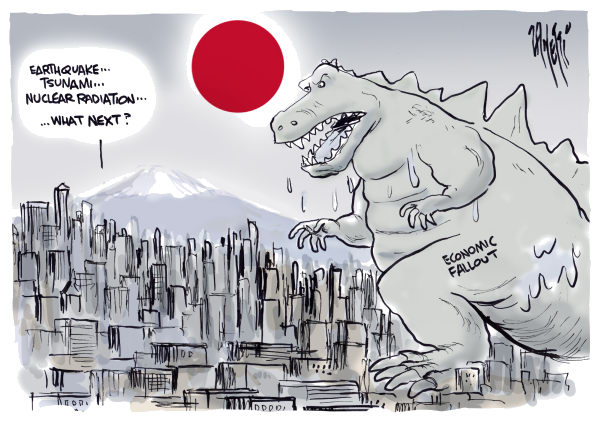
Japan is now committed to either Disaster A or Disaster B. Remember those really bad Japanese “horror” movies of the ’50s and ’60s? Godzilla first released in 1954, and there were dozens of remakes and follow-on movies. It seemed endless. And while the current government policy will not trash downtown Tokyo, it will seriously damage the savings and buying power of two generations. Disaster A is monetization, which is clearly not good when the Japanese want to buy anything not made in Japan (like energy, steel, commodities, a lot of food, etc.) Disaster B is the deflationary depression that budget balancing will yield. Which leads us to the next factor:

3.      Once the government is committed to the new strategy, any retreat will cause a market upheaval. This is not a short-term commitment. It seems to me that the Japanese truly believe that their lack of economic growth can be solved through inflation. Their politicians seem to be channeling their inner Paul Krugman, or at the least taking Bernanke’s advice from 2000, when he published a paper called “Japan’s Slump: A Case of Self-Induced Paralysis?”

When your debt and deficit are as massive as Japan’s, the only way to resolve the issue is to inflate away the debt or willingly enter into a depression. They obviously think they can control both the debt and inflation.

This means you should NOT run out and short Japanese government bonds. Repeat, NOT. The only way for the Japanese to make their plan work without having to battle the Godzilla of a destitute bond market is for the BoJ to move out the yield curve and monetize the debt. They will eventually hit all bids on JGBs. For all intents and purposes, the BoJ will become the yen bond market. You will get all the yen they promised when you bought those bonds … but the contract never stipulates what those yen will actually buy.

The plan is evidently that, with a little inflation, they will jump-start the economy; and with growth they can eventually balance the budget and return to a normal bond market. Rots of ruck, guys.
Just a couple years ago this letter seemed as if it was All Greece, All the Time. Since Japan is, say, about 100 times more important than Greece, we will be revisiting it at length in the coming months. 

martedì 5 giugno 2012

La crisi dell'eurozona ha aiutato la Germania a conservare la AAA

Come mai la Germania ha mantenuto un rating AAA e gli U.S.A. lo hanno perso?

La domanda non è accademica: le condizioni del debito sovrano dei due paesi sono confrontabili, benchè la traiettoria recente del debito sia stata meno virtuosa negli Stati Uniti.

Se si tiene conto però del peso che il debito pubblico complessivo (includendo le pensioni) ha relativamente al reddito disponibile, la situazione tedesca non è molto migliore di quella del Belgio e persino dell'Italia, e addirittura nettamente peggiore di Portogallo, Spagna e Grecia (si veda la tabella qui accanto, tratta da  http://workforall.net/CDS-Credit-default-Swaps.html), una situazione assolutamente diversa da quella degli U.S.A.
Ciononostante i mercati si fidano della Germania e ne amano le emissioni obbligazionarie al punto da prestare
 soldi per due anni senza chiedere nulla in cambio, nemmeno un pochino di interesse. Certo, la Germania deve attingere assai meno ai mercati per rifinanziare il proprio debito nel 2012-2013, con solo il 9-10% del GDP offerto sui mercati obbligazionari contro il 30% degli U.S.A. (che pure riescono ad approvigionarsi a tassi bassissimi, con buona pace di chi invoca i bond vigilantes per punire la dissennatezza finanziaria delle amministrazioni U.S.A. degli ultimi anni). 

Una possibile spiegazione è che la crisi dell'eurozona abbia provocato una fuga verso il Bund come bene rifugio, unico asset percepito come veramente risk-free tra quelli denominati in euro (o almeno come la migliore approssimazione di un asset risk-free disponibile sul mercato), segnalando quindi sul mercato obbligazionario un miglioramento del rating del debito sovrano tedesco proprio mentre sul mercato dei Credit Default Swaps si assisteva a un deterioramento del merito creditizio. E' questo fenomeno, leggibile sulla dinamica congiunta dei CDS e delle obbligazioni, che ha segnato il divorzio tra la Germania e gli USA e che ha reso possibile il downgrade del debito americano mentre quello tedesco ha mantenuto la AAA. Se vi ho incuriosito, e volete comprendere meglio il meccanismo della divergenza tra la dinamica del merito creditizio (implicito nelle quotazioni di mercato) degli USA e della Germania potete leggere questo articolo (in collaborazione con Niccolò Cottini e Aldo Nassigh) nel quale analizziamo la dinamica degli spread dei CDS e delle obbligazioni negli ultimi 5 anni e dal quale ho tratto le due figure riprodotte qui sotto. 

Nella prima si riassumono i movimenti di Germania, Stati Uniti e Francia in un piano i cui due assi coordinati misurano gli spread delle obbligazioni  quinquennali con il LIBOR (in ordinata) e quello del Credit Default Swap pure con scadenza quinquennale (in ascissa). La differenza del comportamento tra la Germania e gli altri due paesi durante la crisi dell'Eurozona è evidente: solo in questo caso l'aumento del CDS quinquennale si accompagna ad una vistosa riduzione dei tassi obbligazionari (ancora una volta guidato dall'affannosa corsa verso un investimento risk-free denominato in euro). Nella figura qui sotto ci concentriamo sul confronto tra USA e Germania, riportando 923 osservazioni giornaliere (dal settembre 2008 al marzo 2012): senza il calo dei tassi un downgrade della Germania sarebbe stato difficilmente evitabile.

mercoledì 29 settembre 2010

La manipolazione delle valute e una vecchia proposta di Keynes

L'Economist dedica un articolo all'analisi della manipolazione
dei mercati valutari da parte delle banche centrali di numerosi paesi. L'effetto principale della riunione
della Fed di martedì scorso è stato quello di indebolire considerevolmente
il dollaro mediante l'evocazione di uno scenario di crescita economica debole
e di ripresa del Quantitative Easing. L'Economist giustamente osserva come la
mossa della Fed sia giunta pochi giorni dopo l'imponente intervento della banca
centrale giapponese contro la rivalutazione dello yen. I giapponesi e gli americani non sono però i soli manipolatori dei cambi: all'elenco si aggiunge la Svizzera, il Brasile ma, soprattutto, la Cina.

The most active interveners, however, are in the emerging world.
China is the extreme case. It has built up $2.45 trillion of reserves thanks to
its determination to keep the yuan stable against the dollar. Others have less rigid currencies but still intervene to stem what they regard as excessive upward pressure. Between September 13th and 16th Brazil’s central bank bought dollars at a rate of $1 billion a day.

As the recovery slows, a growing number of people worry about a descent into
competitive depreciation, as countries try to grab a bigger share of global demand at others’ expense, a trend that could fuel protectionism. Optimists, however, argue there may be benefits from today’s fad for currency fiddling. One argument is that intervention may be a backdoor route to reflation. If central banks all print money to prevent their currencies appreciating and don’t mop up or “sterilise” that liquidity by issuing bonds, then their exchange rates might end up the same but the world will have had a monetary boost in the interim.

The truth lies in between. Although most of the intervening governments have the same goal—to stop their domestic currency from rising—their circumstances and motivations vary widely. China’s ongoing determination to fix the yuan is the least defensible and most distortive. Unfortunately, it is also the world’s most effective intervener.


Il rafforzamento dell'euro rende senz'altro più difficle la ripresa economica nei paesi in crisi alla periferia dell'eurozona (Irlanda, Grecia, Spagna e Portogallo, ma non sto pensando solo a loro...).  Secondo il Wall Street Journal

As in the 1930s, competitive devaluations, whether by fair means or foul,
are likely to increase international tensions and risk protectionist responses.
Meanwhile, they will do nothing to address the global imbalances that led to the
crisis or tackle the chief problem facing the advanced economies today:
lack of domestic demand in many countries.

In the short term, the euro zone has the most to lose from rising currency tensions, given the relative hawkishness of the European Central Bank. The euro already has risen 2.3% against the dollar in the last week. But a rising euro could cause further problems for Europe's periphery as well as for the German export engine at the heart of the European recovery.

Longer term, the biggest gainer is likely to be gold, (...) the traditional refuge of those unwilling to put their faith in politicians.


In un mondo sviluppato completamente nel quale la riduzione del debito (pubblico e delle famiglie) è all'ordine del giorno, non sorprendentemente c'è anche chi ripropone l'idea di Keynes di legare i corsi valutari al deficit della bilancia commerciale (speriamo che i miei lettori tedeschi siano distratti...). Ecco come l'Economist descrive lo schema di Keynes:

Keynes set out a scheme for a “clearing union” that he believed had the benefits to trade of a fixed exchange-rate system but without the gold standard’s shortcomings. At its heart was an international clearing bank (ICB) that would settle the balance of transactions that gave rise to trade surpluses or deficits. Residual balances would be settled by member central banks, but each would have an overdraft facility at the ICB equal to the recent average of its country’s exports and imports (its “quota”). The overdraft would afford deficit countries a credit buffer against the abrupt adjustments required under the gold standard.

The scheme would still discipline members with trade deficits.
A country that used up more than a quarter of its limit would be allowed to
depreciate its currency by 5% against the others. Higher overdrafts would incur an interest charge on a rising scale. A country that breached half its overdraft would be required to devalue, to sell some of its gold to the ICB and to prohibit capital exports. A hopelessly lax country would be expelled from the club.

Keynes’s scheme would also require creditors not to hoard their trade surpluses.
Countries in persistent credit with the ICB would be allowed (and then required)
to revalue their currencies. Credits equal to a quarter of the ICB quota would be
liable to a tax of 5%, rising to 10% for credits above half the quota.

This scheme formed the basis of Britain’s position in the negotiations in 1944 at Bretton Woods, which created the post-war system of exchange rates. However, Keynes could not secure American support for “creditor adjustment”. This was in part because America had both the world’s most powerful economy and (like Germany today) a big trade surplus. Britain was an indebted supplicant.

As Robert Skidelsky argues in his biography of Keynes, this also reflected the contrasting views in America and Britain of the collapse of the gold standard. America associated its earlier prosperity with the standard’s stability and the Depression with the system’s breakdown. Britain linked the misery of the 1920s to the gold straitjacket and its subsequent recovery to being freed from it. The belief that more discipline for debtors is the cure for imbalances persists, though in Germany rather than America. Now a deficit country, America thinks surplus countries should adjust too.

lunedì 27 settembre 2010

La più lunga recessione dai tempi della grande depressione

Chartoftheday.com fa notare come la recessione iniziata nel dicembre 2007 e conclusasi nel giugno 2009 sia stata la più lunga dai tempi della grande depressione, che mantiene solidamente il suo recod di durata (44 mesi!!). 
Il record poco invidiabile della depressione del 1929 viene però messo in discussione da ... Warren Buffett, secondo il quale in termini reali l'economia U.S.A. è ancora alle prese con la recessione.
Il quadro poco edificante dell'economia U.S.A. si è poi arricchito di un ulteriore capitolo, con il salvataggio delle credit unions. Secondo il New York Times

Nearly two years after Wall Street’s giants were rescued by the federal government, regulators on Friday took over three financial institutions that provide the underpinning for hundreds of the nation’s credit unions.(...)
Of the 27 wholesale credit unions operating in the United States, five have been seized by regulators over the last 18 months. The agency announced a plan Friday to separate billions of dollars of the bad assets that have crippled those institutions and then repackage them for sale with a federal guarantee. It also established a set of regulations that will require wholesale credit unions to hold more capital and improve their risk management and governance practices.
It is the latest action by regulators to try to put the financial system on stronger footing, and comes as the nation’s banks and thrifts have shown signs that they are gradually returning to health. Many of the biggest and most troubled institutions, like IndyMac and Washington Mutual, were resolved in the early days of the financial crisis.
The Federal Deposit Insurance Corporation, which insures money deposited in commercial and savings banks, has shuttered more than 295 lenders over the last few years, including two on Friday. The pace of those interventions has been slowing.
The credit union rescue, however, presents a new twist. Credit unions have billed themselves as conservative safe havens that were insulated from risky business like subprime and commercial real estate lending. Now, two years into the worst economic crisis since the Great Depression, it seems that no area of the financial industry managed to escape the effects of the credit bubble.

martedì 21 settembre 2010

Da un check-up all'economia U.S.A. qualche raccomandazione ai politici

L'Economist di questa settimana dedica un approfondimento allo stato di salute dell'economia U.S.A.: l'articolo di apertura è moderatamente ottimista:


The most wrenching recession since the 1930s ended a year ago. But the recovery—none too powerful to begin with—slowed sharply earlier this year. (...) Fears grew over the summer that if this deceleration continued, America’s economy would slip back into recession.
Fortunately, those worries now seem exaggerated. Part of the weakness of second-quarter GDP was probably because of a temporary surge in imports from China. The latest statistics, from reasonably good retail sales in August to falling claims for unemployment benefits, point to an economy that, though still weak, is not slumping further. And history suggests that although nascent recoveries often wobble for a quarter or two, they rarely relapse into recession. For now, it is most likely that America’s economy will crawl along with growth at perhaps 2.5%: above stall speed, but far too slow to make much difference to the jobless rate (see article).
Why, given that America usually rebounds from recession, are the prospects so bleak? Because most past recessions have been caused by tight monetary policy. When policy is loosened, demand rebounds. This recession was the result of a financial crisis. Recoveries after financial crises are normally weak and slow as banking systems are repaired and balance-sheets rebuilt. Typically, this period of debt reduction lasts around seven years, which means America would emerge from it in 2014. By some measures, households are reducing their debt burdens unusually fast, but even optimistic seers do not think the process is much more than half over. 

Secondo l'Economist il principale rischio per l'economia U.S.A. viene dall'apparente incapacità della politica di accettare alcuni dati di fatto e di organizzare una risposta coerente con gli strumenti che la politica fiscale e monetaria mette a disposizione. Sono d'accordo: seguo ogni giorno il dibattito su questi temi sui due principali quotidiani americani, tradizionalmente agli antipodi dal punto di vista delle posizioni politiche (il New York Times, liberal-democratico, e il Wall Street Journal, conservatore-repubblicano) e l'impressione è a volte sconfortante (e se lo dice un italiano...).  Sono quindi d'accordo con le conclusioni dell'articolo del settimanale britannico

Americans are used to great distances. The sooner they, and their politicians, accept that the road to recovery will be a long one, the faster they will get there. 

In questo articolo l'Economist approfondisce l'analisi concentrandosi sul rapporto tra il debito (delle famiglie e del Tesoro U.S.A.) e la debolezza della ripresa, attribuita alla distruzione del sistema bancario e finanziario provocata dalla crisi che, insieme al deleveraging (riduzione del debito) delle famiglie, contribuisce a deprimere i consumi e a ritardare la ripresa dell'occupazione:


Since the recovery began, the economy has grown at a rate of less than 3%. That is faster than its long-term potential, of about 2.5%, but America has woken from past deep recessions at rates of 6-8%. Job creation has thus been too feeble to bring down the unemployment rate, which at 9.6% is much as it was at the start of the recovery. “Progress has been painfully slow,” acknowledged Barack Obama on September 8th—not what a president likes saying less than two months before an election.
What makes this recovery different is that it follows a recession brought on by a financial crisis. A growing body of research has found that such recoveries tend to be slower than those after “normal” recessions. Prakash Kannan, an economist at the IMF, examined 83 recessions in 21 rich countries since 1970. In the first two years after normal recessions growth averaged 3.7%. After the 13 caused by crises, growth averaged 2.4%. America has been doing slightly better than this (see chart 1).
The Federal Reserve brought on most post-war recessions by raising interest rates to squeeze out inflation. When the Fed cut rates, demand revived. Financial crises interfere with the transmission of lower rates to private borrowers. People can’t or won’t borrow because the value of their collateral—in particular, houses—has fallen. Banks are less able to lend because their capital has been depleted by bad loans, or less willing because customers can’t meet tighter underwriting standards.
“Where we are in the economy shouldn’t be surprising,” says Vikram Pandit, chief executive of Citigroup. Mr Pandit sees only two sure things ahead: that American consumers will continue to cut their debt (deleverage, in financial argot) and that emerging markets will grow quickly. At Citi, transaction-service revenues, such as foreign-exchange and cash management for multinationals, are growing healthily while revenue from American consumer loans is shrinking.

La domanda che in molti si pongono è quanto tempo occorrerà aspettare prima che si torni a livelli più tonici di attività economica. Forse dai 4 ai 7 anni, anche se c'è chi è moderatamente più ottimista, sperando che non vi siano nuovi shock (esogeni ? oppure semplici errori della politica fiscale e di bilancio come una prematura politica di austerità? ) che fanno precitipare l'economia in una nuova recessione


How long will deleveraging take? In a recent paper Carmen Reinhart of the University of Maryland and her husband Vincent Reinhart of the American Enterprise Institute looked at 15 crises since 1977. They estimate that on average deleveraging lasted seven years, during which growth was a percentage point lower than in the decade before a crisis. If America follows this pattern, its GDP will grow by 2.4% for the next four to seven years. Because that roughly equals potential, job creation should only just match population growth: the unemployment rate won’t fall.
Few economists are that gloomy. Most think a prolonged period of easy monetary policy and a slow release of pent-up demand for durable goods and homes can yield growth of at least 3%. Some also think that deleveraging is ahead of schedule. Richard Berner of Morgan Stanley predicts that, thanks in part to falling interest rates, debt service will be back to a “sustainable” 11-12% of disposable income later this year. Peter Hooper and Torsten Slok of Deutsche Bank reckon that if saving stays at about 6% of income, write-offs remain near today’s elevated level and household income rises by 4.5% a year, household debt will fall from 126% of disposable income now to around 85%, where it was in the early 1990s, by 2013 (see chart 3).
These calculations will be wrong if incomes stumble or consumers seek to save more than expected. The IMF notes that saving rates in Finland, Norway and Sweden ultimately rose by five to ten percentage points after housing busts in the late 1980s. America’s saving rate has gone up by four points so far.
More cheerfully, the Reinharts find that once economies start to grow after a crisis they tend not to slide back into recession without suffering some new shock. Spain, whose banking crisis began in 1977, was dragged back by global monetary tightening in the early 1980s. Countries recovering from the East Asian crisis of 1997-98 were hit by avian flu, the bursting of the American tech bubble and the economic effects of the terrorist attacks of September 11th 2001. Japan is a special case. It was shoved back into recession partly by its own policies: an ill-timed tax increase in 1997 and the (temporary) ending of the Bank of Japan’s zero-interest-rate policy in 2000.

mercoledì 15 settembre 2010

debito privato + debito pubblico = deficit della bilancia commerciale

Nell'ultima newsletter settimanale John Mauldin insiste sulla conseguenze dell'identità contabile alla quale si perviene dividendo l'economia di una nazione in tre parti:  il settore privato, il settore pubblico e le esportazioni:

Domestic Private Sector Financial Balance + Governmental Fiscal Balance - the Current
Account Balance (or Trade Deficit/Surplus) = 0


Scrive Mauldin:

By Domestic Private Sector Financial Balance we mean the net balance of businesses and consumers. Are they borrowing money or paying down debt? Government Fiscal Balance is the same: is the government borrowing or paying down debt? And the Current Account Balance is the trade deficit or surplus.
The implications are simple. The three items have to add up to zero. That means you cannot have surpluses in both the private and government sectors and run a trade deficit. You have to have a trade surplus. (...) Bottom line: you can run a trade deficit, reduce government debt, and reduce
private debt, but not all three at the same time. Choose two. Choose carefully.


Il punto fondamentale che solleva Mauldin è l'impossibilità di una riduzione del debito (leverage) simultanea nel settore pubblico e in quello privato in mancanza di un surplus della bilancia commerciale. E se si passa dall'analisi di una singola nazione all'analisi dell'economia globale allora le bilancie commerciali dei singoli paesi devono necessariamente sommarsi a zero e si ottiene l'impossibilità a livello globale di una simultanea riduzione del debito sia pubblico che privato.

Le conseguenze non sono troppo negative per i paesi che possono controllare la politica monetaria, come ad esempio l'Inghiliterra, per la quale è ragionevole attendersi che Because they have control of their currency and their debt, which is mostly in their own currency, they can devalue their way to a solution.

(Mauldin si spinge a prevedere un cambio dollaro/sterlina alla pari!)

I guai invece sono pressochè insormontabili per paesi come la Grecia, che non posso utilizzare la svalutazione della moneta per guadagnare in competitività e riequilibrare la bilancia commerciale:

We all know that Greek government deficits are somewhere around 14%. But their trade deficit is running north of 10%. (By comparison, the US trade deficit is now about 4%.)
Going back to the equation, if Greece wants to reduce its fiscal deficit by 11% over the next three years, then either private debt must increase or the trade deficit must drop sharply. That's the accounting rules.
But here's the problem. Greece cannot devalue its currency. It is (for now) stuck
with the euro. So, how can they make their products more competitive? How do they grow their way out of their problems? How do they become more productive relative to the rest of Europe and the world?

Barring some new productivity boost in olive oil and other agricultural produce,
there is no easy way. Since the creation of the euro in1999, Germany has become some 30% more productive than Greece. Very roughly, that means it costs 30% more in Greece to produce the same amount of goods. That is why Greece imports $64 billion and exports $21 billion.
What needs to happen for Greece to become more competitive? Labor costs must
fall by a lot. And not by just 10 or 15%. But if labor costs drop (deflation) then that means that taxes also drop. The government takes in less and GDP drops. The perverse situation is that the debt-to-GDP ratio gets worse, even as they enact their austerity measures.
In short, Greek lifestyles are on the line. They are going to fall. They have no
choice. They are going to have to willingly put themselves into a severe recession or, more realistically, a depression. (...)
What are their choices? They can simply default on the debt. Stop making any
payments. That means they cannot borrow any more money for a minimum of a few years (Argentina seemed to be able to come back fairly quickly after default), but it would go a long way toward balancing the government budget. Government employees would need to take large pay cuts, and there would be other large cuts in services. It would be a depression, but you work your way out of it. You are still in the euro and need to figure out how to become more competitive.


Qui mi pare che il ragionamento di  Mauldin  mostri i suoi limiti, visto che mi sembra poco probabile che una nazione che fa default sia ancora accettabile all'interno dell'area euro. Ma l'opzione dell'abbandono dell'euro benche' possa sembrare piu' verosimile conduce a uno scenario poco incoraggiante, visto che il debito estero rimarrebbe denominato in euro. In un editoriale il Wall Street Journal qualche tempo fa giungeva a conclusioni meno tetre per il futuro di questo paese.

La logica di Mauldin e' a mio avviso ineccepibile quando dall'analisi della Grecia passa a quella della Germania:

Germany is basically saying, you should be like us. And everyone wants to be.
But not everyone can.
Every country cannot run a trade surplus. Someone has to buy. But the
prescription that politicians want is for fiscal austerity and trade surpluses, at least for
European countries. That is the import of Martin Wolfe’s editorial we mentioned above.
He is as wired in as you get in Britain. And in a few short sentences he has laid out the formula Britain will pursue. Devalue and put your goods and services on sale. Figure out how to get to that surplus.
Germany has been thriving because much of Europe has been buying its goods. If
they are forced by circumstances to buy less, that will not be good for Germany. It’s all connected.
Yet politicians want to believe that somehow we can all run surpluses – at least in
their own countries. We can balance the budgets. We can reduce our private debts. We all want to believe in that mythical Lake Woebegone, where all the kids are above average.
Sadly, it just isn't possible for everyone to have a happy ending.


Quando dall'analisi dei guai dell'Europa passa a quella dei guai degli U.S.A. Mauldin si lancia in proposte provocatorie, che mi piacciono molto:

If the US is going to really attempt to balance the budget over time, reduce our
personal leverage, and save more, then we have to address the glaring fact that we import $300 billion in oil (give or take, depending on the price of oil).
This can only partially be done by offshore drilling. The real key is to reduce the
need for oil. Nuclear power, renewables, and a shift to electric cars will be most helpful.
Let us suggest something a little more radical. When the price of oil approached $4 a few years ago, Americans changed their driving and car-buying habits.

Perhaps we need to see the price of oil rise. What if we increased the price of oil
with an increase in gas taxes by 2 cents a gallon each and every month until the demand for oil dropped to the point where we did not need foreign oil? If we had European gasmileage standards, that would be the case now.
And take that 2 cents a month and dedicate it to fixing our infrastructure, which is badly in need of repair.

lunedì 30 agosto 2010

La nuova normalità? Un decennio di crescita anemica per gli U.S.A.

Mentre negli U.S.A. celebrano la buona notizia della nascita di una nuova banca, la prima dalla fine del 2009, i banchieri centrali e gli economisti riuniti a Jackson Hole, Wyoming, ci avvertono che la crescita dell'economia U.S.A. potrebbe continuare a essere anemica per ancora un decennio.  Secondo Carmen Reinhart The American economy could experience painfully slow growth and stubbornly high unemployment for a decade or longer as a result of the 2007 collapse of the housing market and the economic turmoil that followed, (...)
Ms. Reinhart’s paper drew upon research she conducted with the Harvard economist Kenneth S. Rogoff for their book “This Time Is Different: Eight Centuries of Financial Folly,” published last year by Princeton University Press. Her husband, Vincent R. Reinhart, a former director of monetary affairs at the Fed, was the co-author of the paper.
The Reinharts examined 15 severe financial crises since World War II as well as the worldwide economic contractions that followed the 1929 stock market crash, the 1973 oil shock and the 2007 implosion of the subprime mortgage market.
In the decade following the crises, growth rates were significantly lower and unemployment rates were significantly higher. Housing prices took years to recover, and it took about seven years on average for households and companies to reduce their debts and restore their balance sheets. In general, the crises were preceded by decade-long expansions of credit and borrowing, and were followed by lengthy periods of retrenchment that lasted nearly as long.
“Large destabilizing events, such as those analyzed here, evidently produce changes in the performance of key macroeconomic indicators over the longer term, well after the upheaval of the crisis is over,” Ms. Reinhart wrote.
Ms. Reinhart added that officials may err in failing to recognize changed economic circumstances. “Misperceptions can be costly when made by fiscal authorities who overestimate revenue prospects and central bankers who attempt to restore employment to an unattainably high level,” she warned.
Several scholars here cautioned that it was premature to infer long-term economic woes for the United States from the aftermath of past crises.

martedì 24 agosto 2010

Un po' di ottimismo da Credit Suisse e come giocarsi la deflazione prossima ventura

Secondo gli analisti di Credit Suisse, dopotutto, gli Stati Uniti non sono il Giappone e con un po' di fortuna ci salveremo. Non solo: nell'ultima parte di questo rapporto di un paio di giorni fa si danno alcune indicazioni su come posizionarsi se invece si pensa che i deflazionisti avranno ragione.
Ecce report:

No Japanese Repeat for the Us

venerdì 13 agosto 2010

Tre letture consigliate dall'Economist e un video su come evitare un nuovo flash crash

Vi segnalo tre approfondimenti interessanti sull'Economist appena uscito: il primo sul dollaro e le sue prospettive di medio termine. Il secondo è dedicato all'economia mondiale e ai rischi di una ricaduta in recessione. Secondo l'Economist Concern about America’s stumbling recovery has been rising, just as anxieties about the euro area’s economy have faded. The dollar is the weakling among rich-world currencies (see article). But Americans should take a little heart: it is too soon to despair about their economy. And Europeans should show a little caution: it is too soon to be sure that theirs is firmly back on its feet. (...)both Europe and America seem to be suffering from delusions—of strength and weakness respectively. In Europe it is far too early to celebrate recovery on at least two counts. First, Germany apart, the euro area remains weak. Spain, whose economy is barely growing and where the jobless rate is 20%, would love to have America’s problems. Second, Germany relies on exports, not spending at home: the home market is one of the few places where sales of Mercedes cars have fallen this year. So its economic fortunes remain closely tied to the rest of the world—including one of its biggest markets, America.
How real are the risks of a double dip in the United States? The recovery has lost momentum in part because shops and warehouses are fuller, so that the initial boost to demand from restocking is fading. The housing bust still casts a shadow. Households must save to work off excess debts. Firms fearful of weak consumer spending are cautious about investing. Bank credit is scarce. All this stands in the way of a full-blooded recovery. But a slide into a second recession would require firms to cut back again on stocks, capital spending and jobs. The cash buffer corporate America has built up in case of harder times makes a fresh shock of that kind unlikely.(...)
Anxiety about deflation remains justified: any sign of it would require much bolder measures from the central bank. However, for the moment the Fed has sent the right signal: concern but not panic. Apart from anything else, it is not clear that yet more monetary stimulus would have created many new jobs. The relatively high level of job vacancies in America seems consistent with far lower unemployment. Some firms have complained that the available workers do not have the skills that they want. Unemployment, sadly, may thus have deep roots, with more people this time remaining out of work for longer. It will be a hard slog. But on the current evidence don’t expect America’s recovery to grind to a halt. 
Se volete approfondire l'analisi delle prospettive di medio-lungo termine dell'economia tedesca e più in generale delle economie del nord Europa vi raccomando la lettura di questo articolo di GaveKal dal quale ho tratto il grafico che ho riprodotto qui accanto e  che vi consiglio di leggere. Le conclusioni sono un po' diverse da quelle su cui si basa l'editorialista dell'Economst nelle sue considerazioni.

Infine vi segnalo questo articolo dedicato al trading ad alta frequenza, nel quale si scopre che il tempo di esecuzione di un ordine al Nasdaq (177 microsecondi!) è 100 volte più breve di quello necessario a Singapore e 20 volte più breve di quello necessario a Londra. Mentre sul mercato U.S.A. crescono le perplessità sull'opportunità di questa incredibile accelerazione dei mercati high-speed traders are getting a warm welcome in emerging markets. When BM&FBovespa, Brazil’s main exchange, offered firms “co-location” slots to place their trading machines in the exchange’s data centre in February (giving them an additional edge on speed), they quickly sold out. The exchange plans to double the number of slots to meet demand. On Singapore’s exchange, the share of derivatives trades accounted for by HFT has risen from 10% to 30% in two years. (...)
For the traders themselves, expansion abroad makes sense. HFT uses automated strategies to capitalise on inefficient pricing of financial instruments at blinding speed. As markets in America and Europe have become more competitive—HFT now makes up over 60% of equity trades in America and nearly 50% of British transactions—bid-ask spreads have narrowed and arbitrage opportunities exist for ever-briefer periods. In newer markets traders can use simpler algorithms for higher yields.

Il trading ad alta frequenza è uno dei principali imputati del flash crash del 6 maggio scorso, un argomento che abbiamo affrontato più volte in questo blog. Nel video che vi propongo qui sotto il  Chief Investment Officer di Vanguard, Gus Sauter, illustra alcune contromisure che potrebbero essere adottate per rafforzare i market circuit breakers e prevenire il ripetersi di un crash. Uno degli argomenti affrontati è proprio la rischiosità dei market orders (gli ordini al meglio), le considerazioni di Sauter mi sembrano largamente condivisibili:  I think a lot of investors don't really realize the risks of market orders. You think that a stock is selling at a certain price level, so you'll say, "Well, I am happy with that. I'll go ahead and sell it at the market or buy it at the market," and then it turns out that the liquidity really isn't there and by the time you end up buying it with your market order you've pushed the stock dramatically or the floor gets pulled out from under you and on May 6th the limit orders just weren't there. You enter a market ordering, you end up selling it to $0.01 a share. I don't think many investors realize that that risk was really there. For that reason I do like the concept of requiring everything to be a limit order. Now we would point out that you can in effect place an order that would function like a market order even by using a limit order. If you really, really want to buy a stock, let's say, you could offer to buy it or bid for it at $1,000. Well, you're going to buy it at whatever it's being offered at and which would be a reasonable price, but you're really assuring that you'll be able to buy it. So, the advantage of requiring all orders to be limit as opposed to market is that investors can still place the market order or something that functions like a market order, but they are also placing an intentional limit as opposed to one by default that could be $1,000 without realizing that it's a $1,000 on the buy side.


venerdì 6 agosto 2010

Goldman vs. Morgan ovvero deflazione vs. (un po' di) inflazione.

Mr. Hatzius (di Goldman Sachs) is arguably Wall Street’s most prominent pessimist. He warns that the American economy is poised for a sharp slowdown in the second half of the year. That would send unemployment higher again and raise the risk of deflation. A rare occurrence, deflation can have a devastating effect on a struggling economy as prices and wages fall. He says he may be compelled to downgrade his already anemic growth predictions for the economy. 
For months, Mr. Berner (di Morgan Stanley) has been sticking to a more optimistic forecast, despite growing evidence in favor of Mr. Hatzius’s view. Last week, Mr. Berner was caught by surprise when the federal government reported that the economy grew at a 2..4 percent pace in the second quarter, well below the 3.8 percent he had forecast a month before. Mr. Hatzius came closer to hitting the mark, having projected a 2 percent growth rate. (...) On Wall Street, both men were among a very small group that accurately predicted the recent recession. Mr. Berner’s long résumé includes stints at the Federal Reserve in Washington and Mellon Bank in Pittsburgh. “I’ve seen plenty of ups and downs,” said Mr. Berner, 64, sitting in a corner office overlooking the Manhattan skyline at Morgan Stanley’s Midtown headquarters.
Showing not even a hint of doubt, Mr. Hatzius said, “The prospect of substantial inflation seems very remote, but the prospect for deflation is far from remote. A double dip is certainly possible but not likely.”
Mr. Berner does not expect substantial inflation, but he is predicting inflation will run 1 to 2 percent annually rather than the near-zero level Mr. Hatzius sees by the end of next year.
“There is still a one in 10 chance of deflation,” Mr. Berner calculates. “But we already have been much more aggressive and proactive in dealing with the problem than Japan was,” he said, referring to the Federal Reserve’s decision to quickly cut rates and aggressively buy government securities.

Secondo l'ex-governatore della Fed Alan Greenspan l'economia USA ha subito una battuta d'arresto nel corso di una modesta ripresa, creando un clima percepito come una "quasi-recessione". Il timore di una double-dip recession potrebbe diventare realtà se i prezzi delle abitazioni riprendessero la discesa. 
In questo articolo del Wall Street Journal potete leggere come molti tra i più importanti investitori americani stiano riposizionando i loro portafogli preparandosi alla deflazione prossima ventura. Certamente l'economia U.S.A. fatica a riprendersi dopo la grande recessione del 2007-2008: i grafici qui accanto (tratti dal Wall Street Journal) aiutano a comprendere l'entità della recessione e la debolezza della ripresa confrontando l'andamento dell'occupazione e del prodotto interno lordo con le tre recessioni precedenti. Per quanto riguarda il balletto inflazione/deflazione un po'di aiuto inatteso potrebbe venire dai prodotti agricoli: il breakfast index dell'Economist (caffè, succo d'arancia e farina) ha subito un'aumento del 25% dall'inizio di giugno. Sempre secondo l'Economist The purchasing-managers index in the euro area, used to measure manufacturing activity, rose to 56.7 in July, up from 55.6 the previous month. The improvement was almost exclusively led by Germany and Italy. French activity growth was at its slowest in ten months, highlighting the asymmetry of the recovery within the 16-nation common-currency area.
Consumer spending and incomes in America were unexpectedly stagnant in June. Spending was flat, after a 0.1% rise in May, while personal income remained unchanged, having risen continuously since September.
Yields on American Treasury bonds reached record lows, amid concern that the country’s economic recovery was losing momentum. The dollar reached a three-month low against the euro and a 15-year low against the yen, though it stopped falling after news of private-sector jobs growth.


martedì 27 luglio 2010

Più tasse o più inflazione? Meglio più inflazione!

L'ultima lettera settimanale di John Mauldin si conclude con un accorato appello per rinviare il ripristino delle tasse tagliate da G.W. Bush previsto nel 2011, con lo scopo di evitare che l'aumento della pressione fiscale accentui inesorabilmente il clima deflazionario negli U.S.A. rendendo possibile una nuova recessione il prossimo anno. Il grafico qui accanto è abbastanza impressionante. Scrive Mauldin:
When the money supply is falling in tandem with a slowing velocity of money, that brings up serious deflationary issues. I have dealt with that in recent months, so I won't bring it up again, but it is a significant element of deflation. And it is not just the US. Global real broad money growth is close to zero. Deflationary pressures are the norm in the developed world (except for Britain, where inflation is the issue).
Falling home prices and a weak housing market are one more element of deflation. This is happening not just in the US, but also much of Europe is suffering a real estate crisis. Japan has seen its real estate market fall almost 90% in some cities, and that is part of the reason they have had 20 years with no job growth, and that the nominal GDP is where it was 17 years ago.
In the short run, reducing government spending (in the US at local, state, and federal levels) is deflationary in the short run. Martin Wolfe, in the Financial Times, wrote the following last week (arguing that that the move to "fiscal austerity" is ill-advised):
"We can see two huge threats in front of us. The first is the failure to recognize the strength of the deflationary pressures ... The danger that premature fiscal and monetary tightening will end up tipping the world economy back into recession is not small, even if the largest emerging countries should be well able to protect themselves. The second threat is failure to secure the medium-term structural shifts in fiscal positions, in management of the financial sector and in export-dependency, that are needed if a sustained and healthy global recovery is to occur."
Finally, high and chronic unemployment is deflationary. It reduces final demand as people simply don't have the money to buy things.
Deflation that comes from increased productivity is desirable. In the late 1800's the US went through an almost 30-year period of deflation that saw massive improvements in agriculture (the McCormick reaper, etc.) and the ability of producers to get their products to markets through railroads. In fact, too many railroads were built and a number of the companies that built them collapsed. Just as we experienced with the fiber-optic cable build-out, there was soon too much railroad capacity, and freight prices fell. That was bad for the shareholders but good for consumers. It was a time of great economic growth.
But deflation that comes from a lack of pricing power and lower final demand is not good. It hurts the incomes of both employer and employee, and discourages entrepreneurs from increasing their production capacity, and thus employment. (...)
I think we can take it as a given that there is another recession in front of the US. That is the natural order of things. But it would be better to have that inevitable recession as far into the future as possible, and preferably with a little inflationary cushion and some room for active policy responses. A recession next year would be problematic, if not catastrophic. Rates are as low as they can go. Higher deficits are not in the cards. Yet unemployment would shoot up and tax collections go down at all levels of government.
That is why I worry so much about taking the Bush tax cuts away when the economy is weak. Now, maybe those who argue that tax increases don't matter are right. They have their academic studies. But the preponderance of work suggests their studies are flawed and at worst are guilty of data mining (looking for data that supports your already-developed conclusions.)
Professor Michael Boskin wrote today in the Wall Street Journal:
"The president does not say that economists agree that the high future taxes to finance the stimulus will hurt the economy. (The University of Chicago's Harald Uhlig estimates $3.40 of lost output for every dollar of government spending.) Either the president is not being told of serious alternative viewpoints, or serious viewpoints are defined as only those that support his position. In either case, he is being ill-served by his staff."
As noted at the beginning of this letter, I find it very encouraging that there is a movement among Democrats to think about at least postponing the demise of the Bush tax cuts until the economy is in better shape. Those who advocate letting them lapse are in effect operating on our economic body without benefit of anesthesia. If they are wrong, the consequences will be most severe.
We need to think any tax increase through very thoroughly.

Per una sintesi delle posizioni in campo potete leggere il New York Times, dal quale ho tratto la tabella riepilogative che riproduco qui accanto.

Al rischio di deflazione è dedicato anche questo articolo sul Wall Street Journal, che esordisce ammettendo candidamente come la lezione impartita negli ultimi 20 anni dal Giappone non abbia portato i frutti sperati, e la teoria economica non sia ancora in grado di dare una spiegazione soddisfacente di quanto è accaduto:


But Japan's experience has looked nothing like this. Rather than being deep, destructive and concentrated in a few years, deflation has been a surprisingly mild, drawn-out affair. Consumer prices have been falling in Japan for 15 years, but never by more than 2% in any single year. Japan's deflation has been a morass, but not the destructive downward spiral many economists predicted. Why? And what does it portend for the rest of the world today?
Economists don't have good answers. "We don't know how deflation works," says Adam Posen, a member of the Bank of England's monetary policy committee who has been studying Japan since 1997. "We don't have a way of rationalizing steady, several-year flat deflation," he says.
This is a pressing issue for the U.S. Federal Reserve and other central banks. Ireland is already experiencing deflation. Spain has flirted with it. The Fed's preferred inflation gauge was up 1.3% in June from a year earlier, below its informal target of 1.5% to 2%. Some officials worry prices could go negative if the recovery falters.
On paper, Japan looked like a candidate for a deflationary spiral. The economy consistently grew slower than estimates of its capacity to grow. Unemployment rose from 2.1% in the early 1990s to more than 5% a decade later. That growing economic slack should have driven prices down and down. Large burdens of delinquent loans at banks should have exacerbated the debt burden on society.
But that didn't happen. Old textbook tradeoffs between unemployment and inflation might not be working the way they used to. The standard Phillips Curve theory, named after Alban William Phillips who helped explain it, is that when unemployment rises, inflation falls.
Fed officials saw evidence in the U.S. before the crisis that this dynamic might have gotten less powerful over time, meaning a big rise in unemployment might not create the kind of deflationary shock it would have in the past.
Japan's experience reinforces that view.(...)
Another explanation turns on the psychology of households and businesses, which modern economists believe plays a big role in driving inflation. If people believe inflation is going to rise a lot, they will demand higher wages and push up prices. If people believe prices won't move or they expect them to fall, they will act accordingly and create the environment they expect.(...)
Government plays a role, too. Japanese officials responded to their crisis, but many U.S. economists complained officials failed to cut interest rates quickly enough early in the crisis, pulled back fiscal stimulus too soon and were too slow to clean up banks and restructure inefficient industries.(...)
There are other explanations. Japan's aging consumers, for instance, might have been more inclined to save for retirement and more reluctant to spend, undermining consumer demand and weighing on prices.
For the U.S., there are good and bad implications in this. "This is the most significant economic issue there is out there," Mr. Gertler says.
The good news is that the Fed might not need to fear a Depression-style deflationary spiral. The bad news is that if the U.S. does fall into deflation, it could be stuck there for many years like Japan, and suffer the subpar growth that has gone with it. And because deflation is so poorly understood, policy makers could discover they have no good solutions.

lunedì 22 marzo 2010

Ancora sulla Grecia. L'ecologia dell'intelligenza negli USA. Come evitare di dover salvare le banche un'altra volta?

Vi raccomando il breve documentario sulla crisi del debito greco realizzato dal Wall Street Journal: potete guardarlo qui sotto:


Qui invece trovate gli articoli che il WSJ sta dedicando alla crisi greca.

Eccellente articolo di Thomas Friedman sul New York Times: riassume bene una delle ragioni per cui ammiro gli USA e per cui continuo ad essere un acceso sostenitore dell'ecologia dei cervelli (la necessità di costruire un habitat sociale ed economico che coltivi le idee innovative e le persone creative, indipendentemente da ogni altra loro caratteristica) mentre non sopporto la retorica del ritorno dei cervelli (se li fai tornare per farli rimbecillire a che serve farli rientrare?). Certo che gli USA devono curare alcuni dei loro (e non solo loro) mali se desiderano restare il paese di riferimento per libertà di iniziativa e innovazione: l'Op-Ed di Frank Rich sul Times di oggi sviluppa alcuni spunti di riflessione.


Intanto che l'America riflette su come migliorarsi,
l'Economist dedica un'analisi alla crescita della produttività negli USA, al cui confronto l'Europa impallidisce. Vorrei attirare la vostra attenzione sul confronto tra il tasso di crescita annuale della produttività negli USA e in Italia nel decennio 1998-2008:  2.2% vs. 0.4%. In un decennio questo porta ad una differenza del 20% A me sembra un dato significativo. Anche le previsioni per i prossimi 10 anni, nei quali la produttività USA dovrebbe crescere solo dell'1.5%, contro lo 0.5% italico, sono disarmanti.

Dopo due decenni così basteranno tre lavoratori USA per produrre lo stesso output orario di quattro lavoratori italiani.


Sul tema della riforma delle banche e della regolamentazione il punto di vista della Fed e della amministrazione Obama sembrano avvicinarsi
mentre sembra chiara l'intenzione del comitato di Basilea di evitare un ripetersi dei bailouts del 2008:

the final report of the Cross-Border Bank Resolution Group of the Basel Committee called for “firm-specific contingency planning” that would help the most interconnected financial companies survive a crisis or, if necessary, be dismantled in an orderly fashion, without risking a global financial crisis.

Il rapporto completo è disponibile a questo link ed ecco il comunicato stampa che lo annuncia:

The Basel Committee on Banking Supervision today issued its final Report and Recommendations of the Cross-border Bank Resolution Group.
Mr Nout Wellink, Chairman of the Basel Committee and President of the Netherlands Bank, noted that "the resolution of a cross-border bank is a complex and multidimensional process and the financial crisis exposed gaps in intervention techniques and tools needed for an orderly resolution. Based on the lessons of the crisis and our analysis of national resolution frameworks, I believe that implementation of the Committee's recommendations will help make meaningful progress toward addressing systemic risk and the too-big-to-fail problem."
The report, which was first issued for consultation in September 2009, sets out 10 recommendations that fall into three categories:
  • Strengthening national resolution powers and their cross-border implementation. National authorities need to have powers to intervene sufficiently early and to ensure the continuity of critical functions.
  • Firm-specific contingency planning. Banks, as well as key home and host authorities, should develop practical and credible plans to promote resiliency in periods of severe financial distress and to facilitate a rapid resolution should that be necessary. The plans should ensure access to relevant information in a crisis and assist the authorities' evaluation of resolution options. One of the main lessons from the crisis was that the enormous complexity of corporate structure makes resolutions difficult, costly and unpredictable.
  • Reducing contagion. Risk mitigation through mechanisms such as netting arrangements, collateralisation practices and the use of regulated central counterparties should be strengthened to limit the market impact of a bank failure.
Recognising the wide diversity in national legal and resolution frameworks, the Committee's report represents an internationally agreed set of recommendations for improving resolution. It recommends that national authorities seek convergence of national resolution tools and measures to promote the coordinated resolution of banks active in multiple jurisdictions. The report also recommends that systemically important cross-border banks and groups provide a plan to preserve the firm as a going concern, promote the resiliency of key functions, or facilitate a rapid resolution or wind-down should that prove necessary.
The Committee also recommends that supervisors work closely with their foreign counterparts and relevant resolution authorities to understand how complex group structures and operations could be resolved in a crisis. If an institution's group structures are too complex to permit an orderly and cost-effective resolution, national authorities should consider imposing regulatory incentives, through capital or other prudential requirements, to encourage simplification of the structures.

Al riguardo vi segnalo anche l'articolo di Stefano Micossi su La Voce di qualche giorno fa. Un rapporto più lungo centrato sulla situazione europea è disponibile a questo link: ecco una sintesi delle raccomandazioni del rapporto.


SUMMARY OF RECOMMENDATIONS
All EU cross-border banking groups would be required to sign up to a new deposit guarantee scheme managed by the European Banking Authority (EBA). The scheme would be fully funded ex-ante by levying fees determined on an actuarial risk basis. Participating banks would undertake to provide all relevant information required for effective supervision to the EBA and the Colleges of supervisors.
       All banking groups would be supervised and, in case of need,
subjected to mandatory resolution procedures on a consolidated basis,
under the law of the parent company. Subsidiaries chartered in separate
jurisdictions, but unable to survive a crisis of the parent company on their
own, would also fall under the same authority.
       Banking groups would be free to set up fully stand-alone
subsidiaries, under the law of the host countries, but the entities would
then have to meet precise requirements of independence of capital,
liquidity and other critical functions.
       All national supervisors would have administrative powers to
manage early corrective action and resolution, according to the principles
outlined by the Basel Supervisors.
       Supervision, early action and reorganisation would be managed by
strengthened Colleges of supervisors, under the leadership of the parent
company supervisor and a regime of full exchange of information amongst
interested national supervisors. The Colleges of supervisors would make
their proposals to the EBA, which would sanction them with its own
decisions and would mediate disputes between national supervisors.
       By offering all interested parties in a resolution procedure the full
guarantee that they will be heard and treated fairly before an independent
authority, the EBA would create the conditions in which jurisdictions other
than that of the parent company will be ready to accept delegating to the
latter the resolution of the entire banking group on a consolidated basis.
Mandated action will also ensure that supervisory forbearance would not
be used to favour national interests to the detriment of stakeholders from
other jurisdictions.