Visualizzazione post con etichetta mercato azionario Europa. Mostra tutti i post

venerdì 21 ottobre 2011

Caro o a buon mercato? La valutazione dei mercati americani ed europei

Nel video qui sotto John Bogle, il fondatore di Vanguard e uno dei fondatori della moderna industria finanziaria, discute la valutazione attuale dei mercati azionari (un tema da lui affrontato anche in questo articolo sul Wall Street Journal di un mesetto fa). Ecco quanto prevede per i prossimi dieci anni a partire dalle valutazioni attuali:


The dividend yield you know; today’s dividend yield is a known fact. Earnings growth tends to be very similar to the rate of GDP growth at around 5%, 6%, and that's nominal. So we've got to be careful about that. And P/Es if they are over 20, the odds are great that they will be lower at the end of the decade, and if they are under 10 or 12, the odds are they will be much higher at the end of the decade.
So we know much more than we think we know. And using that analysis, I'd say the 2%-plus dividend yield, let’s say a 5% or 6% earnings growth, let’s call it a 7% return, and maybe a loss of a point in a lower P/E, or maybe not. So putting it all together, you get around a 7% forecast outlook for stocks, which is not bad, because you are going to double your money, in nominal terms again, double your money over a decade if we are fortunate to get that 7% return. That's well below the historical norm, however, of 9%. And I think that's reasonable, if only because the dividend yield, a crucial part of this, is, over the long term, 5%, over 100 years, and now it's 2.25%. So that suggests lower returns in the future.


Il punto critico dell'analisi qui sopra è l'idea che l'economia cresca al ritmo del 5-6% nominale nei prossimi 10 anni: Con l'inflazione USA intorno al 3% significa una crescita reale del 2-3%. Possibile ma non scontato, vista la situazione attuale e le magre prospettive dell'età del deleveraging che dovremo affrontare nei prossimi anni.
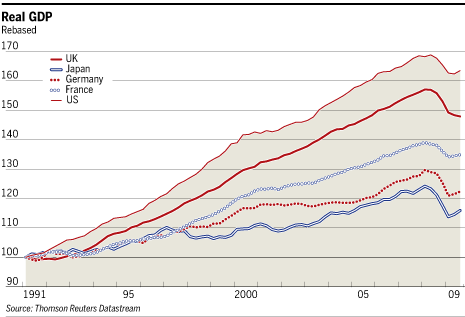
L'Europa, se riuscisse a superare i suoi problemi almeno in parte, potrebbe essere in una situazione molto migliore: il dividend yield è considerevolmente più alto, circa il 4%. Purtroppo il tasso di crescita reale del GDP è stato storicamente decisamente inferiore: nei 20 anni che separano il 1990 dal 2010 gli USA sono cresciuti a un tasso reale pari al 2,4% annuo mentre il Regno Unito ha avuto una crescita reale del 2%, la Germania dell'1% e la Francia appena dello 0,8%. Abbastanza per quasi cancellare l'extra-rendimento che viene dal dividend yield. D'altra parte i mercati europei vedono in questo momento dei multipli prezzo/utili decisamente bassi (tra 8 e 10) e un'espansione del multiplo del 50% su 10 anni (assestandosi così tra 12 e 15) aggiungerebbe un 2% annuo al rendimento atteso. In conclusione: con un po' di fortuna, se la crescita reale dell'economia sarà almeno pari all'1%, nel prossimo decennio l'Europa potrebbe mettere a segno un rendimento reale del 7% !!
Un po' di ottimismo viene anche dalla stima dei rendimenti attesi dei mercati degli analisti di GMO 
che per i prossimi sette anni prevedono un rendimento reale delle large cap americane intorno al 3%, poco inferiore al 7% nominale previsto da Bogle, ma si aspettano un rendimento reale annuo superiore al 7% dalle azioni a grande capitalizzazione dei mercati sviluppati e dei mercati emergenti.

martedì 11 gennaio 2011

Che la forza (relativa) sia con te: il poderoso effetto momento

L'Economist dedica due articoli all'effetto momento: nel primo si discute la schiacciante evidenza statistica a favore delle strategie di investimento che concentrano il portafoglio in quei titoli e asset che hanno avuto i rendimenti maggiori in un orizzonte di investimento di medio-lungo periodo (tipicamente dai 3 ai 12 mesi), mentre nel secondo, più breve, si discutono brevemente i problemi che l'effetto momento pone ai chi pone una fede eccessiva nell'efficienza e nella razionalità dei mercati.

I lettori di Alfa o Beta? sanno bene quanto efficace possa essere il momento come criterio di selezione di asset, visto che la classifica che pubblico settimanalmente si fonda proprio sulla loro forza (relativa), con risultati per niente disprezzabili. E non solo per l'asset allocation:

in 2010 European investors would have prospered by following a different rule. Anyone who bought the best-performing stocks of the previous year would have enjoyed returns more than 12 percentage points higher than someone who bought 2009’s worst performers.
This was not unusual. Since the 1980s academic studies have repeatedly shown that, on average, shares that have performed well in the recent past continue to do so for some time. Longer-term studies have confirmed that this “momentum” effect has been observable for much of the past century. Nor is the phenomenon confined to the stockmarket. Commodity prices and currencies are remarkably persistent, rising or falling for long periods.
The momentum effect drives a juggernaut through one of the tenets of finance theory, the efficient-market hypothesis. In its strongest form this states that past price movements should give no useful information about the future. Investors should have no logical reason to have preferred the winners of 2009 to the losers; both should be fairly priced already.
(...) the momentum effect is huge. Elroy Dimson, Paul Marsh and Mike Staunton of the London Business School (LBS) looked at the largest 100 stocks in the British market since 1900. They calculated the return from buying the 20 best performers over the past 12 months and then holding them, rebalancing the portfolio every month.
This produced an annual average of 10.3 percentage points more than a strategy of buying the previous 12 months’ worst performers. An investment of £1 in 1900 would have grown into £2.3m by the end of 2009; the same sum invested in the losers would have turned into just £49 (see chart 1). 
(...) A study by AQR Capital Management, a hedge fund, found that the American stocks with the best momentum outperformed those with the worst by more than ten percentage points a year between 1927 and 2010 (see chart 2).

L'effetto momento ha ormai più di un quarto di secolo di vita documentata, a partire dai primi studi accademici di Werner de Bondt e Richard Thaler  datati 1985.

Oltre i 12-18 mesi tuttavia il momento tende a perdere efficacia:

Just as trees do not grow to the sky, share prices do not rise for ever. The effect tends to work for the best performers over the past 12 months, but not for those that have shone for longer periods, say three or five years.
The value of value
That may be because of another anomaly, the value effect. Investors eventually get too pessimistic about struggling firms, and price their shares too cheaply. That turns them into bargains. Broadly, whereas momentum works over the short term, value is successful over longer periods. The result can be sharp reversals in markets—and nasty surprises for momentum traders. One such turning-point occurred in 2009. Investors who used a short-term momentum strategy, buying the winners of the previous six months, would have lost 46% in the British market and 53% in America, according to the LBS team. Similarly bad years were 1975, 2000 and 2003.
The momentum effect allows investors to get rich slowly. But many fund managers are impatient and thus use leverage (borrowed money) to enhance returns. Such an approach would lose so much money in bad years that clients might lose faith. “To exploit momentum, you need investors who understand the portfolio is going to be subject to a very high level of volatility,” says Mr Marsh of the LBS.


Lo studio di AQR al quale si fa riferimento nel testo lo trovate qui sotto.

Case for Momentum Investing by AQR (Summer 09)

In conclusione: che la forza (relativa) sia con voi...May the force be with you...

venerdì 31 dicembre 2010

Parole e numeri: l'ossessione di fine anno per le previsioni

Il New York Times ospita un dibattito sul bisogno e sui limiti delle previsioni. Tra i contributori vi segnalo Ray KurzweilRobert Shiller. Il primo fonda le sue previsioni su quella che chiama The law of accelerating returns, il cui esempio più celebre è la legge di Moore; su questa base così
conclude il suo articolo

A computer that fit inside a building when I was a student now fits in my pocket, and is a thousand times more powerful despite being a million times less expensive.
In another quarter century, that capability will fit inside a red blood cell and will again be a billion times more powerful per dollar. 

 Shiller invece si concentra sui limiti della prevsione in economia:
On economic predictions, statisticians and econometricians have some tools that can help forecast conditions, but they are rough. With "time series analysis," which uses data collected over time, one can see patterns, for example, of growth trends interrupted by recessions and recoveries.
But that method can't handle any revolutions, breakthroughs or fundamental change in the way data are generated. The failure to predict the current financial crisis could be considered one of these cases. Statisticians and econometricians can get the direction of the trend right but be off by a mile as to the level. 

La lettera settimanale di commento ai mercati su etfworld.it è interamente dedicata agli auguri di fine anno: ottimista sul 2011 per la borsa statunitense, a proposito dell'ondata di iperottimismo che sembra essere il sentimento prevalente dei commentatori in questi ultimi giorni (date un'occhiata a questo articolo sul WSJ, ai miei post qui, qui e qui e alla discussione sul forum di finanzaonline.com segnalatami nei commenti da un lettore) il redattore del commento (a cura di Kairos Partners SGR) si esprime così:

Dire in questo momento che l’economia globale andrà bene e le borse  saliranno è cantare in coro con tutti gli altri. In teoria dovrebbe essere
preoccupante, ma all’ampio consenso della teoria non corrispondono  portafogli sovrapesati in azioni. Il profilo medio è ancora difensivo e liquidità  e bond sono onnipresenti. Il posizionamento reale conta molto di più del  sentiment ed è questo che renderà possibile l’espansione dei multipli e il  rialzo azionario.
Che questo rialzo debba partire immediatamente in gennaio è un altro  discorso. Vista dalla Fed, la borsa è per il momento già salita abbastanza, quel tanto cioè che è servito ad alimentare una buona stagione di acquisti natalizi e di saldi di gennaio. Ora potrebbe essere più importante stabilizzare i Treasuries e non spaventare troppo chi vuole chiedere un mutuo per comprare casa. Poi ci sarà l’Europa con tutti i suoi problemi.In pratica ci si potrà attenere a qualche semplice regola. In un anno propizio per la borsa non si dovrà mai essere sottopesati di azioni e sovrapesati di bond, neanche per un giorno. Per sovrapesare le azioni e sottopesare i bond si potrà però aspettare, opportunisticamente, una
fase di correzione o di paura. Si può dunque iniziare l’anno stando nel gruppo, senza cercare subito la fuga, e aspettare un momento più favorevole.
Investire sulla borsa americana  potrà essere premiante anche in  termini di cambio. Finché l’Europa  non darà un segnale chiaro di volere  riprendere in mano energicamente la situazione (come fu in maggio con la  costituzione del fondo di salvataggio) l’euro sarà sotto pressione. Più avanti  nell’anno, quando la Germania si deciderà a fare qualcosa di più per i paesi in  difficoltà, l’euro potrà riprendersi. A medio termine, in ogni caso, non va  dimenticato che ogni giorno che passa l’Europa riduce i suoi squilibri, mentre  l’America vede crescere i suoi. Default o meno, nel 2015 tutta Eurolandia sarà ben al di sotto del 3 per cento di disavanzo e la Germania sarà addirittura in pareggio di bilancio. Dove sarà invece l’America, nessuno lo sa.


Nell'ultimo numero dell'Economist Buttonwood elenca le numerose fonti di preoccupazione per il 201, prima tra tutte la dipendenza delle banche e più in generale di tutto il settore finanziario e dell'economia dalle politiche espansive intraprese dalla Fed e dalla Banca Centrale Europea, che come effetto collaterale stanno gonfiando una bolla speculativa nei mercati emergenti. Alfa o Beta? condivide pienamente le conclusioni dell'articolo che vi riproduco qui sotto, soprattutto l'enfasi sul tempo scioccamente perduto da una politica troppo timida e non coordinata che non ha risolto nessuno dei problemi all'origine della crisi del 2008:

Whether all-out currency wars (in the form of trade protection) will emerge in 2011 is harder to tell. The aim of most developing countries is to prevent their currencies rising against the dollar at a faster pace than the Chinese yuan. Oddly enough, the European fiscal crisis eased some of the strains in late 2010: a weaker euro meant a stronger dollar.
But it is quite possible that the dollar could suffer another round of weakness in the coming year. After all, the currency has no yield support, a continuing trade deficit and the prospect of endless fiscal deficits. The sorry condition of municipal and state finances could yet be the trigger for a loss of confidence.
This list of problems is the reason why it is so hard for Buttonwood to join the bullish consensus for 2011. The authorities have kept the plates spinning by dint of an enormous effort and some unprecedented monetary measures. But the underlying problems have not been solved. And the law of gravity cannot be suspended for ever.

Tanti auguri a tutti i lettori per un sano, felice e prospero 2011! 

venerdì 24 dicembre 2010

Un po' di ottimismo natalizio: supertori alla riscossa! Ma attenti alla corrida...

Come ogni fine d'anno si sprecano le previsioni sull'anno che verrà.
Il sentimento prevalente nei mercati è ottimista, con una intensità che risulta piuttosto allarmante. Ne è un buon esempio Peter Eliades, un esperto di "cicli di mercato" (!??), che prevede un rialzo di quasi il 25% per l'indice S&P500 in meno di sei mesi...
...Prima che vi precipitaite a investire anche i risparmi della nonna vi invito però ad ascoltare anche la seconda parte dell'intervista in cui sulla base della valutazione dell'indice utilizzando i dividendi non esclude la possibilità di altri 10 anni di rendimenti negativi per i mercati azionari...


Alla lunga lista degli ottimisti per il 2011 si aggiunge anche Richard Bailey che così scrive sul Wall Street Journal: 

After a bumpy year, stocks could be the best place to make money in 2011. They were saved this year by a stellar fourth quarter. Resilience to the euro crisis and good economic and corporate news in key developed and emerging markets have helped both Europe's Stoxx 600 and the Standard & Poor's 500-stock index climb more than 11%. Those same forces should drive performance next year, too.
The case is simple: Stocks are attractive relative to other asset classes, with cash-rich corporate balance sheets, strong earnings, and global growth looking good.

Secondo Bailey, che invece di guardare i dividendi guarda agli utili
StockherdStock valuations, in contrast, look manageable. Earnings growth will slow as the cycle matures. But multiples could expand as equity risk premiums fall, assuming continued steady growth and low interest rates dispel investor fears about debt deflation. In the U.S., the S&P 500, at around 1250, trades at about 13 times 2011 earnings, below the long-term average. A move to 15 times by the end of 2011 could take the index to 1400, says Bank of America-Merrill Lynch. Similarly, the Stoxx 600, around 280, is trading at about 11.3 times, again below average, but could reach 320 by end-2011 at a multiple of 12 times, according to RBS.

Secondo Bailey le vendite sulle obbligazioni non devono far paura: 

An orderly rise in bond yields, as started late this year, isn't necessarily a threat: Goldman Sachs notes that equities typically rise 20% in the 12 months following a trough in bond yields.

Allacciate le cinture e cavalcate il toro? Pare di sì, soprattutto se il tradizionale know-how spagnolo su come si uccidono i tori non si applicherà ai mercati...

But volatility is likely. Politics and policy are big risks. The euro-zone crisis is manageable if restricted to Portugal, Ireland and Greece, which account for 6.3% of gross domestic product. But global risk appetite will suffer if it engulfs Spain, at which point 18% of the euro zone's economy will be being bailed out

martedì 19 ottobre 2010

Quanto renderanno le azioni nei prossimi 10 anni?

IL New York Times si interroga su quali siano le prospettive del mercato azionario U.S.A. per il prossimo decennio. Il decennio appena trascorso è stato molto negativo, alimentando le aspettative per una mean reversion dei rendimenti azionari nei prossimi dieci anni. Ma se invece di analizzare gli ultimi dieci anni si analizzano gli ultimi venti anni le prospettive sono meno chiare:

Sam Stovall, chief investment strategist at Standard & Poor’s, points out that over 20-year periods since 1919, the average annual price gain for stocks has been 6.8 percent. And even with the market’s losses from 2000 to this year, the S.& P. 500-stock index has still appreciated 7.8 percent a year, on average, in the most recent 20-year stretch. When you factor in dividends, the market has performed even better: up around 10 percent a year, on average.
“On a 20-year basis, we’re only now getting back to the mean,” Mr. Stovall said. 

L'effetto dello straordinario mercato toro degli anni Ottanta e Novanta si fa dunque sentire e alcuni analisti osservano come il decennio negativo appena trascorso sia - questo sì - un modo di riavvicinare i rendimenti azionari alle loro medie di lungo periodo, drogate dal ventennio 1980-2000. Scrive ancora il NYTimes:

In theory, stocks could revisit their long-term historical total return of around 10 percent a year, going back to 1926. But several market strategists and historians say domestic stocks will have a hard time producing such returns in the coming years.
For example, stock performance over the past century includes the time when the United States market was evolving from an emerging player in the global economy to the world’s economic superpower. Elroy Dimson, a finance professor at the London Business School, argues that because this early period of growth can’t be replicated, investors ought to brace for more modest returns.
At the same time, some market strategists worry that using more recent averages — for instance, the nearly 11 percent annualized total returns for stocks since 1980 or the 9 percent since 1990 — is also misleading.
That’s because those returns reflect a historic drop in interest rates and inflation, both of which served as major tail winds for stocks.

Il modo probabilmente più sensato di tenere conto dell'ambiente economico nel quale si muovo le azioni è di utilizzare la valutazione del mercato attraverso il rapporto prezzo/utili cyclically adjusted promosso da Robert Shiller, cioè calcolato utilizzando gli utili reali (deflazionati) degli ultimi 10 anni e mediando su di essi: in questo post potete vedere meglio come questo metodo di valutazione funzioni e permetta delle previsioni dei rendimenti azionari di lungo periodo (10-20 anni) ragionevolmente accurate. Cosa ci aspetta dunque da qui al 2010 o al 2020? Beh niente di eccezionale:

Despite the market’s recent troubles, its P/E ratio, based on this method, currently stands at 21. That’s significantly higher than the long-term average of 16 for domestic stocks. Until that changes, stocks are likely to be in store for below-average returns, Mr. Arnott argues. In fact, since 1900, whenever P/E ratios have ranged from 16 to 24, stocks have gained about 7 percent, annualized, on a nominal basis — or 4 percent after inflation — in the following 10-year stretch. 

Robert Arnott, analista finanziario tra i più importanti negli U.S.A. e fondatore di Research Affiliates, è un po' più prudente:  he thinks that stocks are likely to produce total returns of about 6 percent a year. He comes to that figure by taking the current 2 percent dividend yield for the S.& P. 500 and adding it to the long-term earnings growth rate of around 4 percent.

Arnott non è il solo a essere prudente: la previsione dei rendimenti fatta qualche giorno fa dagli analisti di GMO, la società di asset management fondata nel 1977 dai value investors Jeremy Grantham, Richard Mayo e  Eyk Van Otterloo non è più ottimista: ecco come vedono i rendimenti annualizzati reali dei diversi asset per i prossimi 7 anni. Per il calcolo dei rendimenti reali viene utilizzato un'ipotesi di inflazione di lungo termine pari al 2.5%, che dunque va sommato ai valori riportati qui sotto se volete avere una stima dei rendimenti nominali:

azioni U.S.A. (large caps) + 1.7%
azioni internazionali (large caps) + 3.5%
azioni dei mercati emergenti + 5.1%

Se non vi sembrano prospettive troppo eccitanti, specialmente se confrontate con il rendimento storico reale di lungo periodo delle azioni U.S.A., pari a circa il 6.5%, potete consolarvi con quelle degli investitori in obbligazioni, sempre secondo gli analisti di GMO

obbligazioni governative U.S.A. -0.4%
obbligazioni internazionali         -1.3%
obbligazioni paesi emergenti     +0.7%

mercoledì 11 agosto 2010

Deflazione e dividendi. Skype si quota in borsa.

Il Wall Street Journal è attratto dai dividendi pagati da molte società europee, in particolare nei settori delle telecomunicazioni, delle utilities e dell'energia. Il dividend yield delle azioni in Europa è circa il doppio di quello delle azioni che compongono l'indice S&P500. Se siete in cerca di protezione dalla deflazione prossima ventura potreste trovare le azioni ad alto dividendo attraenti, e cercare altre idee qui: Deflation--if it happens--could cripple global economies and world stock markets. But, there are some stocks that could offer a safe-haven move for investors, companies with plenty of cash, low debt, steady dividends and products that people will buy even in tough economic times. Sempre secondo un sondaggio del WSJ il rischio di deflazione negli U.S.A. è concreto: A Wall Street Journal survey found that by a two-to-one margin Wall Street economists see deflation as a bigger threat to the U.S. economy over the next three years than inflation.
“Deflation is dangerously close,” said David Resler of Nomura Securities, one of 53 economists surveyed by the Wall Street Journal. Among economists who answered the question, nearly two-thirds said that deflation poses the bigger risk to the economy over the next three years; the remainder said inflation is the bigger threat. That compares to an April survey, when the economists were split 50/50 over whether inflation or disinflation posed the bigger risk over the next year.
The survey, conducted earlier this week ahead of today’s meeting of Federal Reserve officials, found that half of the economists expect the Fed to keep its target for short-term interest rates unchanged at least until the middle of 2011. A month earlier, the survey found 70% of the respondents expected the Fed to begin raising rates before June 2011. The Fed has been holding its target for short-term interest rates close to zero since December 2008.
Nel video qui sotto un analista di Morningstar argomenta a favore di portafogli di azioni con alto dividend yield per difendersi dal rischio di un altro decennio perduto. Il punto di vista condivisibile è che  the advantage of having a 30-year Treasury bond or say a 10-year Treasury bond that's going to yield 3%, is that you know exactly what you are going to get, 10 years you are going to get the money back. But you don’t know is what that money will be worth. We don’t know how high inflation or for that matter how low inflation may be. There is still a lot of uncertainty.
If you are buying stocks and at least hypothetically, you are getting the claim on a real operating business that if the economy does move in a higher inflation, you should be able to benefit from that. So to me I would still prefer to own stocks, because of their longer term inflation threat, even if its 3, 4, 5 years out. I don’t want to line up with a 10- or a 30-year commitment to a fixed income instrument.


La decisione di ieri della banca centrale USA di reinvestire i proventi dal mercato dei mutui in obbligazioni del Tesoro a lunga scadenza viene commentata in questo articolo sul WSJ di oggi. La posizione ufficiale relativa al dibattito inflazione/deflazione è così riassunta nell'articolo:
The Fed statement noted that "measures of underlying inflation," already low, "have trended lower" lately and are "likely to be subdued for some time." Some Fed officials, as well as private economists, have been warning that the risk of deflation—broadly falling prices and wages across the economy—is rising. A Wall Street Journal survey of economists, mostly from Wall Street, found this week that, by a two-to-one margin, they see deflation as a greater risk over the next three years than inflation.
With interest rates as low as they can go, the Fed has few attractive options to resist deflation. The main one is to print money—electronically—to resume large-scale purchases of securities.
Qui potete leggere una sintesi delle reazioni di numerosi analisti ed economisti alla decisione di ieri della Fed.

Seguo da alcuni anni con simpatia l'evoluzione di Skype che iniziai ad usare per le telefonate VOIP quando partii per un viaggio di lavoro in Corea del Sud e Giappone nell'autunno del 2005. Non posso allora fare a meno di segnalarvi come Skype abbia annunciato l'intenzione di quotarsi in borsa: se volete un piccolo riassunto dei numeri di Skype potete dare un'occhiata qui. Attenzione al debito che al momento è circa uguale ai ricavi (non i profitti) di un anno.

domenica 4 luglio 2010

Una brutta settimana o l'inizio di una brutta estate? Aggiornamento al 2 luglio 2010

Non è stata una bella settimana per i mercati:  l'indice S&P500 ha perso il 5% (il 6.6% se calcolato in euro),
l'indice Stoxx600 il 4.5% e l'Eurostoxx il 4.2%; gli indici di materie prime hanno perso quasi il 5% (e quasi l'8% se calcolati in euro anzichè in dollari). L'indice Baltic Dry ha aggiunto altri 5 giorni alla sua serie negativa raggiungendo il record di 26 giorni consecutivi di discesa (alla faccia del random walk!): si è ormai quasi dimezzato dal massimo stagionale del 27 maggio scorso.
Spicca quindi il rimbalzo dell'euro che si è rivalutato dell'1.7%, in controtendenza con la buona correlazione con i rendimenti dei mercati azionari che aveva dominato gli ultimi mesi: potete leggere  il commento del Wall Street Journal qui. Sono in molti a mettere in relazione la debolezza del  dollaro con i segni preoccupanti di rallentamento dell'economia U.S.A e soprattutto con i pessimi dati sull'occupazione di venerdì scorso. Secondo il Wall Street Journal:
Some 14.6 million people now are out of work, and some economists predict the unemployment rate could rise again in coming months as others return to the work force in search of jobs.
"It's hard to overstate how deep the hole is," Jesse Rothstein, chief economist for the Labor Department, said in an interview earlier in the week. Many people, he added, "don't seem to be appreciating the gravity of the situation."
I toni di alcuni commenti non sono troppo neri ma confermano la fase di incertezza che probabilmente proseguirà per tutta l'estate: investors may want to consider the bigger picture before assuming a double-dip. Private-sector hiring in the second quarter averaged 119,000, compared with about 78,700 in the first quarter and negative 270,000 during the final three months of 2009.
The jobs report is still not clear enough to make up investors' ever-changing minds on whether the recovery has stalled. That sets up markets for a volatile summer.
Qui trovate altre tre idee per dormire male la notte questa estate, nel caso non basti il caldo...

Ecco l'aggiornamento al 2 luglio.

La digressione paliesca venerdì scorso...ha portato fortuna alla Selva, i miei figli non potevano chiedere di più! Guardate che bella carriera:

mercoledì 9 giugno 2010

Un'altra opinione (troppo ?) ottimista sulle azioni USA mentre il vecchio continente è da buttare?

Dal Wall Street Journal: Bob Doll, strategist per il mercato azionario USA a BlackRock, vede un futuro roseo per le azioni americane. La tesi fondamentale di Doll è che

(...) compared to the rest of the world the U.S. is in reasonably good shape. Our economic fundamentals are sound: Manufacturing levels are up and interest rates and inflation are low. The broader economy's recovery is also finally translating into meaningful employment improvements—recent employment reports show increases in average hourly earnings and hours worked—and I believe this trend will continue. 
The recovery that took root last summer with the help of government stimulus now seems to be evolving into a self-sustaining expansion. In the first quarter of 2010, nominal GDP reached an all-time high. Real GDP will reach a new high either late in the second quarter or early in the third.
Compared with historic trends, these developments are extraordinary. Following the Great Depression, the U.S. took 15 years to return to its previous GDP level. Japan's growth took nearly as long to recover following its "lost decade" of the 1990s. But in just a few quarters, our economy has taken monumental steps toward health.
Now consider Europe, grappling with significant sovereign debt and deflation, and an inflexible currency system straining its governments. In Japan, economic recovery is evident, but the pace is much slower. Deflation and a declining population remain real concerns, a strong yen has slowed exports, and the banking system is pressured.
(...)
What about emerging markets? The largest of the emerging economies (Brazil, Russia, India and China) have advanced their global GDP share to 15% from 7% since 1995. But their relative economic expansion has come at the expense of Europe and Japan—not the U.S. Fifteen years ago, the U.S. accounted for 25% of global GDP. Today? Still 25%.
(...)
Corporate profits could reach a new record high in this year's third quarter. Free cash flow for nonfinancial American companies is also exceptionally high—cash on the balance sheet is close to 11% of assets, a 60-year high. And high cash levels are already generating dividend increases, share buybacks, capital investments and M&A activity—all extremely shareholder friendly.
The importance of improving America's productivity growth can't be overstated. High productivity tends to lower unit labor costs and boost corporate profits.
According to Citigroup, U.S. unit labor costs are dropping at their fastest pace in 40 years. We last saw a similar surge in U.S. productivity in the late 1990s. Then, U.S. corporations were heavily investing in their own businesses, and foreign investors were increasing their U.S. allocations. This sparked a rise in the dollar. Improving productivity, a strengthening currency, and rising equity markets are linked. We saw that synchronization 15 years ago, and we are seeing it today.
(...) The bottom line is that the U.S. has generally performed better on the upside this year and held its ground better on the downside.
The relative strength of U.S. stocks is no accident. Since the credit crisis struck, we have taken quicker action and demonstrated greater innovation than our competitors.
Potential risks—trade complications, escalating credit contagion, overly aggressive financial regulation, and tax increases—clearly remain. But for the moment, our nation seems poised to remain a City Upon a Hill.

La percezione di un'Europa confusa e inconcludente è molto forte negli USA: eccovi altri due assaggi dal Wall Street Journal di oggi:
  •  il piano di salvataggio dell'eurozona non ha garanzie: Is the euro zone's €440 billion ($524 billion) new funding facility more than a very large mirror and an industrial quantity of smoke?It is hard to avoid the suspicion that if the special purpose vehicle (SPV) is truly needed, implying markets have refused to fund several euro-zone countries, it won't work as planned. One fear is over demand for the SPV's bonds.
    (...) Ultimately, the only surefire solution to a major funding crisis may be a common euro-zone bond backed by federal taxation. The SPV proposal is a step in that direction. Completing the journey requires a sacrifice of sovereignty few, if any, are willing to make. For now, austerity to avoid being forced to use the SPV seems the more likely outcome.
  • la nebbia della BCE:  So what do investors want? More information as to how much the central bank will spend on a controversial government-debt-purchase program, the widening chasm between the ECB and Germany's Bundesbank, and the ECB's views on the euro's steep slide.They aren't alone in thirsting for clarity. Financial-market fears have driven overnight deposits at the ECB to records, showing banks figure it is better to accept a paltry 0.25% interest rate than lend to other banks.

lunedì 15 marzo 2010

E gli ultimi saranno i primi...Investire nel litio? I heard it through the grapevine... I CDS e la legge di Groucho Marx

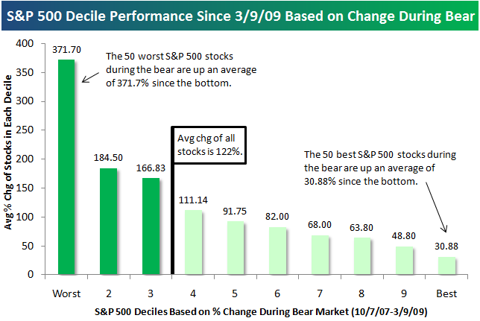
Dall'orso al toro: e gli ultimi saranno i primi...ecco quanto ha scoperto Bespoke


ed ecco una mia elaborazione relativa all'indice Stoxx 50, diviso in cinque quintili
secondo la performance tra il febbraio del 2008 e il febbraio del 2009, confrontata con quella nell'anno successivo (conclusosi a fine febbraio 2010): anche in
Europa gli ultimi sono diventati i primi!


Società Performance (28/2/2008-28/2/2009) Performance Media per quintile (28/2/2008-28/2/2009) Performance (28/2/2009-28/2/2010) Performance Media per quintile (28/2/2009-28/2/2010)
ROYAL BANK OF SCOTLAND GRP -92,80% -75,12% 65,48% 113,29%
ING GRP -83,52%
133,21%
BARCLAYS -79,90%
234,58%
UNICREDIT -79,32%
127,53%
DEUTSCHE BANK -72,02%
124,42%
ARCELORMITTAL -69,51%
81,04%
ANGLO AMERICAN -69,05%
138,76%
NOKIA -68,80%
31,58%
RIO TINTO -68,51%
126,10%
DAIMLER -67,72%
70,24%


AXA -67,36% -58,81% 106,24% 66,86%
GRP SOCIETE GENERALE -64,90%
70,81%
UBS -63,81%
33,91%
ASSICURAZIONI GENERALI -58,13%
39,77%
BCO BILBAO VIZCAYA ARGENTARIA -57,92%
64,94%
INTESA SANPAOLO -56,49%
33,39%
BNP PARIBAS -56,37%
110,34%
BCO SANTANDER -55,95%
94,88%
ALLIANZ -54,36%
58,12%
SIEMENS -52,79%
56,19%


PHILIPS ELECTRONICS -50,98% -42,15% 68,59% 51,26%
E.ON -50,70%
28,15%
BASF -47,70%
87,80%
IBERDROLA -45,83%
13,73%
ABB -45,37%
55,98%
CREDIT SUISSE GRP -44,38%
64,94%
HSBC -35,87%
68,09%
ROCHE HLDG P -35,09%
34,89%
GDF SUEZ -33,41%
8,99%
BHP BILLITON -32,15%
81,46%


ENI -30,80% -24,79% 4,48% 20,00%
ROYAL DUTCH SHELL A -26,66%
15,09%
UNILEVER NV -25,72%
44,92%
BAYER -25,11%
27,81%
TOTAL -25,03%
9,34%
DEUTSCHE TELEKOM -23,91%
-1,20%
TELEFONICA -23,54%
17,23%
NESTLE -23,24%
39,41%
VODAFONE GRP -23,05%
12,98%
DIAGEO -20,79%
29,91%


FRANCE TELECOM -20,06% -8,50% -3,28% 21,27%
SAP -19,28%
28,40%
BP -17,90%
29,10%
NOVARTIS -17,05%
40,00%
TESCO -16,80%
25,96%
SANOFI-AVENTIS -16,14%
31,30%
BRITISH AMERICAN TOBACCO -5,17%
24,07%
GLAXOSMITHKLINE -2,99%
13,56%
ERICSSON LM B 11,94%
-4,93%
ASTRAZENECA 18,49%
28,56%
DJ STOXX 50 -44,48%
39,53%
DJ STOXX 600 -45,78%
42,15%


Se davvero il futuro dell'auto è elettrico, e se non si trovano soluzioni migliori, il mercato delle batterie agli ioni di litio potrebbe esplodere, offrendo a investitori tempestivi e coraggiosi interessanti opportunità di profitto. Questa è in estrema sintesi, la tesi bullish di chi suggerisce di investire in litio. Ne parla il New York Times di qualche giorno fa che tuttavia osserva come:

By the standards of traditional gold and copper booms, the increase in interest in lithium is still muted among big mining companies. Supplies of lithium are plentiful for now, and the price of lithium chemicals actually declined at the end of last year because of the economic slowdown. The price for lithium carbonate, the basic lithium compound used in batteries, had been around $5,000 a ton for the last five years or so, and has leveled at about $4,000 since October.


Ho trovato divertente il post di Pablo Triana su Willmott
che vi propongo insieme alla canzone di Marvin Gaye alla quale si ispira


Heard through the media grapevine after 1997 Asian crisis and 1998 LTCM crisis (which almost destroyed the system):
"The answer is not to reject quantitative finance but to be honest about its limitations. Models have their places but they must be coupled with more subjective approaches to risk, such as stress tests and scenario-planning"
Heard through the media grapevine after 2008 credit crisis (which destroyed the system and almost caused a global depression):
"The answer is not to reject quantitative finance but to be honest about its limitations. Models have their places but they must be coupled with more subjective approaches to risk, such as stress tests and scenario-planning"
To be heard through the grapevine after 2015 sovereign debt CDO crisis (which would do away with the euro, result in the acquisition of Greece by private equity funds, and force President Palin to expulse California from the Union):
"The answer is not to reject quantitative finance but to be honest about its limitations. Models have their places but they must be coupled with more subjective approaches to risk, such as stress tests and scenario-planning"


E se al soul e al rhythm and blues preferite il tango vi consiglio la lettura dei due
articoli di Satyajit Das sulla regolamentazione dei derivati che potete trovare su 
eurointelligence qui e qui. Con tutta la confusione che stanno facendo i commentatori in questi giorni li troverete davvero chiari e utili per farsi un'opinione. Intanto un po' di ordine sulle cifre del fenomeno. 
Il valore totale nozionale del mercato dei derivati nel giugno del 2009 era di circa 605 trilioni di dollari, cioè 605*10^12 US$, pari a circa una decina di volte il GDP mondiale. 
Attenzione però: il valore nozionale è dato dal valore complessivo degli asset sottostanti i contratti derivati stipulati. E' dunque utile per avere un'idea della dimensione del fenomeno e serve per farsi un'idea dell'uso sistematico (e a volte parossistico) della leva finanziaria
Secondo Das: 
The size of the market is inconsistent with the thesis that derivatives are merely a vehicle for hedging and risk management.
Current regulatory proposals do not attempt to deal with the size of the derivatives markets. The current debate about "too big to fail" banks may indirectly affect the size issue. 
Oltre al problema dell'eccesso di leva - con i conseguenti rischi sistemici e di liquidità - un punto fondamentale da tenere presente è che molti prodotti sono troppo complessi e illiquidi per essere "prezzati" efficientemente: è chiaro in questo caso il vantaggio economico per chi li crea mentre la mancanza di trasparenza e di efficienza finisce con il danneggiare l'intero mercato.
La complessità di un derivato comporta anche numerosi problemi legati alla scelta e all'uso dei modelli impiegati per calcolarne il prezzo:
Model based valuations drive pricing of transactions and dealer hedging. They also are used to calculate the risk of the transactions and ultimately to derive the capital required to be held for regulatory and internal purposes.
The model-based valuations are also used to determine earnings and ultimately bonus payments for dealer staff. 
Non-professional dealers rarely have the required sophisticated pricing and valuation systems. They are dependent upon valuation date (predominantly) supplied by dealers or (less frequently) rely on pay-as-you-go pricing services.
Investors use the model-based prices to generate values for their fund units. Investors transact at these model-based prices when they invest or redeem investments
The accuracy and tractability of derivative valuation, especially for complex products, is questionable.


Nei contratti derivati ciascuna delle due parti si assume il rischio di credito dell'altra, ovvero il rischio che la controparte sia effettivamente in grado di mantenere fede agli obblighi contrattuali. Il rischio di controparte è al centro delle proposte di riforma finanziaria con la proposta della creazione di una central clearinghouse (CCP) e con un adeguamento dei requisiti di capitale richiesti alle controparti. Non è chiaro tuttavia come affrontare la regolamentazione senza creare altri rischi, sia di concentrazione che di liquidità: 
Current regulatory proposals do not address liquidity risks in derivative markets. Interestingly, the CCP may inadvertently increase liquidity risk as more participants may be subject to margining and unexpected demands on cash resources. The BIS has proposed an extensive regime of liquidity risk management controls that would, in part, cover some liquidity risks.


La questione della regolamentazione dei derivati è molto complessa, tecnica e di poca utilità se non si riesce a ottenere un coordinamento internazionale. Così Das chiude il suo secondo articolo: 


There will be a familiar threat. Lack of international agreement and regulatory uniformity makes compliance impractical. Banks and derivative activity will relocate with losses of jobs and taxes to the host country. Familiar arguments will be heard regarding the loss of competitive advantage, diminished financial innovation, slower capital formation and higher cost of capital. Each is a well-known step in the familiar "regulatory tango".The complexity of the issues means that ultimately no laws may be truly effective. As one famous law maker, Adlai Stevenson, observed "Laws are never as effective as habits."
Groucho Marx observed that "[government] is the art of looking for trouble, finding it, misdiagnosing it and then misapplying the wrong remedies." Legislators and regulators are likely to discover the truth of that proposition in their attempts to regulate the derivative market.