Non sono completamente convinto dalla tesi di questo analista del Motley Fool ma ho ugualmente trovato la lettura dell'articolo interessante. In molti hanno osservato come il dividend yield dei principali indici azionari (nel caso in questione il Dow Jones) sia superiore al rendimento delle obbligazioni governative decennali.
Benchè questa situazione fosse frequente in passato negli U.S.A. non si verificava da oltre mezzo secolo. Secondo alcuni però non si può giungere alla conclusione che le azioni siano a buon mercato, ma semplicemente che una bolla di straordinaria durata si sta lentamente sgonfiando, riportando le valutazioni più vicine a quelle in vigore nel XIX secolo e nella prima metà del XX secolo.
Le cose sono però un po' differenti se si tiene conto che in passato i dividendi erano il principale mezzo impiegato per condividere i profitti con gli azionisti. Ma le cose sono molto cambiate e negli ultimi decenni dividend payouts as a percentage of net income were falling. (...) From 1920-1950, the average S&P 500 company paid out 72% of net income in the form of dividends. From 1950-2010, that number dropped to 51%. From 1990-2007, the average was 45%. Over the past year, it's down to 33%. Today, some of the most profitable and fastest-growing companies (...) pay no dividends at all. The slow-growers (...) are where you find yield. That was unheard of 60 years ago.
More than anything, this explains why stocks consistently out-yielded bonds before 1950. Back then, stocks were essentially just high-yield bonds with variable-rate coupons. Today, companies tend to hoard net income to finance growth, acquisitions, and buybacks. It's inane to compare the two periods without adjusting for that paradigm shift.
L'idea dell'analista del Fool è di normalizzare il divendend yield fissando il payout: la cosa è naturalmente criticabile per varie ragioni, ma ugualmente vi presento le conclusioni dell'articolo:
What happens when you do? Well, if you model the past to assume that S&P companies have always paid out 33% of net income as dividends, like they do today, then prolonged periods of stocks out-yielding bonds become incredibly rare. There would have been only two such periods in modern history: from 1940-1944, and 1947-1955.
And what's neat about these two periods? They were both phenomenal times to buy stocks. In the 10 years after 1944, stocks surged 161%. In the 10 years following 1955, investors were rewarded with a 145% return -- and both figures don't include dividends.
History is pretty clear on this stuff: When stocks out-yield bonds, it's a great time to buy them. Some patience may be required, but the rewards for those patient few are invariably awesome. Today, with the average large-cap stock out-yielding Treasuries, there's little reason to think patient investors won't be rewarded like champions 10 years from now.
Ben Graham gets the last word: "The market price is frequently out of line with the true value. There is, however, an inherent tendency for these disparities to correct themselves."
Se l'analista del Fool vi convince, qui potete dare un'occhiata ad alcune caratteristiche delle 10 azioni dell'indice Dow Jones con il più alto dividend yield.
Visualizzazione post con etichetta dividendi. Mostra tutti i post
Visualizzazione post con etichetta dividendi. Mostra tutti i post
mercoledì 22 settembre 2010

mercoledì 11 agosto 2010
Deflazione e dividendi. Skype si quota in borsa.
Il Wall Street Journal è attratto dai dividendi pagati da molte società europee, in particolare nei settori delle telecomunicazioni, delle utilities e dell'energia. Il dividend yield delle azioni in Europa è circa il doppio di quello delle azioni che compongono l'indice S&P500. Se siete in cerca di protezione dalla deflazione prossima ventura potreste trovare le azioni ad alto dividendo attraenti, e cercare altre idee qui: Deflation--if it happens--could cripple global economies and world stock markets. But, there are some stocks that could offer a safe-haven move for investors, companies with plenty of cash, low debt, steady dividends and products that people will buy even in tough economic times. Sempre secondo un sondaggio del WSJ il rischio di deflazione negli U.S.A. è concreto: A Wall Street Journal survey found that by a two-to-one margin Wall Street economists see deflation as a bigger threat to the U.S. economy over the next three years than inflation.
“Deflation is dangerously close,” said David Resler of Nomura Securities, one of 53 economists surveyed by the Wall Street Journal. Among economists who answered the question, nearly two-thirds said that deflation poses the bigger risk to the economy over the next three years; the remainder said inflation is the bigger threat. That compares to an April survey, when the economists were split 50/50 over whether inflation or disinflation posed the bigger risk over the next year.
The survey, conducted earlier this week ahead of today’s meeting of Federal Reserve officials, found that half of the economists expect the Fed to keep its target for short-term interest rates unchanged at least until the middle of 2011. A month earlier, the survey found 70% of the respondents expected the Fed to begin raising rates before June 2011. The Fed has been holding its target for short-term interest rates close to zero since December 2008.
Nel video qui sotto un analista di Morningstar argomenta a favore di portafogli di azioni con alto dividend yield per difendersi dal rischio di un altro decennio perduto. Il punto di vista condivisibile è che the advantage of having a 30-year Treasury bond or say a 10-year Treasury bond that's going to yield 3%, is that you know exactly what you are going to get, 10 years you are going to get the money back. But you don’t know is what that money will be worth. We don’t know how high inflation or for that matter how low inflation may be. There is still a lot of uncertainty.
If you are buying stocks and at least hypothetically, you are getting the claim on a real operating business that if the economy does move in a higher inflation, you should be able to benefit from that. So to me I would still prefer to own stocks, because of their longer term inflation threat, even if its 3, 4, 5 years out. I don’t want to line up with a 10- or a 30-year commitment to a fixed income instrument.
 La decisione di ieri della banca centrale USA di reinvestire i proventi dal mercato dei mutui in obbligazioni del Tesoro a lunga scadenza viene commentata in questo articolo sul WSJ di oggi. La posizione ufficiale relativa al dibattito inflazione/deflazione è così riassunta nell'articolo:
The Fed statement noted that "measures of underlying inflation," already low, "have trended lower" lately and are "likely to be subdued for some time." Some Fed officials, as well as private economists, have been warning that the risk of deflation—broadly falling prices and wages across the economy—is rising. A Wall Street Journal survey of economists, mostly from Wall Street, found this week that, by a two-to-one margin, they see deflation as a greater risk over the next three years than inflation.
With interest rates as low as they can go, the Fed has few attractive options to resist deflation. The main one is to print money—electronically—to resume large-scale purchases of securities.
Qui potete leggere una sintesi delle reazioni di numerosi analisti ed economisti alla decisione di ieri della Fed.
Seguo da alcuni anni con simpatia l'evoluzione di Skype che iniziai ad usare per le telefonate VOIP quando partii per un viaggio di lavoro in Corea del Sud e Giappone nell'autunno del 2005. Non posso allora fare a meno di segnalarvi come Skype abbia annunciato l'intenzione di quotarsi in borsa: se volete un piccolo riassunto dei numeri di Skype potete dare un'occhiata qui. Attenzione al debito che al momento è circa uguale ai ricavi (non i profitti) di un anno.
“Deflation is dangerously close,” said David Resler of Nomura Securities, one of 53 economists surveyed by the Wall Street Journal. Among economists who answered the question, nearly two-thirds said that deflation poses the bigger risk to the economy over the next three years; the remainder said inflation is the bigger threat. That compares to an April survey, when the economists were split 50/50 over whether inflation or disinflation posed the bigger risk over the next year.
The survey, conducted earlier this week ahead of today’s meeting of Federal Reserve officials, found that half of the economists expect the Fed to keep its target for short-term interest rates unchanged at least until the middle of 2011. A month earlier, the survey found 70% of the respondents expected the Fed to begin raising rates before June 2011. The Fed has been holding its target for short-term interest rates close to zero since December 2008.
Nel video qui sotto un analista di Morningstar argomenta a favore di portafogli di azioni con alto dividend yield per difendersi dal rischio di un altro decennio perduto. Il punto di vista condivisibile è che the advantage of having a 30-year Treasury bond or say a 10-year Treasury bond that's going to yield 3%, is that you know exactly what you are going to get, 10 years you are going to get the money back. But you don’t know is what that money will be worth. We don’t know how high inflation or for that matter how low inflation may be. There is still a lot of uncertainty.
If you are buying stocks and at least hypothetically, you are getting the claim on a real operating business that if the economy does move in a higher inflation, you should be able to benefit from that. So to me I would still prefer to own stocks, because of their longer term inflation threat, even if its 3, 4, 5 years out. I don’t want to line up with a 10- or a 30-year commitment to a fixed income instrument.
 La decisione di ieri della banca centrale USA di reinvestire i proventi dal mercato dei mutui in obbligazioni del Tesoro a lunga scadenza viene commentata in questo articolo sul WSJ di oggi. La posizione ufficiale relativa al dibattito inflazione/deflazione è così riassunta nell'articolo:
 The Fed statement noted that "measures of underlying inflation," already low, "have trended lower" lately and are "likely to be subdued for some time." Some Fed officials, as well as private economists, have been warning that the risk of deflation—broadly falling prices and wages across the economy—is rising. A Wall Street Journal survey of economists, mostly from Wall Street, found this week that, by a two-to-one margin, they see deflation as a greater risk over the next three years than inflation.
With interest rates as low as they can go, the Fed has few attractive options to resist deflation. The main one is to print money—electronically—to resume large-scale purchases of securities.
Qui potete leggere una sintesi delle reazioni di numerosi analisti ed economisti alla decisione di ieri della Fed.
Seguo da alcuni anni con simpatia l'evoluzione di Skype che iniziai ad usare per le telefonate VOIP quando partii per un viaggio di lavoro in Corea del Sud e Giappone nell'autunno del 2005. Non posso allora fare a meno di segnalarvi come Skype abbia annunciato l'intenzione di quotarsi in borsa: se volete un piccolo riassunto dei numeri di Skype potete dare un'occhiata qui. Attenzione al debito che al momento è circa uguale ai ricavi (non i profitti) di un anno.
domenica 28 marzo 2010
Day trading? La ricchezza delle regioni italiane. Prevedere i rendimenti futuri dell'indice S&P500
Questo post di TraderMark su SeekingAlpha mi ha fatto sorridere e ve lo segnalo.
Volete dedicarvi al day trading? A me non pare una buona idea, comunque troverete forse interessante questo articolo del New York Times
Oggi e domani ci sono le elezioni regionali: trovate qui e qui e tabelle comparative
Volete dedicarvi al day trading? A me non pare una buona idea, comunque troverete forse interessante questo articolo del New York Times
Oggi e domani ci sono le elezioni regionali: trovate qui e qui e tabelle comparative
dei principali indicatori economici delle regioni in cui è in corso la votazione, raccolte da www.lavoce.info. Secondo gli autori (Fonte: Istat, Eurostat - elaborazione dati Davide Baldi e Ludovico Poggi) raffrontando le regioni tra loro e rispetto alle medie nazionali, i lettori possono farsi un'idea dello sviluppo economico e civile raggiunto nei diversi territori, nonché della qualità dei loro governi.
 Infine vi segnalo un interessante post di Prieur du Plessis su Seekingalpha:
 il tentativo è di prevedere i rendimenti azionari su una scala di tempo lunga (10 anni) utilizzando la metodologia di Robert Shiller che impiega come predittore il rapporto prezzo/utili dell'indice S&P500 mediato sugli ultimi 10 anni di profitti reali (deflazionati) aggregati dell'indice. L'evidenza a supporto di questa relazione è robusta come mostra la prima delle figure qui accanto. Invece del rapporto prezzo su utili si possono utilizzare i dividendi (anch'essi deflazionati e mediati su dieci anni) giungendo a conclusioni molto simili.
Le conclusioni non sono troppo incorraggianti:
I dati necessari per riprodurre le analisi riportate sopra sono messi a disposizione da Robert Shiller sulla sua pagina web. Conoscete qualche link dove poter trovare gli stessi dati (magari solo per 30-40 anni anziche per 140 anni) per altri indici azionari? Per esempio per azioni inglesi o giapponesi?
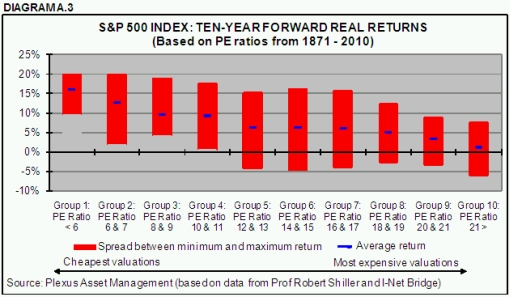
 il tentativo è di prevedere i rendimenti azionari su una scala di tempo lunga (10 anni) utilizzando la metodologia di Robert Shiller che impiega come predittore il rapporto prezzo/utili dell'indice S&P500 mediato sugli ultimi 10 anni di profitti reali (deflazionati) aggregati dell'indice. L'evidenza a supporto di questa relazione è robusta come mostra la prima delle figure qui accanto. Invece del rapporto prezzo su utili si possono utilizzare i dividendi (anch'essi deflazionati e mediati su dieci anni) giungendo a conclusioni molto simili.
Le conclusioni non sono troppo incorraggianti:
Based on the above research findings, with the S&P 500 Index’s current ten-year normalized PE of 20.3 and ten-year normalized dividend yield of 2.1%, investors should be aware of the fact that the market is by historical standards expensive. As far as the market in general is concerned, this argues for unexciting long-term returns, possibly a “muddle-through” trading range for quite a number of years to come.
Although the research results offer no guidance as to calling market tops and bottoms, they do indicate that it would not be consistent with the findings to bank on above-average returns based on the current ten-year normalized valuation levels. As a matter of fact, there is a distinct possibility of some negative returns off current price levels.
I dati necessari per riprodurre le analisi riportate sopra sono messi a disposizione da Robert Shiller sulla sua pagina web. Conoscete qualche link dove poter trovare gli stessi dati (magari solo per 30-40 anni anziche per 140 anni) per altri indici azionari? Per esempio per azioni inglesi o giapponesi?
Iscriviti a:
Post (Atom)

 Post
Post


