- per fortuna che c'è la Germania! L'analisi del New York Times dei dati economici pubblicati venerdì scorso: Statistics released Fridaybuttress Germany’s view that it had the formula right all along. The government on Friday announced quarter-on-quarter economic growth of 2.2 percent, Germany’s best performance since reunification 20 years ago — and equivalent to a nearly 9 percent annual rate if growth were that robust all year. The strong growth figures will also bolster the conviction here that German workers and companies in recent years made the short-term sacrifices necessary for long-term success that Germany’s European partners did not. And it will reinforce the widespread conviction among policy makers that they handled the financial crisis and the painful recession that followed it far better than the United States, which, they never hesitate to remind, brought the world into this crisis. A vast expansion of a program paying to keep workers employed, rather than dealing with them once they lost their jobs, was the most direct step taken in the heat of the crisis. But the roots of Germany’s export-driven success reach back to the painful restructuring under the previous government of Chancellor Gerhard Schröder. By paring unemployment benefits, easing rules for hiring and firing, and management and labor’s working together to keep a lid on wages, Germany ensured that it could again export its way to growth with competitive, nimble companies producing the cars and machine tools the world’s economies — emerging and developed alike — demanded.
- Il mercato degli ETF negli USA è talmente sviluppato che le società si fanno causa per poter scegliere i ticker più attraenti. Perchè? E' semplice: siccome siamo tutti agenti razionali....Researchers have shown that U.S. stocks with catchy tickers like BID or LUV perform better than those with unpronounceable trading symbols—at least in the short run. In Italia potremmo suggerire ETF con tickers come FIGO.MI oppure SGHEI.MI....Per andare corti che ne pensate di SOLA.MI?
- L'indebolimento dell'euro negli ultimi due-tre giorni viene imputato da alcuni alla faticosa asta dei BTP con scadenze lunghe. Ma la domanda più interessante è un'altra: l'austerità dei bilanci degli stati dell'eurozona ucciderà la ripresa economica? Secondo il Wall Street Journal A fiscal multiplier above one implies a dollar of government spending generates more than a dollar of GDP; a fiscal multiplier below one implies that it is less effective. A working paper from the European Central Bank estimates that fiscal policy in the euro area has become less effective over time, with an increase in government spending of 1% of GDP generating a response of just over 0.5%, down from over 1% in the late 1980s. A fiscal multiplier below one doesn't automatically mean government-stimulus efforts are wasted, since the boost to GDP could still be important to counteract falling private demand. But the ECB paper argues that the decline in effectiveness is due to rising government debt; as private-sector concerns about the sustainability of public finances increase, individuals and companies rein back spending amid fears of future tax increases. With the euro-zone bond-market crisis, this process may have reached its logical conclusion. Not all government spending is equal: Multipliers on capital investment are reckoned to be much higher, for instance, than on government consumption or tax cuts. But if the fiscal multiplier overall is less than one, then tightening shouldn't be self-defeating: Public finances can improve even with weak growth.Better public finances should also reduce the risk premiums investors demand on government bonds; this, in turn, should make risk assets more attractive, providing companies with better financing conditions. Indeed, sometimes fiscal tightening appears to drive economic growth. A study of OECD countries from 1970 to 2007 by Alberto Alesina and Silvia Ardagna shows that of 107 episodes in which severe fiscal tightening took place, growth accelerated significantly relative to the G-7 average on 26 occasions, or 24%. Remarkably, this is slightly higher than the 22% of periods when very loose fiscal policy drove better growth. A vital question is whether private-sector confidence is boosted by austerity. If it is, and growth picks up, then the really important debate about tightening still lies ahead—and in the realm of monetary, rather than fiscal, policy. Io sono un matematico di professione, non un esperto di statistica. Tuttavia trarre delle conclusioni da un confronto del 24% rispetto al 22% su un campione di 107 casi mi sembra un esempio eccellente di cattivo giornalismo.
- E' sempre più dura trovare un lavoro per gli immigrati, ovunque nei paesi sviluppati, tranne che in Ungheria.
domenica 15 agosto 2010
Letture domenicali.
Un po' di letture per una domenica oziosa in spiaggia (o in attesa della prova generale, per i senesi in città):
Etichette:
debito sovrano,
Germania
sabato 14 agosto 2010
Aggiornamento al 13 agosto 2010.
L'onda verde della scorsa settimana si è già ritirata e già quattro asset hanno invertito la tendenza di medio periodo. Resistono solamente le obbligazioni governative europee di lunghissimo periodo e i fondi immobiliari. Se cercate due ETF armonizzati che replichino questi indici potete dare un'occhiata alla pagina dedicata agli ETF di borsa italiana .
Tra gli ETF che investono in obbligazioni governative di lungo periodo trovate X25E.MI, IBGL.MI e EM15.MI mentre per il mercato immobiliare dei paesi sviluppati c'è IWDP.MI.
Dall'inizio del 2010 il rendimento di un portafoglio ribilanciato settimanalmente e investito nei primi 2 asset della tabella è stato di circa il 12%. Nell'intero 2009 la stessa strategia aveva reso il 12.2%. Ecco l'aggiornamento al 13 agosto 2010.
Tra gli ETF che investono in obbligazioni governative di lungo periodo trovate X25E.MI, IBGL.MI e EM15.MI mentre per il mercato immobiliare dei paesi sviluppati c'è IWDP.MI.
Dall'inizio del 2010 il rendimento di un portafoglio ribilanciato settimanalmente e investito nei primi 2 asset della tabella è stato di circa il 12%. Nell'intero 2009 la stessa strategia aveva reso il 12.2%. Ecco l'aggiornamento al 13 agosto 2010.
| Asset | valuta | tendenza | pendenza | tendenza | pendenza | valore | |
| medio | medio | breve | breve | ||||
| periodo | periodo | periodo | periodo | ||||
| 1. | Euro Government Bond 30yr | EUR | POS | POS | POS | POS | 197.26 |
| 2. | Ftse EPRA/NAREIT Global | USD | POS | POS | POS | NEU | 1832.55 |
| 3. | CRB | USD | NEG | NEG | POS | NEU | 268.79 |
| 4. | Eur/USD | N/A | NEG | POS | NEG | NEG | 1.2813 |
| 5. | EuroStoxx | EUR | NEG | POS | POS | NEU | 257.90 |
| 6. | S&P500 | USD | NEG | NEG | NEG | NEU | 1079.25 |
Etichette:
asset allocation
Sempre più populista? I valori di un banchiere di successo e i tagli di stipendio dei lavoratori. La crisi economica vista dal segretario del Tesoro U.S:A.
A spasso sul web sono incappato in questa vignetta del superideologico Doonesbury: mi ha ricordato qualche mia conoscenza e mi ha fatto sorridere, così ve la ripropongo qui accanto.
Poco dopo leggendo il New York Times ho trovato questo articolo relativo ai tagli di stipendio che i dipendenti pubblici (ma non solo) stanno subendo negli U.S.A. Secondo il NYTimes
“We’ve seen pay freezes before in the public sector, but pay cuts are something very new to that sector,” said Gary N. Chaison, an industrial relations professor at Clark University. Outsize pension costs and balanced budget requirements are squeezing many states as tax revenue has come up short.
It is impossible to say how many employers have cut workers’ pay, because the government does not keep such statistics. Economists say a modest but growing number of employers have ordered wage cuts, especially in the public sector. In a 2010 survey by the National League of Cities, 51 percent of the cities that responded said they had either cut or frozen salaries of city employees, 22 percent said they had revised union contracts to reduce some pay and benefits, and 19 percent said they had instituted furloughs.
Some businesses are also cutting workers’ pay, often to help stay afloat or to eliminate their losses, although a few have seized on the slack labor market and workers’ weak bargaining power to cut pay and thereby increase their profits and competitiveness.
Economists note that wages continued to increase in 2008 after the recession began, even adjusted for inflation. But those wages have been flat for the last 18 months, according to the Bureau of Labor Statistics.(...)
While most of the pay cuts seem to hit unionized workers, David Lewin, a professor of management at the University of California, Los Angeles, who has written extensively on employee compensation, says some cuts are also quietly taking place among nonunion employers.
Reed Smith, a firm with 1,500 lawyers, has cut salaries for first-year associates in major cities to $130,000 from $160,000. Warren Hospital, a nonunionized facility in Phillipsburg, N.J., ordered pay cuts of 2 to 4 percent because lower Medicaid reimbursements had squeezed the hospital’s finances.
Fast-rising pension and health costs are making benefit costs grow more rapidly than wages, some employers say, and cutting wages is often easier than other ways to pare labor costs. But some workers say these cuts are unfair at a time when corporate profits and employee productivity have risen strongly.
Sometimes unions and their workers cooperate with management on pay cuts, hoping to recoup some wage increases when conditions improve. In Madawaska, Me., 460 unionized workers accepted an 8.5 percent wage cut in May to help keep their paper mill in business.
“Workers, of course, do not like to have their pay cut, but I think that workers’ major concern now is, ‘Do I have a job?’ ” Professor Lewin said. “If the unemployment rate were lower, we’d see a lot more resentment toward pay cuts.”
La situazione dei disoccupati U.S.A. è peggiorata sensibilmente negli ultimi due anni: la percentuale dei senzalavoro in attesa di occupazione da oltre un anno è schizzata da un fisiologico (e invidiabile) 10% pre-crisi ad oltre il 30%. Anche altri indicatori sono decisamente sconfortanti, primo fra tutti la percentuale degli occupati sulla popolazione totale, scesa dal 65% al 59%.
Qualche giorno fa il New York Times ha pubblicato un breve Op-Ed del ministro del Tesoro americano Timothy Geithner dedicato alle prospettive dell'economia statunitense. Secondo Geithner ci sono segnali incoraggianti di ripresa....mah...la difesa è d'ufficio e scontata e soprattutto necessaria viste le midterm elections incombenti. La riproduco ugualmente qui visto che la fonte è indiscutibilmente la seconda massima autorità USA in materia (dopo il governatore della Fed):
Poco dopo leggendo il New York Times ho trovato questo articolo relativo ai tagli di stipendio che i dipendenti pubblici (ma non solo) stanno subendo negli U.S.A. Secondo il NYTimes
“We’ve seen pay freezes before in the public sector, but pay cuts are something very new to that sector,” said Gary N. Chaison, an industrial relations professor at Clark University. Outsize pension costs and balanced budget requirements are squeezing many states as tax revenue has come up short.
It is impossible to say how many employers have cut workers’ pay, because the government does not keep such statistics. Economists say a modest but growing number of employers have ordered wage cuts, especially in the public sector. In a 2010 survey by the National League of Cities, 51 percent of the cities that responded said they had either cut or frozen salaries of city employees, 22 percent said they had revised union contracts to reduce some pay and benefits, and 19 percent said they had instituted furloughs.
Some businesses are also cutting workers’ pay, often to help stay afloat or to eliminate their losses, although a few have seized on the slack labor market and workers’ weak bargaining power to cut pay and thereby increase their profits and competitiveness.
Economists note that wages continued to increase in 2008 after the recession began, even adjusted for inflation. But those wages have been flat for the last 18 months, according to the Bureau of Labor Statistics.(...)
While most of the pay cuts seem to hit unionized workers, David Lewin, a professor of management at the University of California, Los Angeles, who has written extensively on employee compensation, says some cuts are also quietly taking place among nonunion employers.
Reed Smith, a firm with 1,500 lawyers, has cut salaries for first-year associates in major cities to $130,000 from $160,000. Warren Hospital, a nonunionized facility in Phillipsburg, N.J., ordered pay cuts of 2 to 4 percent because lower Medicaid reimbursements had squeezed the hospital’s finances.
Fast-rising pension and health costs are making benefit costs grow more rapidly than wages, some employers say, and cutting wages is often easier than other ways to pare labor costs. But some workers say these cuts are unfair at a time when corporate profits and employee productivity have risen strongly.
Sometimes unions and their workers cooperate with management on pay cuts, hoping to recoup some wage increases when conditions improve. In Madawaska, Me., 460 unionized workers accepted an 8.5 percent wage cut in May to help keep their paper mill in business.
“Workers, of course, do not like to have their pay cut, but I think that workers’ major concern now is, ‘Do I have a job?’ ” Professor Lewin said. “If the unemployment rate were lower, we’d see a lot more resentment toward pay cuts.”
La situazione dei disoccupati U.S.A. è peggiorata sensibilmente negli ultimi due anni: la percentuale dei senzalavoro in attesa di occupazione da oltre un anno è schizzata da un fisiologico (e invidiabile) 10% pre-crisi ad oltre il 30%. Anche altri indicatori sono decisamente sconfortanti, primo fra tutti la percentuale degli occupati sulla popolazione totale, scesa dal 65% al 59%.
Qualche giorno fa il New York Times ha pubblicato un breve Op-Ed del ministro del Tesoro americano Timothy Geithner dedicato alle prospettive dell'economia statunitense. Secondo Geithner ci sono segnali incoraggianti di ripresa....mah...la difesa è d'ufficio e scontata e soprattutto necessaria viste le midterm elections incombenti. La riproduco ugualmente qui visto che la fonte è indiscutibilmente la seconda massima autorità USA in materia (dopo il governatore della Fed):
While the economy has a long way to go before reaching its full potential, last week’s data on economic growth show that large parts of the private sector continue to strengthen. Business investment and consumption — the two keys to private demand — are getting stronger, better than last year and better than last quarter. Uncertainty is still inhibiting investment, but business capital spending increased at a solid annual rate of about 17 percent.
Together, private consumption and fixed investment contributed about 3.25 percent to growth. Even the surge in imports, which lowered the rate of increase of G.D.P., actually reflects healthy and growing American demand.
As the economists Ken Rogoff and Carmen Reinhart have written, recoveries that follow financial crises are typically a hard climb. That is reality. The process of repair means economic growth will come slower than we would like. But despite these challenges, there is good news to report:
• Exports are booming because American companies are very competitive and lead the world in many high-tech industries.
• Private job growth has returned — not as fast as we would like, but at an earlier stage of this recovery than in the last two recoveries. Manufacturing has generated 136,000 new jobs in the past six months.
• Businesses have repaired their balance sheets and are now in a strong financial position to reinvest and grow.
• American families are saving more, paying down their debt and borrowing more responsibly. This has been a necessary adjustment because the borrow-and-spend path we were on wasn’t sustainable.
• The auto industry is coming back, and the Big Three — Chrysler, Ford and General Motors — are now leaner, generating profits despite lower annual sales.
• Major banks, forced by the stress tests to raise capital and open their books, are stronger and more competitive. Now, as businesses expand again, our banks are better positioned to finance growth.
• The government’s investment in banks has already earned more than $20 billion in profits for taxpayers, and the TARP program will be out of business earlier than expected — and costing nearly a quarter of a trillion dollars less than projected last year.
We all understand and appreciate that these signs of strength in parts of the economy are cold comfort to those Americans still looking for work and to those industries, like construction, hit hardest by the crisis. But these economic measures, nonetheless, do represent an encouraging turnaround from the frightening future we faced just 18 months ago.
The new data show that this recession was even deeper than previously estimated. The plunge in economic activity started an entire year before President Obama took office and was accelerating at the end of 2008, when G.D.P. fell at an annual rate of roughly 7 percent.
Panicked by the collapse in demand and financing and fearing a prolonged slump, the private sector cut payrolls and investment savagely. The rate of job loss worsened with time: by early last year, 750,000 jobs vanished every month. The economic collapse drove tax revenue down, pushing the annual deficit up to $1.3 trillion by last January.
The economic rescue package that President Obama put in place was essential to turning the economy around. The combined effect of government actions taken over the past two years — the stimulus package, the stress tests and recapitalization of the banks, the restructuring of the American car industry and the many steps taken by the Federal Reserve — were extremely effective in stopping the freefall and restarting the economy.
According to a report released last week by Alan Blinder and Mark Zandi, advisers to President Bill Clinton and Senator John McCain, respectively, the combined actions since the fall of 2007 of the Federal Reserve, the White House and Congress helped save 8.5 million jobs and increased gross domestic product by 6.5 percent relative to what would have happened had we done nothing. The study showed that government action delivered a powerful bang for the buck, and that the bank rescue on its own will turn a profit for taxpayers.
We have a long way to go to address the fiscal trauma and damage across the country, and we will need to monitor the ups and downs in the economy month by month. The share of workers who have been unemployed for six months or more is at its highest level since 1948, when the data was first recorded, and we must do more to ensure that they have the skills they need to re-enter the 21st-century economy. Small businesses are still battling a tough climate. State and local governments are still hurting.
There are urgent tasks to be undertaken to reinforce the recovery, and Congress should move now to help small business, to assist states in keeping teachers in the classroom, to increase investments in public infrastructure, to promote clean energy and to increase exports. And while making smart, targeted investments in our future, we must also cut the deficit over the next few years and make sure that America once again lives within its means.
These are considerable challenges, but we are in a much stronger position to face them today than when President Obama took office. By taking aggressive action to fix the financial system, reduce growth in health care costs and improve education, we have put the American economy on a firmer foundation for future growth.
And as the president said last week, no one should bet against the American worker, American business and American ingenuity.
We suffered a terrible blow, but we are coming back.
Etichette:
banche,
disoccupazione U.S.A.
venerdì 13 agosto 2010
Tre letture consigliate dall'Economist e un video su come evitare un nuovo flash crash
Vi segnalo tre approfondimenti interessanti sull'Economist appena uscito: il primo sul dollaro e le sue prospettive di medio termine. Il secondo è dedicato all'economia mondiale e ai rischi di una ricaduta in recessione. Secondo l'Economist Concern about America’s stumbling recovery has been rising, just as anxieties about the euro area’s economy have faded. The dollar is the weakling among rich-world currencies (see article). But Americans should take a little heart: it is too soon to despair about their economy. And Europeans should show a little caution: it is too soon to be sure that theirs is firmly back on its feet. (...)both Europe and America seem to be suffering from delusions—of strength and weakness respectively. In Europe it is far too early to celebrate recovery on at least two counts. First, Germany apart, the euro area remains weak. Spain, whose economy is barely growing and where the jobless rate is 20%, would love to have America’s problems. Second, Germany relies on exports, not spending at home: the home market is one of the few places where sales of Mercedes cars have fallen this year. So its economic fortunes remain closely tied to the rest of the world—including one of its biggest markets, America.
How real are the risks of a double dip in the United States? The recovery has lost momentum in part because shops and warehouses are fuller, so that the initial boost to demand from restocking is fading. The housing bust still casts a shadow. Households must save to work off excess debts. Firms fearful of weak consumer spending are cautious about investing. Bank credit is scarce. All this stands in the way of a full-blooded recovery. But a slide into a second recession would require firms to cut back again on stocks, capital spending and jobs. The cash buffer corporate America has built up in case of harder times makes a fresh shock of that kind unlikely.(...)
Anxiety about deflation remains justified: any sign of it would require much bolder measures from the central bank. However, for the moment the Fed has sent the right signal: concern but not panic. Apart from anything else, it is not clear that yet more monetary stimulus would have created many new jobs. The relatively high level of job vacancies in America seems consistent with far lower unemployment. Some firms have complained that the available workers do not have the skills that they want. Unemployment, sadly, may thus have deep roots, with more people this time remaining out of work for longer. It will be a hard slog. But on the current evidence don’t expect America’s recovery to grind to a halt.
Se volete approfondire l'analisi delle prospettive di medio-lungo termine dell'economia tedesca e più in generale delle economie del nord Europa vi raccomando la lettura di questo articolo di GaveKal dal quale ho tratto il grafico che ho riprodotto qui accanto e che vi consiglio di leggere. Le conclusioni sono un po' diverse da quelle su cui si basa l'editorialista dell'Economst nelle sue considerazioni.
Infine vi segnalo questo articolo dedicato al trading ad alta frequenza, nel quale si scopre che il tempo di esecuzione di un ordine al Nasdaq (177 microsecondi!) è 100 volte più breve di quello necessario a Singapore e 20 volte più breve di quello necessario a Londra. Mentre sul mercato U.S.A. crescono le perplessità sull'opportunità di questa incredibile accelerazione dei mercati high-speed traders are getting a warm welcome in emerging markets. When BM&FBovespa, Brazil’s main exchange, offered firms “co-location” slots to place their trading machines in the exchange’s data centre in February (giving them an additional edge on speed), they quickly sold out. The exchange plans to double the number of slots to meet demand. On Singapore’s exchange, the share of derivatives trades accounted for by HFT has risen from 10% to 30% in two years. (...)
For the traders themselves, expansion abroad makes sense. HFT uses automated strategies to capitalise on inefficient pricing of financial instruments at blinding speed. As markets in America and Europe have become more competitive—HFT now makes up over 60% of equity trades in America and nearly 50% of British transactions—bid-ask spreads have narrowed and arbitrage opportunities exist for ever-briefer periods. In newer markets traders can use simpler algorithms for higher yields.
Il trading ad alta frequenza è uno dei principali imputati del flash crash del 6 maggio scorso, un argomento che abbiamo affrontato più volte in questo blog. Nel video che vi propongo qui sotto il Chief Investment Officer di Vanguard, Gus Sauter, illustra alcune contromisure che potrebbero essere adottate per rafforzare i market circuit breakers e prevenire il ripetersi di un crash. Uno degli argomenti affrontati è proprio la rischiosità dei market orders (gli ordini al meglio), le considerazioni di Sauter mi sembrano largamente condivisibili: I think a lot of investors don't really realize the risks of market orders. You think that a stock is selling at a certain price level, so you'll say, "Well, I am happy with that. I'll go ahead and sell it at the market or buy it at the market," and then it turns out that the liquidity really isn't there and by the time you end up buying it with your market order you've pushed the stock dramatically or the floor gets pulled out from under you and on May 6th the limit orders just weren't there. You enter a market ordering, you end up selling it to $0.01 a share. I don't think many investors realize that that risk was really there. For that reason I do like the concept of requiring everything to be a limit order. Now we would point out that you can in effect place an order that would function like a market order even by using a limit order. If you really, really want to buy a stock, let's say, you could offer to buy it or bid for it at $1,000. Well, you're going to buy it at whatever it's being offered at and which would be a reasonable price, but you're really assuring that you'll be able to buy it. So, the advantage of requiring all orders to be limit as opposed to market is that investors can still place the market order or something that functions like a market order, but they are also placing an intentional limit as opposed to one by default that could be $1,000 without realizing that it's a $1,000 on the buy side.
How real are the risks of a double dip in the United States? The recovery has lost momentum in part because shops and warehouses are fuller, so that the initial boost to demand from restocking is fading. The housing bust still casts a shadow. Households must save to work off excess debts. Firms fearful of weak consumer spending are cautious about investing. Bank credit is scarce. All this stands in the way of a full-blooded recovery. But a slide into a second recession would require firms to cut back again on stocks, capital spending and jobs. The cash buffer corporate America has built up in case of harder times makes a fresh shock of that kind unlikely.(...)
Anxiety about deflation remains justified: any sign of it would require much bolder measures from the central bank. However, for the moment the Fed has sent the right signal: concern but not panic. Apart from anything else, it is not clear that yet more monetary stimulus would have created many new jobs. The relatively high level of job vacancies in America seems consistent with far lower unemployment. Some firms have complained that the available workers do not have the skills that they want. Unemployment, sadly, may thus have deep roots, with more people this time remaining out of work for longer. It will be a hard slog. But on the current evidence don’t expect America’s recovery to grind to a halt.
Infine vi segnalo questo articolo dedicato al trading ad alta frequenza, nel quale si scopre che il tempo di esecuzione di un ordine al Nasdaq (177 microsecondi!) è 100 volte più breve di quello necessario a Singapore e 20 volte più breve di quello necessario a Londra. Mentre sul mercato U.S.A. crescono le perplessità sull'opportunità di questa incredibile accelerazione dei mercati high-speed traders are getting a warm welcome in emerging markets. When BM&FBovespa, Brazil’s main exchange, offered firms “co-location” slots to place their trading machines in the exchange’s data centre in February (giving them an additional edge on speed), they quickly sold out. The exchange plans to double the number of slots to meet demand. On Singapore’s exchange, the share of derivatives trades accounted for by HFT has risen from 10% to 30% in two years. (...)
For the traders themselves, expansion abroad makes sense. HFT uses automated strategies to capitalise on inefficient pricing of financial instruments at blinding speed. As markets in America and Europe have become more competitive—HFT now makes up over 60% of equity trades in America and nearly 50% of British transactions—bid-ask spreads have narrowed and arbitrage opportunities exist for ever-briefer periods. In newer markets traders can use simpler algorithms for higher yields.
Il trading ad alta frequenza è uno dei principali imputati del flash crash del 6 maggio scorso, un argomento che abbiamo affrontato più volte in questo blog. Nel video che vi propongo qui sotto il Chief Investment Officer di Vanguard, Gus Sauter, illustra alcune contromisure che potrebbero essere adottate per rafforzare i market circuit breakers e prevenire il ripetersi di un crash. Uno degli argomenti affrontati è proprio la rischiosità dei market orders (gli ordini al meglio), le considerazioni di Sauter mi sembrano largamente condivisibili: I think a lot of investors don't really realize the risks of market orders. You think that a stock is selling at a certain price level, so you'll say, "Well, I am happy with that. I'll go ahead and sell it at the market or buy it at the market," and then it turns out that the liquidity really isn't there and by the time you end up buying it with your market order you've pushed the stock dramatically or the floor gets pulled out from under you and on May 6th the limit orders just weren't there. You enter a market ordering, you end up selling it to $0.01 a share. I don't think many investors realize that that risk was really there. For that reason I do like the concept of requiring everything to be a limit order. Now we would point out that you can in effect place an order that would function like a market order even by using a limit order. If you really, really want to buy a stock, let's say, you could offer to buy it or bid for it at $1,000. Well, you're going to buy it at whatever it's being offered at and which would be a reasonable price, but you're really assuring that you'll be able to buy it. So, the advantage of requiring all orders to be limit as opposed to market is that investors can still place the market order or something that functions like a market order, but they are also placing an intentional limit as opposed to one by default that could be $1,000 without realizing that it's a $1,000 on the buy side.
giovedì 12 agosto 2010
Le preoccupazioni di Nouriel Roubini
Una video intervista a Roubini dal sito dell'Economist: secondo Roubini la riforma finanziaria U.S.A. è too little too late, le crisi finanziarie non sono cigni neri ma possono essere anticipate, la crescita dell'economia U.S.A. dovrebbe assestarsi intorno all'1.5%, circa la metà del potenziale, ma il rischio di una nuova recessione nelle economie avanzate è concreto. I problemi fondamentali della zona Euro sono ancora tutti lì e il bailout è servito solo a guadagnare tempo. Gli stress tests? A fudge
Etichette:
Nouriel Roubini
mercoledì 11 agosto 2010
Deflazione e dividendi. Skype si quota in borsa.
Il Wall Street Journal è attratto dai dividendi pagati da molte società europee, in particolare nei settori delle telecomunicazioni, delle utilities e dell'energia. Il dividend yield delle azioni in Europa è circa il doppio di quello delle azioni che compongono l'indice S&P500. Se siete in cerca di protezione dalla deflazione prossima ventura potreste trovare le azioni ad alto dividendo attraenti, e cercare altre idee qui: Deflation--if it happens--could cripple global economies and world stock markets. But, there are some stocks that could offer a safe-haven move for investors, companies with plenty of cash, low debt, steady dividends and products that people will buy even in tough economic times. Sempre secondo un sondaggio del WSJ il rischio di deflazione negli U.S.A. è concreto: A Wall Street Journal survey found that by a two-to-one margin Wall Street economists see deflation as a bigger threat to the U.S. economy over the next three years than inflation.
“Deflation is dangerously close,” said David Resler of Nomura Securities, one of 53 economists surveyed by the Wall Street Journal. Among economists who answered the question, nearly two-thirds said that deflation poses the bigger risk to the economy over the next three years; the remainder said inflation is the bigger threat. That compares to an April survey, when the economists were split 50/50 over whether inflation or disinflation posed the bigger risk over the next year.
The survey, conducted earlier this week ahead of today’s meeting of Federal Reserve officials, found that half of the economists expect the Fed to keep its target for short-term interest rates unchanged at least until the middle of 2011. A month earlier, the survey found 70% of the respondents expected the Fed to begin raising rates before June 2011. The Fed has been holding its target for short-term interest rates close to zero since December 2008.
Nel video qui sotto un analista di Morningstar argomenta a favore di portafogli di azioni con alto dividend yield per difendersi dal rischio di un altro decennio perduto. Il punto di vista condivisibile è che the advantage of having a 30-year Treasury bond or say a 10-year Treasury bond that's going to yield 3%, is that you know exactly what you are going to get, 10 years you are going to get the money back. But you don’t know is what that money will be worth. We don’t know how high inflation or for that matter how low inflation may be. There is still a lot of uncertainty.
If you are buying stocks and at least hypothetically, you are getting the claim on a real operating business that if the economy does move in a higher inflation, you should be able to benefit from that. So to me I would still prefer to own stocks, because of their longer term inflation threat, even if its 3, 4, 5 years out. I don’t want to line up with a 10- or a 30-year commitment to a fixed income instrument.
La decisione di ieri della banca centrale USA di reinvestire i proventi dal mercato dei mutui in obbligazioni del Tesoro a lunga scadenza viene commentata in questo articolo sul WSJ di oggi. La posizione ufficiale relativa al dibattito inflazione/deflazione è così riassunta nell'articolo:
The Fed statement noted that "measures of underlying inflation," already low, "have trended lower" lately and are "likely to be subdued for some time." Some Fed officials, as well as private economists, have been warning that the risk of deflation—broadly falling prices and wages across the economy—is rising. A Wall Street Journal survey of economists, mostly from Wall Street, found this week that, by a two-to-one margin, they see deflation as a greater risk over the next three years than inflation.
With interest rates as low as they can go, the Fed has few attractive options to resist deflation. The main one is to print money—electronically—to resume large-scale purchases of securities.
Qui potete leggere una sintesi delle reazioni di numerosi analisti ed economisti alla decisione di ieri della Fed.
Seguo da alcuni anni con simpatia l'evoluzione di Skype che iniziai ad usare per le telefonate VOIP quando partii per un viaggio di lavoro in Corea del Sud e Giappone nell'autunno del 2005. Non posso allora fare a meno di segnalarvi come Skype abbia annunciato l'intenzione di quotarsi in borsa: se volete un piccolo riassunto dei numeri di Skype potete dare un'occhiata qui. Attenzione al debito che al momento è circa uguale ai ricavi (non i profitti) di un anno.
“Deflation is dangerously close,” said David Resler of Nomura Securities, one of 53 economists surveyed by the Wall Street Journal. Among economists who answered the question, nearly two-thirds said that deflation poses the bigger risk to the economy over the next three years; the remainder said inflation is the bigger threat. That compares to an April survey, when the economists were split 50/50 over whether inflation or disinflation posed the bigger risk over the next year.
The survey, conducted earlier this week ahead of today’s meeting of Federal Reserve officials, found that half of the economists expect the Fed to keep its target for short-term interest rates unchanged at least until the middle of 2011. A month earlier, the survey found 70% of the respondents expected the Fed to begin raising rates before June 2011. The Fed has been holding its target for short-term interest rates close to zero since December 2008.
Nel video qui sotto un analista di Morningstar argomenta a favore di portafogli di azioni con alto dividend yield per difendersi dal rischio di un altro decennio perduto. Il punto di vista condivisibile è che the advantage of having a 30-year Treasury bond or say a 10-year Treasury bond that's going to yield 3%, is that you know exactly what you are going to get, 10 years you are going to get the money back. But you don’t know is what that money will be worth. We don’t know how high inflation or for that matter how low inflation may be. There is still a lot of uncertainty.
If you are buying stocks and at least hypothetically, you are getting the claim on a real operating business that if the economy does move in a higher inflation, you should be able to benefit from that. So to me I would still prefer to own stocks, because of their longer term inflation threat, even if its 3, 4, 5 years out. I don’t want to line up with a 10- or a 30-year commitment to a fixed income instrument.
The Fed statement noted that "measures of underlying inflation," already low, "have trended lower" lately and are "likely to be subdued for some time." Some Fed officials, as well as private economists, have been warning that the risk of deflation—broadly falling prices and wages across the economy—is rising. A Wall Street Journal survey of economists, mostly from Wall Street, found this week that, by a two-to-one margin, they see deflation as a greater risk over the next three years than inflation.
With interest rates as low as they can go, the Fed has few attractive options to resist deflation. The main one is to print money—electronically—to resume large-scale purchases of securities.
Qui potete leggere una sintesi delle reazioni di numerosi analisti ed economisti alla decisione di ieri della Fed.
Seguo da alcuni anni con simpatia l'evoluzione di Skype che iniziai ad usare per le telefonate VOIP quando partii per un viaggio di lavoro in Corea del Sud e Giappone nell'autunno del 2005. Non posso allora fare a meno di segnalarvi come Skype abbia annunciato l'intenzione di quotarsi in borsa: se volete un piccolo riassunto dei numeri di Skype potete dare un'occhiata qui. Attenzione al debito che al momento è circa uguale ai ricavi (non i profitti) di un anno.
Etichette:
deflazione,
dividendi,
mercato azionario Europa,
mercato azionario USA
martedì 10 agosto 2010
...compra obbliggazioni!
Dal Wall Street Journal: Fed officials said they would reinvest the proceeds from expiring mortgage-backed securities into longer-term U.S. Treasurys. The officials said the "pace of the economic recovery is likely to be more modest in the near term than had been anticipated."
La borsa rimbalza mentre il dollaro perde lo 0.5% in pochi secondi.
Che farà la Fed oggi?
La decisione sui tassi e sulla ripresa (o meno) del Quantitative Easing sarà resa nota a momenti. Intanto c'è chi auspica che i tassi siano alzati...
Lo stesso analista forse se lo augura anche perchè ha previsto e prevede che il Dow Jones perda il 20% assestandosi intorno a quota 8500: state a sentire
Etichette:
Fed,
mercato azionario USA
L'inesorabile discesa dei tassi. Krugman e il Times all'attacco.
Quanto possono ancora scendere i rendimenti delle obbligazioni governative USA? Secondo il New York Times
Rates keep falling, and Wall Street increasingly seems convinced that they will stay low for years. But it isn’t the Federal Reserve that is cutting them — it is the bond market. The weak-kneed economy has investors piling into United States Treasury securities, driving prices up and yields down.
(...) rates are unlikely to turn higher soon, economists say. In fact, they could fall even further. While the Fed cannot lower its official federal funds rate much more — that rate has been stuck at 0.25 percent all year — it can ease credit in other ways. On Wall Street, a consensus is forming that the Fed might take less conventional steps, like buying more Treasury securities, to push market rates lower still.
(...) William H. Gross, a managing director at Pimco, the giant bond fund manager, said the jobs report strengthened his argument that the economy and the job market would remain weak for the next few years. He calls his unhappy situation “the new normal” for the American economy. “Currently, financial markets have accepted this thesis, the best evidence of which is the two-year Treasury yield at 0.50 percent,” Mr. Gross said in an e-mail. “If investors expected the Fed to raise rates at any time in the next two years, the yield would be much higher.”
Like Mr. McCarthy, Mr. Gross expects the federal policy makers to consider other steps, besides lowering rates directly, to try to revive growth. The Fed, for its part, will probably keep the fed funds rate at 0.25 percent for two to three years, he said.
Alla debolezza dell'economia U.S.A. il NYTimes dedica anche un editoriale che invoca a chiare lettere azioni di sostegno per l'occupazione
The economic news — on growth, consumers, housing and manufacturing — was bad enough before the jobs report for July, released last Friday. The report leaves no doubt that a slowdown is well under way. The odds of renewed recession remain uncomfortably high.
And yet, the response from Washington has been inadequate, at best, with Democratic initiatives too timid and Republicans bent on obstruction. When legislation does emerge from the gridlock, it is invariably a disappointment in the face of a dissolving recovery.(...)
With unemployment persistently high, the economy is losing whatever momentum it had after last year’s stimulus. Recovery, such as it is, appears to be a repeat of the lopsided growth of the Bush years, with corporate profits rebounding and jobs and incomes lagging. Back then, policy makers advised patience, saying that with time, economic gains would distribute themselves more evenly. We know how that ended.
There is no one way to foster job growth. There are many ways, and they should all be deployed. Maybe after Congress gets back from vacation.
Sempre dal NYTimes di ieri Paul Krugman attacca senza mezze misure l'inerzia del governo e i fautori di una politica di bilancio rigorosa:
The lights are going out all over America — literally. Colorado Springs has made headlines with its desperate attempt to save money by turning off a third of its streetlights, but similar things are either happening or being contemplated across the nation, from Philadelphia to Fresno.
Rates keep falling, and Wall Street increasingly seems convinced that they will stay low for years. But it isn’t the Federal Reserve that is cutting them — it is the bond market. The weak-kneed economy has investors piling into United States Treasury securities, driving prices up and yields down.
(...) rates are unlikely to turn higher soon, economists say. In fact, they could fall even further. While the Fed cannot lower its official federal funds rate much more — that rate has been stuck at 0.25 percent all year — it can ease credit in other ways. On Wall Street, a consensus is forming that the Fed might take less conventional steps, like buying more Treasury securities, to push market rates lower still.
(...) William H. Gross, a managing director at Pimco, the giant bond fund manager, said the jobs report strengthened his argument that the economy and the job market would remain weak for the next few years. He calls his unhappy situation “the new normal” for the American economy. “Currently, financial markets have accepted this thesis, the best evidence of which is the two-year Treasury yield at 0.50 percent,” Mr. Gross said in an e-mail. “If investors expected the Fed to raise rates at any time in the next two years, the yield would be much higher.”
Like Mr. McCarthy, Mr. Gross expects the federal policy makers to consider other steps, besides lowering rates directly, to try to revive growth. The Fed, for its part, will probably keep the fed funds rate at 0.25 percent for two to three years, he said.
Alla debolezza dell'economia U.S.A. il NYTimes dedica anche un editoriale che invoca a chiare lettere azioni di sostegno per l'occupazione
The economic news — on growth, consumers, housing and manufacturing — was bad enough before the jobs report for July, released last Friday. The report leaves no doubt that a slowdown is well under way. The odds of renewed recession remain uncomfortably high.
And yet, the response from Washington has been inadequate, at best, with Democratic initiatives too timid and Republicans bent on obstruction. When legislation does emerge from the gridlock, it is invariably a disappointment in the face of a dissolving recovery.(...)
With unemployment persistently high, the economy is losing whatever momentum it had after last year’s stimulus. Recovery, such as it is, appears to be a repeat of the lopsided growth of the Bush years, with corporate profits rebounding and jobs and incomes lagging. Back then, policy makers advised patience, saying that with time, economic gains would distribute themselves more evenly. We know how that ended.
There is no one way to foster job growth. There are many ways, and they should all be deployed. Maybe after Congress gets back from vacation.
Sempre dal NYTimes di ieri Paul Krugman attacca senza mezze misure l'inerzia del governo e i fautori di una politica di bilancio rigorosa:
The lights are going out all over America — literally. Colorado Springs has made headlines with its desperate attempt to save money by turning off a third of its streetlights, but similar things are either happening or being contemplated across the nation, from Philadelphia to Fresno.
Meanwhile, a country that once amazed the world with its visionary investments in transportation, from the Erie Canal to the Interstate Highway System, is now in the process of unpaving itself: in a number of states, local governments are breaking up roads they can no longer afford to maintain, and returning them to gravel.
And a nation that once prized education — that was among the first to provide basic schooling to all its children — is now cutting back. Teachers are being laid off; programs are being canceled; in Hawaii, the school year itself is being drastically shortened. And all signs point to even more cuts ahead.
We’re told that we have no choice, that basic government functions — essential services that have been provided for generations — are no longer affordable. (...) We must place priority on reducing the deficit, say Republicans and “centrist” Democrats. And then, virtually in the next breath, they declare that we must preserve tax cuts for the very affluent, at a budget cost of $700 billion over the next decade.
In effect, a large part of our political class is showing its priorities: given the choice between asking the richest 2 percent or so of Americans to go back to paying the tax rates they paid during the Clinton-era boom, or allowing the nation’s foundations to crumble — literally in the case of roads, figuratively in the case of education — they’re choosing the latter.
It’s a disastrous choice in both the short run and the long run.
And a nation that once prized education — that was among the first to provide basic schooling to all its children — is now cutting back. Teachers are being laid off; programs are being canceled; in Hawaii, the school year itself is being drastically shortened. And all signs point to even more cuts ahead.
We’re told that we have no choice, that basic government functions — essential services that have been provided for generations — are no longer affordable. (...) We must place priority on reducing the deficit, say Republicans and “centrist” Democrats. And then, virtually in the next breath, they declare that we must preserve tax cuts for the very affluent, at a budget cost of $700 billion over the next decade.
In effect, a large part of our political class is showing its priorities: given the choice between asking the richest 2 percent or so of Americans to go back to paying the tax rates they paid during the Clinton-era boom, or allowing the nation’s foundations to crumble — literally in the case of roads, figuratively in the case of education — they’re choosing the latter.
It’s a disastrous choice in both the short run and the long run.
Etichette:
azioni e obbligazioni,
disoccupazione U.S.A.,
Krugman
domenica 8 agosto 2010
Aggiornamento al 6 agosto 2010.
Il sole d'agosto ha rinverdito le speranze degli investitori: era dall'11 dicembre 2009 che non si avevano
tutti e 6 gli asset che seguiamo settimanalmente con una tendenza di medio periodo positiva. Il primo a indebolirsi fu l'euro, con una discesa da 1.47 al 1.33 di oggi, con un picco negativo di 1.19 un paio di mesi fa. Dall'inizio del 2010 il rendimento di un portafoglio ribilanciato settimanalmente e investito nei primi 2 asset della tabella è stato di circa l'11.6%. Niente male per un inizio anno così pieno di incertezze e di turbolenza.
Ecco l'aggiornamento al 6 agosto 2010.
tutti e 6 gli asset che seguiamo settimanalmente con una tendenza di medio periodo positiva. Il primo a indebolirsi fu l'euro, con una discesa da 1.47 al 1.33 di oggi, con un picco negativo di 1.19 un paio di mesi fa. Dall'inizio del 2010 il rendimento di un portafoglio ribilanciato settimanalmente e investito nei primi 2 asset della tabella è stato di circa l'11.6%. Niente male per un inizio anno così pieno di incertezze e di turbolenza.
Ecco l'aggiornamento al 6 agosto 2010.
| |||||||||||||||||||||||||||||||||||||||||||||||||||||||||||||||||||||||||||||||
Etichette:
asset allocation
sabato 7 agosto 2010
Ancora sulle obbligazioni.
Vecchio di quasi un anno e mezzo ma ancora attuale nelle sue conclusioni vi propongo un commento al mercato obbligazionario scritto da James Montier un anno e mezzo fa. I rendimenti dei Treasury Bonds decennali sono saliti dal minimo del 2% del gennaio 2009 a poco meno del 3% ma non mi sembra che questo cambi sostanzialmente i termini della questione, come già discutevamo qui.
SocGen Mind Matters Jan 6 209
Etichette:
azioni e obbligazioni,
Valutazione
venerdì 6 agosto 2010
Goldman vs. Morgan ovvero deflazione vs. (un po' di) inflazione.
Chi avrà ragione nel duello tra questi due pesi massimi dell'analisi economica? Scrive il NYTimes:
Mr. Hatzius (di Goldman Sachs) is arguably Wall Street’s most prominent pessimist. He warns that the American economy is poised for a sharp slowdown in the second half of the year. That would send unemployment higher again and raise the risk of deflation. A rare occurrence, deflation can have a devastating effect on a struggling economy as prices and wages fall. He says he may be compelled to downgrade his already anemic growth predictions for the economy.
For months, Mr. Berner (di Morgan Stanley) has been sticking to a more optimistic forecast, despite growing evidence in favor of Mr. Hatzius’s view. Last week, Mr. Berner was caught by surprise when the federal government reported that the economy grew at a 2..4 percent pace in the second quarter, well below the 3.8 percent he had forecast a month before. Mr. Hatzius came closer to hitting the mark, having projected a 2 percent growth rate. (...) On Wall Street, both men were among a very small group that accurately predicted the recent recession. Mr. Berner’s long résumé includes stints at the Federal Reserve in Washington and Mellon Bank in Pittsburgh. “I’ve seen plenty of ups and downs,” said Mr. Berner, 64, sitting in a corner office overlooking the Manhattan skyline at Morgan Stanley’s Midtown headquarters.
Showing not even a hint of doubt, Mr. Hatzius said, “The prospect of substantial inflation seems very remote, but the prospect for deflation is far from remote. A double dip is certainly possible but not likely.”
Mr. Berner does not expect substantial inflation, but he is predicting inflation will run 1 to 2 percent annually rather than the near-zero level Mr. Hatzius sees by the end of next year.
“There is still a one in 10 chance of deflation,” Mr. Berner calculates. “But we already have been much more aggressive and proactive in dealing with the problem than Japan was,” he said, referring to the Federal Reserve’s decision to quickly cut rates and aggressively buy government securities.
Secondo l'ex-governatore della Fed Alan Greenspan l'economia USA ha subito una battuta d'arresto nel corso di una modesta ripresa, creando un clima percepito come una "quasi-recessione". Il timore di una double-dip recession potrebbe diventare realtà se i prezzi delle abitazioni riprendessero la discesa.
In questo articolo del Wall Street Journal potete leggere come molti tra i più importanti investitori americani stiano riposizionando i loro portafogli preparandosi alla deflazione prossima ventura. Certamente l'economia U.S.A. fatica a riprendersi dopo la grande recessione del 2007-2008: i grafici qui accanto (tratti dal Wall Street Journal) aiutano a comprendere l'entità della recessione e la debolezza della ripresa confrontando l'andamento dell'occupazione e del prodotto interno lordo con le tre recessioni precedenti. Per quanto riguarda il balletto inflazione/deflazione un po'di aiuto inatteso potrebbe venire dai prodotti agricoli: il breakfast index dell'Economist (caffè, succo d'arancia e farina) ha subito un'aumento del 25% dall'inizio di giugno. Sempre secondo l'Economist The purchasing-managers index in the euro area, used to measure manufacturing activity, rose to 56.7 in July, up from 55.6 the previous month. The improvement was almost exclusively led by Germany and Italy. French activity growth was at its slowest in ten months, highlighting the asymmetry of the recovery within the 16-nation common-currency area.Consumer spending and incomes in America were unexpectedly stagnant in June. Spending was flat, after a 0.1% rise in May, while personal income remained unchanged, having risen continuously since September.
Yields on American Treasury bonds reached record lows, amid concern that the country’s economic recovery was losing momentum. The dollar reached a three-month low against the euro and a 15-year low against the yen, though it stopped falling after news of private-sector jobs growth.
Etichette:
deflazione,
inflazione,
USA
giovedì 5 agosto 2010
50 anni di economia e di mercati visti da Warren Buffett
Si è fatto un gran parlare del possibile successore di Warren Buffett nella gestione del portafoglio azionario da 100 miliardi di dollari di Berkshire Hathaway. Se volete approfondire la conoscenza di questo leggendario investitore il modo migliore è probabilmente immergersi nella lettura delle lettere agli azionisti di Berkshire, nelle quali Buffett analizza l'andamento dei mercati e dell'economia nell'anno appena trascorso e soprattutto spiega le sue decisioni di gestione di portafoglio e di investimento: qui sotto trovate la collezione completa dal 1977 al 2008
The Warren Buffett Letters
Se volete andare ancora più indietro nel tempo potete leggere anche le lettere che Buffett ha scritto dal 1957 al 1970 quando la struttura del suo fondo di investimento era differente e molto più simile a quella di un hedge fund.
Complete Buffett Partnership Letters-1957-70
The Warren Buffett Letters
Se volete andare ancora più indietro nel tempo potete leggere anche le lettere che Buffett ha scritto dal 1957 al 1970 quando la struttura del suo fondo di investimento era differente e molto più simile a quella di un hedge fund.
Complete Buffett Partnership Letters-1957-70
Etichette:
mercato azionario USA,
value investing,
Warren Buffett
mercoledì 4 agosto 2010
I rischi dell'austerità e degli investimenti obbligazionari.
James Montier ha fatto un ottimo lavoro nel riassumere le (buone) ragioni addotte dai critici della politica dell'austerità di bilancio in questo fase della ripresa (se di ripresa si può parlare...) economica. Vi consiglio di leggere le sue argomentazioni che vi ho riportato qui sotto: le troverete molto interessanti.
Peraltro condivido largamente l'opinione di Montier sulle prospettive di medio-lungo periodo delle obbligazioni: In accordance with our 7-year forecasts, we generally think that bonds are a lousy investment – although possibly not as a speculation. Ben Graham said, “An investment operation is one which, upon thorough analysis promises safety of principal and a satisfactory return. Operations
not meeting these requirements are speculative.” Judged from a long-term perspective in which inflation must be a concern, bonds look exceptionally unattractive.
However, if deflationary pressure builds as a result of theAusterians, then bonds could well be a good speculation.
How does a long-term value manager like GMO deal with this conundrum?
Generally, we simply can’t bring ourselves to own bonds at the yields on offer in most markets today.
However, that doesn’t mean we are ignoring the short-term risks. So whilst we are generally
inclined to be short nominal duration across portfolios (as suggested by the 7-year forecasts),
we have been adding nominal duration. How can one add nominal duration when bonds are overpriced?
Doesn’t this imply that we are betraying our value investing credentials?
Thankfully, no. There are a couple of bond markets that are still essentially at fair value
(based on our measures): Australia and New Zealand both offer government bonds that look to be fairly priced. Are we happy about buying fair-priced bonds? Of course not. We are happy only when we buy cheap assets. However, these fair-priced bonds provide us with some useful insurance, without
which our portfolios would be exposed to intensifying short-term deflation pressure. If deflation does arise, most likely we will be on the look-out for longer-term insurance against inflation. Ultimately, I suspect that is where we will end up. (And remember, the time to purchase insurance is when no else wants it as it’s likely to be cheap.)
GMO - James Montier - Is Austerity the Road to Ruin
Peraltro condivido largamente l'opinione di Montier sulle prospettive di medio-lungo periodo delle obbligazioni: In accordance with our 7-year forecasts, we generally think that bonds are a lousy investment – although possibly not as a speculation. Ben Graham said, “An investment operation is one which, upon thorough analysis promises safety of principal and a satisfactory return. Operations
not meeting these requirements are speculative.” Judged from a long-term perspective in which inflation must be a concern, bonds look exceptionally unattractive.
However, if deflationary pressure builds as a result of theAusterians, then bonds could well be a good speculation.
How does a long-term value manager like GMO deal with this conundrum?
Generally, we simply can’t bring ourselves to own bonds at the yields on offer in most markets today.
However, that doesn’t mean we are ignoring the short-term risks. So whilst we are generally
inclined to be short nominal duration across portfolios (as suggested by the 7-year forecasts),
we have been adding nominal duration. How can one add nominal duration when bonds are overpriced?
Doesn’t this imply that we are betraying our value investing credentials?
Thankfully, no. There are a couple of bond markets that are still essentially at fair value
(based on our measures): Australia and New Zealand both offer government bonds that look to be fairly priced. Are we happy about buying fair-priced bonds? Of course not. We are happy only when we buy cheap assets. However, these fair-priced bonds provide us with some useful insurance, without
which our portfolios would be exposed to intensifying short-term deflation pressure. If deflation does arise, most likely we will be on the look-out for longer-term insurance against inflation. Ultimately, I suspect that is where we will end up. (And remember, the time to purchase insurance is when no else wants it as it’s likely to be cheap.)
GMO - James Montier - Is Austerity the Road to Ruin
Etichette:
azioni e obbligazioni,
deflazione,
inflazione,
Valutazione
martedì 3 agosto 2010
Quanto renderanno i mercati azionari nei prossimi 10-20 anni?
L'ultima lettera settimanale di John Mauldin torna sul dibattito inflazione/deflazione, approfondendo l'analisi della muddle through economy. Grafici come quello che vi ripropongo qui accanto danno una misura della situazione davvero pessima del mercato del lavoro negli U.S.A. e sono veramente deprimenti...
Se sconfortati dalle prospettive poco incoraggianti dell'economia - e forse anche dei mercati - nel breve-medio periodo siete desiderosi di affrontare la questione con una prospettiva di lungo periodo troverete interessanti i link che vi propongo qui sotto:
- qui potete ascoltare una recente intervista di Robert Shiller che spiega come utilizzando il rapporto P/E10 (nel quale gli utili - earnings - sono mediati su 10 anni in termini reali) sia possibile avere una previsione decentemente accurata dei rendimenti azionari futuri su una scala di tempo di 10-20 anni. La buona notizia è che siamo lontani dai picchi della fine degli anni novanta, in cui la valutazione del mercato era persino superiore di quella che precedette la crisi del '29, la cattiva è che siamo ancora considerevolmente al di sopra della media storica (circa 22 vs. 15). La conclusione: probabilmente è lecito aspettarsi un rendimento annualizzato di circa il 2-3% in termini reali. Sulla questione poi della valutazione del mercato azionario rispetto a quello obbligazionario sentite cosa dice Shiller: The second point that Siegel made is in relation to the interest rate environment. His comment was that, based on his research, that periods that have high interest rates, the [market] P/E multiple, historically, has been much lower, and in periods of low interest rates, such as we have today, that multiples, the normal multiples, that is, would be significantly higher, and that we should be adjusting for that in terms of what a fair value is. What’s Shiller’s view on that? RS: This is a complicated point. One thing is whether we look at nominal or real interest rates. He assumes that Jeremy Siegel is looking at real, like the TIPS in the US or the inflation index. But we don’t have a history of that before 1997.
Look at nominal rates. If you look at nominal long-term rates and you compare them with the P/E ratio back to 1881, there were periods where it looked Jeremy was right, but it hasn’t been consistently right. I think that’s a half truth.
The other thought is, okay, long term interest rates are very low now, so that would seem to say, the stock market is very high, and also commodities and everything else should be high. There’s some truth to that, but the other question is, how reliably are those long term rates going to stay low?
The real question that people really want to know the answer to is how do we forecast the market?
I don’t think that anyone has found that long term rates offer a significant way of forecasting the market.
DR: Last question. You mentioned that the long-term average multiple is 15 times 10-year earnings, currently its about 22 times, which you said, is a bit on the high side, not egregiously… Based on that, what kind of returns could investors expect over a 10 year period, coming from an environment like the one we’re in today?
RS: Based on our forecasting regressions, its a tough call, whether stocks or bonds will pay more over that period. Its not an inspired time.
The Campbell-Shiller forecasting regression suggests positive returns, but not teriffic.
- qui invece potete leggere un interessante post di Bill Gross sulla relazione tra la crescita demografica e quella economica. La tesi è molto chiara: la diminuzione del debito (sia privato che pubblico) nei prossimi anni si combinerà con una decisa diminuzione del tasso di crescita della popolazione aumentando il rischio di deflazione e diminuendo il tasso di crescita dell'economia:
The danger today, as opposed to prior deleveraging cycles, is that the deleveraging is being attempted into the headwinds of a structural demographic downwave as opposed to a decade of substantial population growth. Japan is the modern-day example of what deleveraging in the face of a slowing and now negatively growing population can do. Prior deleveraging periods such as what the U.S. and European economies experienced in the 1930s exhibited a similar demographic with the lowest levels of fertility in the 20th century and extremely low population growth. Things did not go well then. Today’s developed economies almost assuredly offer substantially less population growth than the 1.5% rate experienced over the prior 50 years. Even when viewed from a total global economy perspective, population growth over the next 10–20 years will barely exceed 1%.
The preceding analysis does not even begin to discuss the aging of this slower-growing population base itself. Japan, Germany, Italy and of course the United States, with its boomers moving toward their 60s, are getting older year after year. Even China with their previous one baby policy faces a similar demographic. And while older people spend a larger percentage of their income – that is, they save less and eventually dissave – the fact is that they spend far fewer dollars per capita than their younger counterparts. No new homes, fewer vacations, less emphasis on conspicuous consumption and no new cars every few years. Healthcare is their primary concern. These aging trends present a one-two negative punch to our New Normal thesis over the next 5–10 years: fewer new consumers in terms of total population, and a growing number of older ones who don’t spend as much money. The combined effect will slow economic growth more than otherwise.
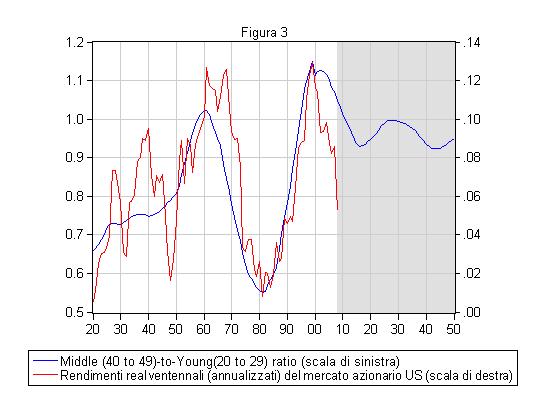
Per un ulteriore discussione del rapporto tra crescita economica, finanza e demografia potete leggere anche qui. Un punto di vista un po' più ottimista sul futuro, almeno per quanto riguarda la borsa U.S.A., fu espresso circa un anno fa in un post molto divertente da Carlo Favero su noiseFromAmeriKa. Le conclusioni sono molto più ottimistiche di quelle di Shiller e Gross: In un lavoro recente Favero, Gozluklu and Tamoni (2009, FGT) analizzano le implicazioni empiriche del modello GMQ identificando econometricamente un equilibrio di lungo periodo per il rapporto dividendi/prezzi coerente con gli andamenti delle variabili riportate nella Figura 3. FGT illustrano come la media che si evolve lentamente nel tempo a cui tende il rapporto diviidendi-prezzi sia determinata da MY assieme ad un trend che coglie lo sviluppo della tecnologia. A conseguenza di questo fatto i trend demografici risultano molto significativi per la previsione dei rendimenti azionari nel medio-lungo periodo. Gli stessi trend demografici portano ad indicare, come si evince dalla Figura 3, un rendimento annuale reale medio attorno all’8 per cento per il mercato azionario nei prossimi venti anni.
Etichette:
demografia,
mercato azionario USA,
Valutazione
lunedì 2 agosto 2010
Azioni o obbligazioni?
Una buona domande dal Wall Street Journal di sabato: Are stocks too cheap or are bonds too expensive?
After consistently lagging behind bond performance this year, stocks appear historically cheap compared with bonds, offering investors reason to favor stocks, particularly if they are optimistic about the economic outlook. But stocks may be cheap because the outlook is dim, meaning bonds—from Treasurys to corporate debt—could continue to outperform for the foreseeable future.
So far this year, the stock market's total return is slightly negative, while normally staid investment-grade corporate bond returns are up nearly 8%, according to Bank of America Merrill Lynch indexes. Even risk-free Treasury returns are up 6%. (...)
One way to compare the relative value of stocks and bonds is to compare their yields, or the amount of cash each asset generates on a regular basis.
Bond yields are easy to see; stock yields are trickier. Many analysts like to use something called an "earnings yield," which is the inverse of a company's price/earnings ratio. While imperfect, earnings yield measures how much cash a company generates for itself and its shareholders as a percentage of its price. As with bonds, higher yields represent lower prices, and vice-versa.
At the end of trading Friday, the earnings yield on the Standard & Poor's 500 index was 6.6%, based on the past four quarters' operating earnings, the highest since 1995.
The gap between that yield and the 10-year Treasury yield—a measure of the cheapness of stocks relative to Treasury bonds—is the widest about 30 years, according to Jason DeSena Trennert, chief investment strategist at Strategas Research Partners.
To Mr. Trennert, this suggests that stocks are too cheap, bonds are too expensive after a strong rally this year, or both.
"People are so risk-averse now that a tremendous potential opportunity is being created in stocks," he said. (...)
"You would have to believe in at least a mild recession to prefer corporate bonds over equities at this stage," said David Bianco, chief U.S. equity strategist for Bank of America Merrill Lynch.
Today, that gap is about six percentage points, compared with about three historically, according to Mr. Bianco—suggesting stocks are underpriced relative to bonds, particularly given how low inflation is.
"I would argue that the asset class with the most upside, even in a scenario of slow growth, is equities," said Mr. Bianco, who has a 12-month target of 1350 for the S&P 500. (...)
Skeptics note that bonds have outperformed stocks partly because economic growth has been too sluggish to help stocks go very far, but not so slow that it pushes companies, many of which are loaded with cash, into default. If such conditions persist as many observers believe, then the stock market could continue to lag behind.
"We could end up with slower growth than people think, and that's not going to be great for the equity market, but it doesn't really matter for credit," said Mr. Quinn of Barclays Capital.
Many skeptics warn that a key difference between this recovery and others where stocks consistently outpaced bonds is the withering of private borrowing and the financial sector, big drivers of recovery in economic and corporate-profit growth in prior expansions.
Private-sector borrowing has shrunk in this recession for the first time since the Great Depression, notes Northern Trust chief economist Paul Kasriel, who in July cut his forecast for annualized economic growth in the second half of 2009 to 1.8% from 2.5%.
He noted that private borrowing continues to contract despite near-zero interest rates from the Federal Reserve. Stimulus is set to fade and unemployment remains high. Under such conditions, borrowing will remain low, and the scarcity of new debt will prop up its value.
"The risk premium in the bond market will increase, but I'm not going to put that bet on now," Northern Trust chief investment officer Bob Browne said in an interview.
L'idea di impiegare il rendimento delle obbligazioni come benchmark per la valutazione del mercato azionario è molto antica (ad esempio il padre del value investing, Benjamin Graham nell capitolo 20 del suo libro The Intelligent Investo utilizza: il rendimento dei titoli di stato U.S.A. per il calcolo del margin of safety di un investimento azionario, confrontandolo proprio con il rendimento degli utili - earnings yield - dell'azione). La questione merita però un approfondimento e un po' di precisazioni, ne riparleremo presto qui su alfaobeta.
After consistently lagging behind bond performance this year, stocks appear historically cheap compared with bonds, offering investors reason to favor stocks, particularly if they are optimistic about the economic outlook. But stocks may be cheap because the outlook is dim, meaning bonds—from Treasurys to corporate debt—could continue to outperform for the foreseeable future.
So far this year, the stock market's total return is slightly negative, while normally staid investment-grade corporate bond returns are up nearly 8%, according to Bank of America Merrill Lynch indexes. Even risk-free Treasury returns are up 6%. (...)
Bond yields are easy to see; stock yields are trickier. Many analysts like to use something called an "earnings yield," which is the inverse of a company's price/earnings ratio. While imperfect, earnings yield measures how much cash a company generates for itself and its shareholders as a percentage of its price. As with bonds, higher yields represent lower prices, and vice-versa.
At the end of trading Friday, the earnings yield on the Standard & Poor's 500 index was 6.6%, based on the past four quarters' operating earnings, the highest since 1995.
The gap between that yield and the 10-year Treasury yield—a measure of the cheapness of stocks relative to Treasury bonds—is the widest about 30 years, according to Jason DeSena Trennert, chief investment strategist at Strategas Research Partners.
To Mr. Trennert, this suggests that stocks are too cheap, bonds are too expensive after a strong rally this year, or both.
"People are so risk-averse now that a tremendous potential opportunity is being created in stocks," he said. (...)
"You would have to believe in at least a mild recession to prefer corporate bonds over equities at this stage," said David Bianco, chief U.S. equity strategist for Bank of America Merrill Lynch.
Mr. Bianco prefers to compare the stock market's earnings yield to the yield on 10-year Treasury Inflation-Protected Securities, as TIPS yields include inflation protection while stock prices and dividend yields do not.
"I would argue that the asset class with the most upside, even in a scenario of slow growth, is equities," said Mr. Bianco, who has a 12-month target of 1350 for the S&P 500. (...)
Skeptics note that bonds have outperformed stocks partly because economic growth has been too sluggish to help stocks go very far, but not so slow that it pushes companies, many of which are loaded with cash, into default. If such conditions persist as many observers believe, then the stock market could continue to lag behind.
"We could end up with slower growth than people think, and that's not going to be great for the equity market, but it doesn't really matter for credit," said Mr. Quinn of Barclays Capital.
Many skeptics warn that a key difference between this recovery and others where stocks consistently outpaced bonds is the withering of private borrowing and the financial sector, big drivers of recovery in economic and corporate-profit growth in prior expansions.
Private-sector borrowing has shrunk in this recession for the first time since the Great Depression, notes Northern Trust chief economist Paul Kasriel, who in July cut his forecast for annualized economic growth in the second half of 2009 to 1.8% from 2.5%.
He noted that private borrowing continues to contract despite near-zero interest rates from the Federal Reserve. Stimulus is set to fade and unemployment remains high. Under such conditions, borrowing will remain low, and the scarcity of new debt will prop up its value.
"The risk premium in the bond market will increase, but I'm not going to put that bet on now," Northern Trust chief investment officer Bob Browne said in an interview.
L'idea di impiegare il rendimento delle obbligazioni come benchmark per la valutazione del mercato azionario è molto antica (ad esempio il padre del value investing, Benjamin Graham nell capitolo 20 del suo libro The Intelligent Investo utilizza: il rendimento dei titoli di stato U.S.A. per il calcolo del margin of safety di un investimento azionario, confrontandolo proprio con il rendimento degli utili - earnings yield - dell'azione). La questione merita però un approfondimento e un po' di precisazioni, ne riparleremo presto qui su alfaobeta.
Etichette:
value investing,
Valutazione
domenica 1 agosto 2010
Aggiornamento al 30 luglio 2010
Ecco l'aggiornamento al 30 luglio 2010.
| Asset | valuta | tendenza | pendenza | tendenza | pendenza | valore | |
| medio | medio | breve | breve | ||||
| periodo | periodo | periodo | periodo | ||||
| 1. | Euro Government Bond 30yr | EUR | POS | POS | POS | NEG | 191.02 |
| 2. | Ftse EPRA/NAREIT Global | USD | POS | POS | POS | POS | 1862.51 |
| 3. | CRB | USD | POS | NEG | POS | POS | 274.35 |
| 4. | Eur/USD | N/A | NEG | POS | POS | POS | 1.3044 |
| 5. | EuroStoxx | EUR | NEG | NEU | POS | POS | 261.65 |
| 6. | S&P500 | USD | NEG | NEU | POS | POS | 1101.60 |
Iscriviti a:
Post (Atom)