lunedì 15 marzo 2010

E gli ultimi saranno i primi...Investire nel litio? I heard it through the grapevine... I CDS e la legge di Groucho Marx

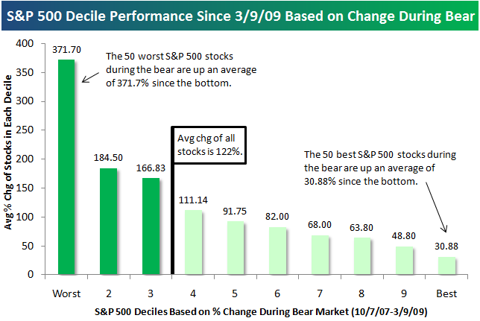
Dall'orso al toro: e gli ultimi saranno i primi...ecco quanto ha scoperto Bespoke


ed ecco una mia elaborazione relativa all'indice Stoxx 50, diviso in cinque quintili
secondo la performance tra il febbraio del 2008 e il febbraio del 2009, confrontata con quella nell'anno successivo (conclusosi a fine febbraio 2010): anche in
Europa gli ultimi sono diventati i primi!


Società Performance (28/2/2008-28/2/2009) Performance Media per quintile (28/2/2008-28/2/2009) Performance (28/2/2009-28/2/2010) Performance Media per quintile (28/2/2009-28/2/2010)
ROYAL BANK OF SCOTLAND GRP -92,80% -75,12% 65,48% 113,29%
ING GRP -83,52%
133,21%
BARCLAYS -79,90%
234,58%
UNICREDIT -79,32%
127,53%
DEUTSCHE BANK -72,02%
124,42%
ARCELORMITTAL -69,51%
81,04%
ANGLO AMERICAN -69,05%
138,76%
NOKIA -68,80%
31,58%
RIO TINTO -68,51%
126,10%
DAIMLER -67,72%
70,24%


AXA -67,36% -58,81% 106,24% 66,86%
GRP SOCIETE GENERALE -64,90%
70,81%
UBS -63,81%
33,91%
ASSICURAZIONI GENERALI -58,13%
39,77%
BCO BILBAO VIZCAYA ARGENTARIA -57,92%
64,94%
INTESA SANPAOLO -56,49%
33,39%
BNP PARIBAS -56,37%
110,34%
BCO SANTANDER -55,95%
94,88%
ALLIANZ -54,36%
58,12%
SIEMENS -52,79%
56,19%


PHILIPS ELECTRONICS -50,98% -42,15% 68,59% 51,26%
E.ON -50,70%
28,15%
BASF -47,70%
87,80%
IBERDROLA -45,83%
13,73%
ABB -45,37%
55,98%
CREDIT SUISSE GRP -44,38%
64,94%
HSBC -35,87%
68,09%
ROCHE HLDG P -35,09%
34,89%
GDF SUEZ -33,41%
8,99%
BHP BILLITON -32,15%
81,46%


ENI -30,80% -24,79% 4,48% 20,00%
ROYAL DUTCH SHELL A -26,66%
15,09%
UNILEVER NV -25,72%
44,92%
BAYER -25,11%
27,81%
TOTAL -25,03%
9,34%
DEUTSCHE TELEKOM -23,91%
-1,20%
TELEFONICA -23,54%
17,23%
NESTLE -23,24%
39,41%
VODAFONE GRP -23,05%
12,98%
DIAGEO -20,79%
29,91%


FRANCE TELECOM -20,06% -8,50% -3,28% 21,27%
SAP -19,28%
28,40%
BP -17,90%
29,10%
NOVARTIS -17,05%
40,00%
TESCO -16,80%
25,96%
SANOFI-AVENTIS -16,14%
31,30%
BRITISH AMERICAN TOBACCO -5,17%
24,07%
GLAXOSMITHKLINE -2,99%
13,56%
ERICSSON LM B 11,94%
-4,93%
ASTRAZENECA 18,49%
28,56%
DJ STOXX 50 -44,48%
39,53%
DJ STOXX 600 -45,78%
42,15%


Se davvero il futuro dell'auto è elettrico, e se non si trovano soluzioni migliori, il mercato delle batterie agli ioni di litio potrebbe esplodere, offrendo a investitori tempestivi e coraggiosi interessanti opportunità di profitto. Questa è in estrema sintesi, la tesi bullish di chi suggerisce di investire in litio. Ne parla il New York Times di qualche giorno fa che tuttavia osserva come:

By the standards of traditional gold and copper booms, the increase in interest in lithium is still muted among big mining companies. Supplies of lithium are plentiful for now, and the price of lithium chemicals actually declined at the end of last year because of the economic slowdown. The price for lithium carbonate, the basic lithium compound used in batteries, had been around $5,000 a ton for the last five years or so, and has leveled at about $4,000 since October.


Ho trovato divertente il post di Pablo Triana su Willmott
che vi propongo insieme alla canzone di Marvin Gaye alla quale si ispira


Heard through the media grapevine after 1997 Asian crisis and 1998 LTCM crisis (which almost destroyed the system):
"The answer is not to reject quantitative finance but to be honest about its limitations. Models have their places but they must be coupled with more subjective approaches to risk, such as stress tests and scenario-planning"
Heard through the media grapevine after 2008 credit crisis (which destroyed the system and almost caused a global depression):
"The answer is not to reject quantitative finance but to be honest about its limitations. Models have their places but they must be coupled with more subjective approaches to risk, such as stress tests and scenario-planning"
To be heard through the grapevine after 2015 sovereign debt CDO crisis (which would do away with the euro, result in the acquisition of Greece by private equity funds, and force President Palin to expulse California from the Union):
"The answer is not to reject quantitative finance but to be honest about its limitations. Models have their places but they must be coupled with more subjective approaches to risk, such as stress tests and scenario-planning"


E se al soul e al rhythm and blues preferite il tango vi consiglio la lettura dei due
articoli di Satyajit Das sulla regolamentazione dei derivati che potete trovare su 
eurointelligence qui e qui. Con tutta la confusione che stanno facendo i commentatori in questi giorni li troverete davvero chiari e utili per farsi un'opinione. Intanto un po' di ordine sulle cifre del fenomeno. 
Il valore totale nozionale del mercato dei derivati nel giugno del 2009 era di circa 605 trilioni di dollari, cioè 605*10^12 US$, pari a circa una decina di volte il GDP mondiale. 
Attenzione però: il valore nozionale è dato dal valore complessivo degli asset sottostanti i contratti derivati stipulati. E' dunque utile per avere un'idea della dimensione del fenomeno e serve per farsi un'idea dell'uso sistematico (e a volte parossistico) della leva finanziaria
Secondo Das: 
The size of the market is inconsistent with the thesis that derivatives are merely a vehicle for hedging and risk management.
Current regulatory proposals do not attempt to deal with the size of the derivatives markets. The current debate about "too big to fail" banks may indirectly affect the size issue. 
Oltre al problema dell'eccesso di leva - con i conseguenti rischi sistemici e di liquidità - un punto fondamentale da tenere presente è che molti prodotti sono troppo complessi e illiquidi per essere "prezzati" efficientemente: è chiaro in questo caso il vantaggio economico per chi li crea mentre la mancanza di trasparenza e di efficienza finisce con il danneggiare l'intero mercato.
La complessità di un derivato comporta anche numerosi problemi legati alla scelta e all'uso dei modelli impiegati per calcolarne il prezzo:
Model based valuations drive pricing of transactions and dealer hedging. They also are used to calculate the risk of the transactions and ultimately to derive the capital required to be held for regulatory and internal purposes.
The model-based valuations are also used to determine earnings and ultimately bonus payments for dealer staff. 
Non-professional dealers rarely have the required sophisticated pricing and valuation systems. They are dependent upon valuation date (predominantly) supplied by dealers or (less frequently) rely on pay-as-you-go pricing services.
Investors use the model-based prices to generate values for their fund units. Investors transact at these model-based prices when they invest or redeem investments
The accuracy and tractability of derivative valuation, especially for complex products, is questionable.


Nei contratti derivati ciascuna delle due parti si assume il rischio di credito dell'altra, ovvero il rischio che la controparte sia effettivamente in grado di mantenere fede agli obblighi contrattuali. Il rischio di controparte è al centro delle proposte di riforma finanziaria con la proposta della creazione di una central clearinghouse (CCP) e con un adeguamento dei requisiti di capitale richiesti alle controparti. Non è chiaro tuttavia come affrontare la regolamentazione senza creare altri rischi, sia di concentrazione che di liquidità: 
Current regulatory proposals do not address liquidity risks in derivative markets. Interestingly, the CCP may inadvertently increase liquidity risk as more participants may be subject to margining and unexpected demands on cash resources. The BIS has proposed an extensive regime of liquidity risk management controls that would, in part, cover some liquidity risks.


La questione della regolamentazione dei derivati è molto complessa, tecnica e di poca utilità se non si riesce a ottenere un coordinamento internazionale. Così Das chiude il suo secondo articolo: 


There will be a familiar threat. Lack of international agreement and regulatory uniformity makes compliance impractical. Banks and derivative activity will relocate with losses of jobs and taxes to the host country. Familiar arguments will be heard regarding the loss of competitive advantage, diminished financial innovation, slower capital formation and higher cost of capital. Each is a well-known step in the familiar "regulatory tango".The complexity of the issues means that ultimately no laws may be truly effective. As one famous law maker, Adlai Stevenson, observed "Laws are never as effective as habits."
Groucho Marx observed that "[government] is the art of looking for trouble, finding it, misdiagnosing it and then misapplying the wrong remedies." Legislators and regulators are likely to discover the truth of that proposition in their attempts to regulate the derivative market.


sabato 13 marzo 2010

Un video dall'Economist e la riforma della regolamentazione finanziaria USA

Vi segnalo un video dell'Economist che descrive in modo sintetico e chiaro alcuni tratti
salienti dell'economia tedesca...


...e un articolo sul New York Times di oggi dedicato alla riforma Dodd: ecco alcune anticipazioni sui contenuti che vanno dalla riforma del voto societario alla costitu
zione di un'agenzia per l'analisi e la prevenzione del rischio sistemico.

...empower shareholders to have advisory votes on executive pay and to nominate directors for the boards of public companies through company proxy ballots (...)
The shareholder provisions, which have been vigorously opposed by many corporations and by Republicans, will be part of a bill that would amount to the most sweeping overhaul of financial regulations since the Depression. In one of the most fiercely debated provisions, the bill would create a consumer financial protection agency under the umbrella of the Federal Reserve, a move certain to disappoint liberal Democrats who believe the Fed failed to safeguard consumers in the years leading up to the banking meltdown. (...)


The consumer financial protection agency would have a director appointed by the president and the ability to write rules governing mortgages, credit cards, payday loans and a wide range of other financial products.
It would have some ability to ensure that the rules are followed; (...)
The Federal Reserve would see its bank supervision powers significantly diminished. It would continue to oversee bank holding companies with $50 billion or more in assets, and would be entrusted to regulate systemically important nonbank financial institutions. (...) 
Smaller bank holding companies, if they have a federal charter, would be overseen by a new regulator formed out of the Office of the Comptroller of the Currency, which already oversees national banks. The Federal Deposit Insurance Corporation, which already oversees state-chartered banks that are not members of the Fed system, would gain oversight over those that are. (...)

The proposal would substantially alter the role of the Federal Reserve in protecting the economy, but the net effect would be a mixed outcome for the central bank.
On one hand, the Fed would be entrusted with oversight over all systemically important financial institutions, even if they are not banks.American International Group, the insurance giant that nearly brought down the financial system, was the most notorious example of such a company in the recent financial crisis. The Fed would also continue to oversee the nation’s largest bank holding companies — those with assets of $50 billion or more, or about 35 companies.
In addition, investment banks like Goldman Sachs and Morgan Stanley, which converted to bank holding companies in 2008 to take advantage of the Fed’s liquidity programs, would not be able to go back to their earlier status to avoid Fed oversight.
On the other hand, the Fed would lose oversight over more than 4,900 bank holding companies with roughly $3 trillion in assets, and about 870 state-chartered banks that are members of the Fed system and have a total of $1.7 trillion in assets. (...)
The bill would also create a council to detect systemic risks to the financial system, and trigger, if necessary, a process to seize and dismantle a large financial firm on the verge of failure; the goal would be to limit the possibility of a broader meltdown and the need for a government bailout.
The risk council would be headed by the treasury secretary and include representatives of the Fed, the new consumer agency, the F.D.I.C., theSecurities and Exchange Commission, the Commodity Futures Trading Commission and the Federal Housing Finance Agency — along with an official appointed to monitor the insurance industry, which is largely regulated by the states.
The bill would also impose comprehensive regulation of the sprawling market in over-the-counter derivatives. Standardized swaps and derivatives would have to be traded on exchanges or clearinghouses.

Ancora il New York Times sul caso Lehman. Il bailout della Grecia.

Un breve post per segnalarvi altri dettagli su come Lehman aggiustava i suoi conti sul New York Times di oggi, che mettono in causa la due diligence di Ernst & Young, incaricata di certificare i bilanci e che apparentemente girò la testa dall'altra parte per non vedere come venivano cucinati i libri contabili grazie a Repo 105.

Pare poi che la New York Fed sia stata molto attiva nel sostenere Lehman nei mesi immediatamente precedenti il fallimento:

...the report by Mr. Valukas nonetheless raises fresh questions about the role of the New York Fed in supporting Lehman during the frantic months leading up to its collapse. It suggests that Lehman executives believed the Fed would be able to help the bank avert disaster and provide it with a business opportunity.
“Bernanke and Co. may have ‘saved the day’ ” a Lehman executive, Geoffrey Feldkamp, wrote in an e-mail message to a colleague in March 2008, according to the report. Neither Ben S. Bernanke, the chairman of the Federal Reserve, nor Treasury officials saved Lehman, of course. But it was that month that the Fed started a special lending program open to Wall Street banks like Lehman that could not borrow directly from it. The Fed also lowered its standards for the kinds of collateral that it would accept against such short-term loans.
Lehman, desperate for financing, seized its chance. It packaged billions of dollars of troubled corporate loans into an investment called Freedom CLO. Then, in a series of transactions, it shifted Freedom back and forth to the New York Fed, in exchange for cash. Those moves helped make Lehman look healthier.
Essentially, Lehman was able to temporarily warehouse illiquid investments that were worrying its investors at the New York Fed in return for cash. The Fed created this facility immediately after the near collapse of Bear Stearns. Some suspect that other banks engaged in similar maneuvers.
“There were a number of tricks designed to make their balance sheet look stronger than it was,” said Janet Tavakoli, a structured finance analyst. “And they weren’t alone.”
A spokesman for the New York Fed said the loan facility was created to help the entire financial system and prevent the problems at one bank from cascading. The collateral accepted from Lehman met the Fed’s standards, he added. A third party valued it, the Fed accepted it and then reduced prices to limit the risk.
In March 2008, Lehman packaged 66 corporate loans to create the $2.8 billion Freedom CLO, which it planned to use exclusively for transactions with the Fed, the examiner’s report found.
The idea, according to a former Lehman trader familiar with Freedom, was to temporarily reduce the size of Lehman’s balance sheet. The Repo 105 transactions, according to the examiner, were created with a similar goal in mind.
The deals with the New York Fed let Lehman pledge Freedom — a mix of low-quality assets, plus some cash — in return for all cash from the Fed.
According to the examiner’s report, New York Fed officials were aware that Lehman viewed the lending facility as an opportunity to finance a bundle of loans that it could not offload easily to a rival bank. In August 2008, Lehman tried to pledge Freedom CLO and similar investments as collateral for its trading positions with Citigroup. A Citigroup executive rejected the offer as “junk” that was impossible to value, the report said.

Al rapporto Valukas dedica un articolo anche l'Economist.


Vi segnalo questo divertente post di TraderMark sul bailout della Grecia e sull'accumularsi di moral hazards:

US banks, Fannie (FNM), Freddie (FRE), AIG (AIG), Dubai, Greece... let us keep this moral hazard party going. It's official.
If you are following along at home...
UAE stands behind Dubai
EU stands behind Greece (as they will behind Portugal and Spain)
Japan stands behind itself
The IMF will stand behind the UK
Federal Government stands behind US banks, Fannie, Freddie, AIG
Federal Reserve stands behind Federal Government
The Earth stands behind the Federal Reserve
Mars stands behind the Earth
The Solar System stands behind Mars
The Universe stands behind the Solar System


Mettendo le cose così in prospettiva i 55 miliardi promessi alla Grecia sembrano ... noccioline:

55 billion euro? That's a sixth of just a single oligarch (Citi (C)? Bank of America (BAC)?) bailout in the US. Peanuts. Uncle Ben could print that in one evening. With his eyes closed. Bring on the Spanish!

Una bella sbronza di bailouts...dopo l'Ouzo siamo pronti per un bel botellón... altro che il trattamento riservato dalle banche ai piccoli imprenditori.

I retroscena del fallimento di Lehman Brothers. Aggiornamento al 12 marzo 2010.

 Un bell'articolo del New York Times riassume il rapporto in nove volumi e complessive  2200 pagine sul fallimento di Lehman Brothers e sulle pratiche ... diciamo poco ortodosse .. di cosmesi di biliancio: 


The 158-year-old company, it concluded, died from multiple causes. Among them were bad mortgage holdings and, less directly, demands by rivals like JPMorgan Chaseand Citigroup, that the foundering bank post collateral against loans it desperately needed.
But the examiner, Anton R. Valukas, also for the first time, laid out what the report characterized as “materially misleading” accounting gimmicks that Lehman used to mask the perilous state of its finances. The bank’s bankruptcy, the largest in American history, shook the financial world. Fears that other banks might topple in a cascade of failures eventually led Washington to arrange a sweeping rescue for the nation’s financial system.
According to the report, Lehman used what amounted to financial engineering to temporarily shuffle $50 billion of troubled assets off its books in the months before its collapse in September 2008 to conceal its dependence on leverage, or borrowed money. Senior Lehman executives, as well as the bank’s accountants at Ernst & Young, were aware of the moves, according to Mr. Valukas, the chairman of the law firm Jenner & Block and a former federal prosecutor, who filed the report in connection with Lehman’s bankruptcy case.
Richard S. Fuld Jr., Lehman’s former chief executive, certified the misleading accounts, the report said.
“Unbeknownst to the investing public, rating agencies, government regulators, and Lehman’s board of directors, Lehman reverse engineered the firm’s net leverage ratio for public consumption,” Mr. Valukas wrote.
Mr. Fuld was “at least grossly negligent,” the report states, adding thatHenry M. Paulson Jr., who was then the Treasury secretary, warned Mr. Fuld that Lehman might fail unless it stabilized its finances or found a buyer.
Lehman executives engaged in what the report characterized as “actionable balance sheet manipulation,” and “nonculpable errors of business judgment.”
The report draws no conclusions as to whether Lehman executives violated securities laws. But it does suggest that enough evidence exists for potential civil claims. Lehman executives are already defendants in civil suits, but have not been charged with any criminal wrongdoing.
A large portion of the nine-volume report centers on the accounting maneuvers, known inside Lehman as “Repo 105.”
First used in 2001, long before the crisis struck, Repo 105 involved transactions that secretly moved billions of dollars off Lehman’s books at a time when the bank was under heavy scrutiny. (...)
Repos, short for repurchase agreements, are a standard practice on Wall Street, representing short-term loans that provide sometimes crucial financing. In them, firms essentially lend assets to other firms in exchange for money for short periods of time, sometimes overnight.
But Lehman used aggressive accounting in its Repo 105 transactions: it appears to have structured transactions such that they sold securities at the end of the quarter, but planned to buy them back again days later. These assets were mostly illiquid real estate holdings, meaning that they were hard to sell in normal transactions.
The effect of the accounting was to artificially and temporarily lower the firm’s debt levels to hit certain targets, making the firm look healthier than it really was.
Ecco l'aggiornamento al 12 marzo 2010.


venerdì 12 marzo 2010

Investire nei mercati emergenti, la riforma finanziaria e come essere un top blogger.

Investire nei mercati emergenti per ridurre il rischio? Ecco un video del Wall Street Journal sull'argomento:


Attenti però che secondo alcuni c'è il rischio di una bolla, per esempio nell'immobiliare in Cina. Se n'era occupato anche l'Economist un paio di mesi fa in un'analisi comparativa della Cina di oggi con il Giappone della bolla immobiliare degli anni Ottanta concludendo che la situazione è molto diversa e tale da non giustificare allarmismi:


a close inspection of pessimists’ three main concerns—overvalued asset prices, overinvestment and excessive bank lending—suggests that China’s economy is more robust than they think. Start with asset markets. Chinese share prices are nowhere near as giddy as Japan’s were in the late 1980s. In 1989 Tokyo’s stockmarket had a price-earnings ratio of almost 70; today’s figure for Shanghai A shares is 28, well below its long-run average of 37. Granted, prices jumped by 80% last year, but markets in other large emerging economies went up even more: Brazil, India and Russia rose by an average of 120% in dollar terms. And Chinese profits have rebounded faster than those elsewhere. In the three months to November, industrial profits were 70% higher than a year before.
China’s property market is certainly hot. Prices of new apartments in Beijing and Shanghai leapt by 50-60% during 2009. Some lavish projects have much in common with those in Dubai—notably “The World”, a luxury development in Tianjin, 120km (75 miles) from Beijing, in which homes will be arranged as a map of the world, along with the world’s biggest indoor ski slope and a seven-star hotel.
Average home prices nationally, however, cannot yet be called a bubble. On January 14th the National Development and Reform Commission reported that average prices in 70 cities had climbed by 8% in the year to December, the fastest pace for 18 months; other measures suggest a bigger rise. But this followed a fall in prices in 2008. By most measures average prices have fallen relative to incomes in the past decade (see chart 1).
The most cited evidence of a bubble—and hence of impending collapse—is the ratio of average home prices to average annual household incomes. This is almost ten in China; in most developed economies it is only four or five. However, Tao Wang, an economist at UBS, argues that this rich-world yardstick is misleading. Chinese homebuyers do not have average incomes but come largely from the richest 20-30% of the urban population. Using this group’s average income, the ratio falls to rich-world levels. In Japan the price-income ratio hit 18 in 1990, obliging some buyers to take out 100-year mortgages.


Potrebbe nascere negli USA il National Institute of Finance, con il compito di cane da guardia contro i rischi di collasso del sistema finanziario...


The proposed agency, which has sometimes been referred to as the National Institute of Finance, is intended to give federal regulators daily updates on the stability of individual firms as well as that of their trading partners, including hedge funds.
By standardizing financial instruments and reporting mechanisms, the agency would give regulators a broader view of the health of participants in the financial markets and the potential for problems to spread. The idea’s supporters say that kind of information was lacking in recent years as the housing bubble burst and troubles spread from firm to firm. (...)

The agency would gather data from the largest firms and from a broad set of market participants, including all United States-based financial institutions, which would be required to report all their financial transactions, regardless of whether the counterparty was based here or abroad. The agency would take steps to safeguard proprietary trading information, while also shining a light onto the so-called shadow banking system of mortgage brokers, subprime lenders and unregulated hedge funds that contributed to the financial crisis.


The financial reform bill approved last year by the House would create a systemic risk council that would collect similar data without establishing an independent agency, a difference that will have to be resolved before a bill is sent to the president.

...anche se la rottura tra Democratici e Repubblicani sul tema della riforma finanziaria mi fa pensare che le cose andranno per le lunghe. Tra i più accesi sostenitori delle riforme c'è Gary G. Gensler, ex di Goldman Sachs che propone di 


... forcing the big banks that sell derivatives to conduct their trades in the open on public exchanges and clear them through central clearinghouses, so that any investor can see the prices that dealers charge their customers. Today, those transactions are bilateral and private.
The banks and their customers might have to post collateral or guarantees to prevent the kinds of panics seen during the financial crisis, in which some investors worried that trading partners might have trouble keeping their side of the contract.
In this way, the clearinghouses would work as circuit breakers in the great web of derivatives trading encircling the globe. Shifting the products, and the risk of default, off the books of the banks and onto these middlemen would ensure that no single bank was too interconnected to fail, the rationale goes.


Anche Goldman Sachs sembra essere d'accordo mentre alcune compagnie non finanziarie, che usano i derivati per la gestione del rischio (e basta?) sono preoccupate di dover sostenere dei costi aggiuntivi: 


Goldman also does not oppose a clearinghouse for trades, he said.
“We’re in favor of central clearing for derivatives,” he said. “We also think that all derivatives that can be traded on an exchange should be, but we don’t think it is a good idea to insist that derivatives can only be traded if they’re on an exchange.”
Some big nonfinancial companies that use the derivatives for hedging are fighting the reforms for their own reasons.
Organizations including the United States Chambers of Commerce have formed the Coalition of Derivatives End-Users, representing about 170 companies including Coca-ColaCaterpillar and General Electric. The group argues that the changes could make derivatives too expensive for them to use — or tie up capital they should be putting to work in their businesses.
“The question is how much is legitimate hedging by corporations” as opposed to speculative trading, said Don M. Chance, a finance professor at Louisiana State University. “You have to be careful you don’t punish companies that want to use swaps in a productive, safe manner.

Divertente post di Mebane Faber su come diventare un blogger importante: mi era sfuggito e ve lo segnalo. Il giorno che alfa o beta? raggiungerà il modesto obiettivo delle mille visite mensili organizziamo una festa (virtuale?)...

giovedì 11 marzo 2010

Macro alphabet soup?

Ancora sull'alphabet soup della recessione: U, V o W? Ecco una sintesi dell'opinione di Nouriel Roubini su RGE Monitor tratta dalla sua newsletter settimanale gratuita: 

A slew of poor economic data over the past two weeks suggests that the U.S. economy is headed for a U-shaped recovery—at best—in 2010. The macro news, (...)  actually suggests a significant downside risk (...). The U.S. faces continued challenges in H2—particularly as historic levels of fiscal stimulus fade—and appears far too close to the tipping point of a double-dip recession.

This is not the conventional wisdom. Heated debate continues to rage in the United States on whether the economic recovery will be V-shaped (with a rapid return to robust growth above potential), U-shaped (slow anemic, sub-par, below trend growth for at least the next two years) or W-shaped (a double-dip recession). The V camp includes distinguished research groups and individuals such as Ed Hyman’s ISI, Larry Meyer’s Macroeconomic Advisors, the research group of JP Morgan, Michael Mussa and others. The U camp includes—among others—Roubini Global Economics, Goldman Sachs’ U.S. economic research group, PIMCO and Ken Rogoff. As early as August 2009, I worried in a Financial Times op-ed about the risk of a double-dip recession even if our RGE benchmark scenario characterizes the risk of a W as still a low probability event (20% probability) as opposed to a 60% probability for a U-shaped recovery. Others concerned about the double-dip risk include also David Rosenberg, Gary Shilling and John Makin.

Ed Hyman and I debated whether the recovery would be U or V-shaped on a February 22 conference call attended by over 2,200 listeners. Since that call, a slew of new U.S. macro data have come out. They have been almost uniformly poor, if not outright awful. (...)

The eurozone (EZ) debt crisis, which RGE discusses in depth in a major new paper, predisposes Europe to a rising double-dip risk, due to the wave of fiscal austerity sweeping the periphery of the EZ. Even if the EZ doesn’t enter a double dip, the growth of domestic demand there will be as or more constrained than in the United States. This, in turn, will be a drag on the potential for U.S. export growth. The U.S. dollar rally on risk aversion reflects this risk. (...)  A similar retrenchment may well lie ahead in the United Kingdom, given rising fiscal sustainability concerns and the threat of a sterling crisis. Europe then will have great difficulty being a source of demand for U.S. exports, and may even provide impetus to faltering global demand growth, contributing to the threat of a wider double dip across high-income countries.


Ho trovato interessante questo post di Bespoke sulle nanotecnologie:

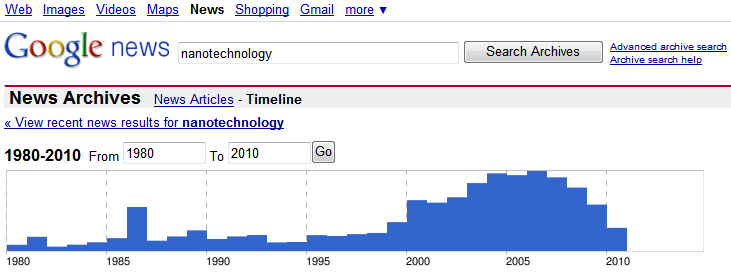
Back in the "good 'ole days" of the mid-2000s, investors were riding a bull market wave and looking for "the next big thing." One of those "next big things" was nanotechnology. Ever since the collapse began in 2007, however, the nanotech craze seems all but forgotten. We can't remember the last time we read or watched something about nanotech. A search of the term on Google News Archives confirms that there has indeed been a decline in nanotech coverage. As shown below, news articles containing the word "nanotechnology" peaked in 2006, and they've been declining steadily ever since. (Interestingly, this year does seem to be on pace to eclipse 2009.)

click to enlarge

Stocks and ETFs relating to nanotech have also lost investor interest. The PowerShares Nanotech ETF (PXN) actually came out right when the nanotech craze was peaking in 2005. As shown below, the ETF never really went anywhere. Even as the overall market was rising from 2005 to late 2007, PXN traded sideways. When the collapse hit, PXN wasn't spared.

Un'occasione per investitori contrarian? .

Tra gli investitori contrarian spicca Michael Burry,  un giovane value investor di grande successo: Vanity Fair gli dedica un lungo articolo molto ben scritto che vi raccomando caldamente di leggere.