Michael Burry è un leggendario investitore americano di quaranta anni che ha fondato e diretto il fondo hedge
Scion Capital LLC dal 2000 al 2008 quando lo chiuse ai capitali esterni dopo aver assicurato un rendimento di quasi il +500% in poco più di otto anni. Burry anticipò con successo lo scoppio della bolla internet e la crisi dei mutui subprime. Alfa o beta? gli ha dedicato un post quando poco più di un anno fa scrisse un accorato articolo accusando Alan Greenspan e la Fed di non aver agito per tempo impedendo la crisi finanziaria e le conseguenze catastrofiche che ancora oggi condizionano i mercati. Bloomberg TV gli ha dedicato un documentario nella serie Bloomberg Risk Takers che vi raccomando e che potete vedere qui sotto:
Visualizzazione post con etichetta contrarian. Mostra tutti i post
Visualizzazione post con etichetta contrarian. Mostra tutti i post
martedì 30 agosto 2011

martedì 6 aprile 2010
La Fed, le Bolle e un coraggioso investitore contrarian. Come scegliere e quanto pagare i CEO?
Sulle colonne del New York Times troviamo un vibrante J'accuse di Michael Burry (del quale Alfaobeta si è occupato qualche settimana fa alla fine di questo post) sulla cecità della Fed nei confronti della bolla subprime:
ALAN GREENSPAN, the former chairman of the Federal Reserve, proclaimed last month that no one could have predicted the housing bubble.“Everybody missed it,” he said, “academia, the Federal Reserve, all regulators.”
But that is not how I remember it. Back in 2005 and 2006, I argued as forcefully as I could, in letters to clients of my investment firm, Scion Capital, that the mortgage market would melt down in the second half of 2007, causing substantial damage to the economy. (...)
By mid-2005, I had so much confidence in my analysis that I staked my reputation on it. That is, I purchased credit default swaps — a type of insurance — on billions of dollars worth of both subprime mortgage-backed securities and the bonds of many of the financial companies that would be devastated when the real estate bubble burst. As the value of the bonds fell, the value of the credit default swaps would rise. Our swaps covered many of the firms that failed or nearly failed, including the insurer American International Group and the mortgage lenders Fannie Mae and Freddie Mac.
I entered these trades carefully. Suspecting that my Wall Street counterparties might not be able or willing to pay up when the time came, I used six counterparties to minimize my exposure to any one of them. I also specifically avoided using Lehman Brothers and Bear Stearns as counterparties, as I viewed both to be mortally exposed to the crisis I foresaw.
What’s more, I demanded daily collateral settlement — if positions moved in our favor, I wanted cash posted to our account the next day. This was something I knew that Goldman Sachs and other derivatives dealers did not demand of AAA-rated A.I.G.
I believed that the collapse of the subprime mortgage market would ultimately lead to huge failures among the largest financial institutions. But at the time almost no one else thought these trades would work out in my favor. (...)
I have often wondered why nobody in Washington showed any interest in hearing exactly how I arrived at my conclusions that the housing bubble would burst when it did and that it could cripple the big financial institutions. A week ago I learned the answer when Al Hunt of Bloomberg Television, who had read Michael Lewis’s book, “The Big Short,” which includes the story of my predictions, asked Mr. Greenspan directly. The former Fed chairman responded that my insights had been a “statistical illusion.” Perhaps, he suggested, I was just a supremely lucky flipper of coins.
Mr. Greenspan said that he sat through innumerable meetings at the Fed with crack economists, and not one of them warned of the problems that were to come. By Mr. Greenspan’s logic, anyone who might have foreseen the housing bubble would have been invited into the ivory tower, so if all those who were there did not hear it, then no one could have said it.
As a nation, we cannot afford to live with Mr. Greenspan’s way of thinking. The truth is, he should have seen what was coming and offered a sober, apolitical warning. Everyone would have listened; when he talked about the economy, the world hung on every single word.
Unfortunately, he did not give good advice.
Observing these trends in April 2005, Mr. Greenspan trumpeted the expansion of the subprime mortgage market. “Where once more-marginal applicants would simply have been denied credit,” he said, “lenders are now able to quite efficiently judge the risk posed by individual applicants and to price that risk appropriately.”
Yet the tide was about to turn. By December 2005, subprime mortgages that had been issued just six months earlier were already showing atypically high delinquency rates. (It’s worth noting that even though most of these mortgages had a low two-year teaser rate, the borrowers still had early difficulty making payments.)
The market for subprime mortgages and the derivatives thereof would not begin its spectacular collapse until roughly two years after Mr. Greenspan’s speech. But the signs were all there in 2005, when a bursting of the bubble would have had far less dire consequences, and when the government could have acted to minimize the fallout.
Instead, our leaders in Washington either willfully or ignorantly aided and abetted the bubble. And even when the full extent of the financial crisis became painfully clear early in 2007, the Federal Reserve chairman, the Treasury secretary, the president and senior members of Congress repeatedly underestimated the severity of the problem, ultimately leaving themselves with only one policy tool — the epic and unfair taxpayer-financed bailouts. Now, in exchange for that extra year or two of consumer bliss we all enjoyed, our children and our children’s children will suffer terrible financial consequences.
It did not have to be this way. And at this point there is no reason to reflexively dismiss the analysis of those who foresaw the crisis. Mr. Greenspan should use his substantial intellect and unsurpassed knowledge of government to ascertain and explain exactly how he and other officials missed the boat. If the mistakes were properly outlined, that might both inform Congress’s efforts to improve financial regulation and help keep future Fed chairmen from making the same errors again.
giovedì 11 marzo 2010
Macro alphabet soup?
Ancora sull'alphabet soup della recessione: U, V o W? Ecco una sintesi dell'opinione di Nouriel Roubini su RGE Monitor tratta dalla sua newsletter settimanale gratuita:
A slew of poor economic data over the past two weeks suggests that the U.S. economy is headed for a U-shaped recovery—at best—in 2010. The macro news, (...) actually suggests a significant downside risk (...). The U.S. faces continued challenges in H2—particularly as historic levels of fiscal stimulus fade—and appears far too close to the tipping point of a double-dip recession.
This is not the conventional wisdom. Heated debate continues to rage in the United States on whether the economic recovery will be V-shaped (with a rapid return to robust growth above potential), U-shaped (slow anemic, sub-par, below trend growth for at least the next two years) or W-shaped (a double-dip recession). The V camp includes distinguished research groups and individuals such as Ed Hyman’s ISI, Larry Meyer’s Macroeconomic Advisors, the research group of JP Morgan, Michael Mussa and others. The U camp includes—among others—Roubini Global Economics, Goldman Sachs’ U.S. economic research group, PIMCO and Ken Rogoff. As early as August 2009, I worried in a Financial Times op-ed about the risk of a double-dip recession even if our RGE benchmark scenario characterizes the risk of a W as still a low probability event (20% probability) as opposed to a 60% probability for a U-shaped recovery. Others concerned about the double-dip risk include also David Rosenberg, Gary Shilling and John Makin.
Ed Hyman and I debated whether the recovery would be U or V-shaped on a February 22 conference call attended by over 2,200 listeners. Since that call, a slew of new U.S. macro data have come out. They have been almost uniformly poor, if not outright awful. (...)
The eurozone (EZ) debt crisis, which RGE discusses in depth in a major new paper, predisposes Europe to a rising double-dip risk, due to the wave of fiscal austerity sweeping the periphery of the EZ. Even if the EZ doesn’t enter a double dip, the growth of domestic demand there will be as or more constrained than in the United States. This, in turn, will be a drag on the potential for U.S. export growth. The U.S. dollar rally on risk aversion reflects this risk. (...) A similar retrenchment may well lie ahead in the United Kingdom, given rising fiscal sustainability concerns and the threat of a sterling crisis. Europe then will have great difficulty being a source of demand for U.S. exports, and may even provide impetus to faltering global demand growth, contributing to the threat of a wider double dip across high-income countries.
Ho trovato interessante questo post di Bespoke sulle nanotecnologie:
Back in the "good 'ole days" of the mid-2000s, investors were riding a bull market wave and looking for "the next big thing." One of those "next big things" was nanotechnology. Ever since the collapse began in 2007, however, the nanotech craze seems all but forgotten. We can't remember the last time we read or watched something about nanotech. A search of the term on Google News Archives confirms that there has indeed been a decline in nanotech coverage. As shown below, news articles containing the word "nanotechnology" peaked in 2006, and they've been declining steadily ever since. (Interestingly, this year does seem to be on pace to eclipse 2009.)
click to enlarge

Stocks and ETFs relating to nanotech have also lost investor interest. The PowerShares Nanotech ETF (PXN) actually came out right when the nanotech craze was peaking in 2005. As shown below, the ETF never really went anywhere. Even as the overall market was rising from 2005 to late 2007, PXN traded sideways. When the collapse hit, PXN wasn't spared.
Un'occasione per investitori contrarian? .
Tra gli investitori contrarian spicca Michael Burry, un giovane value investor di grande successo: Vanity Fair gli dedica un lungo articolo molto ben scritto che vi raccomando caldamente di leggere.
A slew of poor economic data over the past two weeks suggests that the U.S. economy is headed for a U-shaped recovery—at best—in 2010. The macro news, (...) actually suggests a significant downside risk (...). The U.S. faces continued challenges in H2—particularly as historic levels of fiscal stimulus fade—and appears far too close to the tipping point of a double-dip recession.
This is not the conventional wisdom. Heated debate continues to rage in the United States on whether the economic recovery will be V-shaped (with a rapid return to robust growth above potential), U-shaped (slow anemic, sub-par, below trend growth for at least the next two years) or W-shaped (a double-dip recession). The V camp includes distinguished research groups and individuals such as Ed Hyman’s ISI, Larry Meyer’s Macroeconomic Advisors, the research group of JP Morgan, Michael Mussa and others. The U camp includes—among others—Roubini Global Economics, Goldman Sachs’ U.S. economic research group, PIMCO and Ken Rogoff. As early as August 2009, I worried in a Financial Times op-ed about the risk of a double-dip recession even if our RGE benchmark scenario characterizes the risk of a W as still a low probability event (20% probability) as opposed to a 60% probability for a U-shaped recovery. Others concerned about the double-dip risk include also David Rosenberg, Gary Shilling and John Makin.
Ed Hyman and I debated whether the recovery would be U or V-shaped on a February 22 conference call attended by over 2,200 listeners. Since that call, a slew of new U.S. macro data have come out. They have been almost uniformly poor, if not outright awful. (...)
The eurozone (EZ) debt crisis, which RGE discusses in depth in a major new paper, predisposes Europe to a rising double-dip risk, due to the wave of fiscal austerity sweeping the periphery of the EZ. Even if the EZ doesn’t enter a double dip, the growth of domestic demand there will be as or more constrained than in the United States. This, in turn, will be a drag on the potential for U.S. export growth. The U.S. dollar rally on risk aversion reflects this risk. (...) A similar retrenchment may well lie ahead in the United Kingdom, given rising fiscal sustainability concerns and the threat of a sterling crisis. Europe then will have great difficulty being a source of demand for U.S. exports, and may even provide impetus to faltering global demand growth, contributing to the threat of a wider double dip across high-income countries.
Ho trovato interessante questo post di Bespoke sulle nanotecnologie:
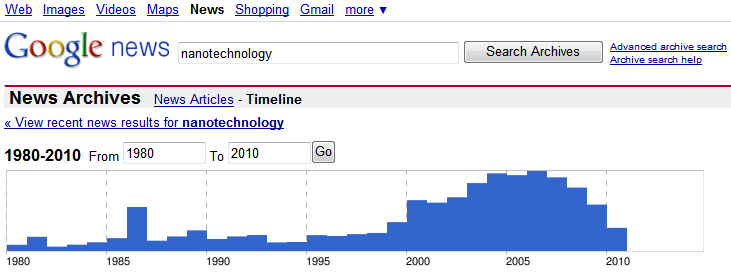
Back in the "good 'ole days" of the mid-2000s, investors were riding a bull market wave and looking for "the next big thing." One of those "next big things" was nanotechnology. Ever since the collapse began in 2007, however, the nanotech craze seems all but forgotten. We can't remember the last time we read or watched something about nanotech. A search of the term on Google News Archives confirms that there has indeed been a decline in nanotech coverage. As shown below, news articles containing the word "nanotechnology" peaked in 2006, and they've been declining steadily ever since. (Interestingly, this year does seem to be on pace to eclipse 2009.)
click to enlarge
Stocks and ETFs relating to nanotech have also lost investor interest. The PowerShares Nanotech ETF (PXN) actually came out right when the nanotech craze was peaking in 2005. As shown below, the ETF never really went anywhere. Even as the overall market was rising from 2005 to late 2007, PXN traded sideways. When the collapse hit, PXN wasn't spared.
Un'occasione per investitori contrarian? .
Tra gli investitori contrarian spicca Michael Burry, un giovane value investor di grande successo: Vanity Fair gli dedica un lungo articolo molto ben scritto che vi raccomando caldamente di leggere.
Iscriviti a:
Post (Atom)


 Post
Post


