Da non perdere! Ecco qui (grazie a John Mauldin che segnala il link sulla sua lettera di questa settimana)...
Per non dimenticare che questo è un blog molto serio, molto utile (e talvolta molto profittevole): due link a una lezione che Brad De Long (decisamente un Keynes boy...) sul ciclo economico e sulla dismal science: parte uno e parte due. Secondo De Long il ciclo economico è vivo e vegeto ed è stato un madornale errore
pensare che fosse un concetto obsoleto da gettare nel dimenticatoio...
...four years ago we economists were writing learned papers about the "Great Moderation," about how it looked as though the governing institutions of the world economy had finally learned how to control and moderate if not completely eliminate the business cycle - the epileptic seizures of the economy that leave us with pointlessly high unemployment, pointlessly idle capacity, and pointlessly rusting away machines in spite of there being no fundamental cause for machines to be idle, factories closed, and workers unemployed. In such an epileptic seizure of the economy, workers are unemployed and machines are idle because there isn’t the demand to employ them, and there isn’t the demand to employ because the workers are unemployed and have no incomes.
We have been seeing these epileptic seizures called business cycles fairly regularly since at least 1825.
And we have been claiming that we have it licked fairly regularly since 1825 as well.
British Prime Minister Robert Peel thought we had it licked with his Bank of England reforms in the 1840s.
Yale professor Irving Fisher thought we had it licked in the 1920s - that the founding of the Federal Reserve and the successful winning of the war of drugs in America with the passage of Prohibition had raised living standards, eliminated the business cycle, and carried stock prices to a permanently high plateau.
In the 1960s the Commerce Department's Bureau of Economic Analysis was so convinced that the business cycle was licked they changed the title of their trademark publication from Business Cycle Digest to Business Conditions Digest. That way they could keep the BCD acronym - but they would no longer be tied to this outmoded idea that there was an inevitable business cycle.
They were all wrong.
But did we learn? No. We did it again.
Visualizzazione post con etichetta Brad De Long. Mostra tutti i post
Visualizzazione post con etichetta Brad De Long. Mostra tutti i post
domenica 29 maggio 2011

giovedì 12 maggio 2011
L'infazione, questa sconosciuta...
Pricestats è un importante spin-off dell'MIT che analizzando i prezzi dei beni sui negozi online permette con una buona attendibilità di calcolare il tasso di inflazione in tempo pressochè reale:
PRICESTATS COUNTRY INFLATION SERIES
Daily series that represent an average of individual price changes across multiple categories and retailers by country. It is updated on a daily basis and leveraged to estimate annual and monthly inflation. This index is not designed to forecast official inflation announcements, but to provide real-time information on major inflation trends.
PRICESTATS PROJECTIONS OF OFFICIAL INFLATION ANNOUNCEMENTS
We combine the PriceStats Country Inflation Series with publicly available macroeconomic information to make projections about inflation releases in select countries. Our projections are model-based and differentiate from standard forecasts by the use of daily price information. These projections are released on a monthly basis prior to statistical office publications.
Chi ha accesso a una sottoscrizione online di Scientific American può leggere qui un articolo appena uscito sull'argomento.
 Ora che la sappiamo misurare così bene potremmo anche riconsiderare la necessità di avere un target rate così basso come quello che sia la BCE che la Fed si pongono come obiettivo (il 2%). O no?
Così almeno sembra pensarla Brad De Long che scrive
First, the question is not whether the Federal Reserve should raise its target inflation rate above 2% per year. The question is whether the Federal Reserve should raise its target inflation rate to 2% per year. On Wednesday afternoon, Federal Reserve Chair Bernanke stated that he was unwilling to undertake more stimulative policies because "it is not clear we can get substantial improvements in payrolls without some additional inflation risks." But the PCE deflator ex food and energy has not seen a 2% per year growth rate since late 2008: over the past four quarters it has only grown at 0.9%. At a 3.5% real GDP growth rate, unemployment is still likely to be at 8.4% at the end of 2011 and 8.0% at the end of 2012--neither of them levels of unemployment that would put any upward pressure at all on wage inflation. It thus looks like 1% is the new 2%: on current Federal Reserve policy, we are looking forward to a likely 1% core inflation rate for at least another year, and more likely three. A Federal Reserve that was now targeting a 2% per year inflation rate would be aggressively upping the ante on its stimulative policies right now. That is not what the Federal Reserve is doing. Would that we had a 2% per year inflation target.
PRICESTATS COUNTRY INFLATION SERIES
Daily series that represent an average of individual price changes across multiple categories and retailers by country. It is updated on a daily basis and leveraged to estimate annual and monthly inflation. This index is not designed to forecast official inflation announcements, but to provide real-time information on major inflation trends.
PRICESTATS PROJECTIONS OF OFFICIAL INFLATION ANNOUNCEMENTS
We combine the PriceStats Country Inflation Series with publicly available macroeconomic information to make projections about inflation releases in select countries. Our projections are model-based and differentiate from standard forecasts by the use of daily price information. These projections are released on a monthly basis prior to statistical office publications.
Chi ha accesso a una sottoscrizione online di Scientific American può leggere qui un articolo appena uscito sull'argomento.
Così almeno sembra pensarla Brad De Long che scrive
First, the question is not whether the Federal Reserve should raise its target inflation rate above 2% per year. The question is whether the Federal Reserve should raise its target inflation rate to 2% per year. On Wednesday afternoon, Federal Reserve Chair Bernanke stated that he was unwilling to undertake more stimulative policies because "it is not clear we can get substantial improvements in payrolls without some additional inflation risks." But the PCE deflator ex food and energy has not seen a 2% per year growth rate since late 2008: over the past four quarters it has only grown at 0.9%. At a 3.5% real GDP growth rate, unemployment is still likely to be at 8.4% at the end of 2011 and 8.0% at the end of 2012--neither of them levels of unemployment that would put any upward pressure at all on wage inflation. It thus looks like 1% is the new 2%: on current Federal Reserve policy, we are looking forward to a likely 1% core inflation rate for at least another year, and more likely three. A Federal Reserve that was now targeting a 2% per year inflation rate would be aggressively upping the ante on its stimulative policies right now. That is not what the Federal Reserve is doing. Would that we had a 2% per year inflation target.
But if we were targeting a 2% inflation rate--which we are not--should we be targeting a higher rate? I believe that the answer is yes.
La tesi centrale di De Long è che per minimizzare la probabilità che un'economia si ritrovi spinta dalle spinte deflazionistiche in una situazione nella quale i tassi sono talmente vicini a zero da rendere inefficaci la politica monetaria tradizionale è più utile avere un pochino di inflazione nel sistema. Solo un pochino però: not enough to derange the price mechanism, but enough to elevate nominal interest rates in normal times, so that monetary policy has plenty of elbow room to take the steps it needs to take to create macroeconomic stability when recession threatens. We want "creeping inflation."
How much creeping inflation do we want? We used to think that about 2% per year was enough. But in the past generation major economies have twice gotten themselves stranded on the rocks of the zero nominal bound while pursuing 2% per year inflation targets. First Japan in the 1990s, and now the United States today, have found themselves on the lee shore in the hurricane.
That strongly suggests to me that a 2% per year inflation target is too low. Two macroeconomic disasters in two decades is too many.
Fermo restando la necessità di affrontare seriamente il nodo delle risorse e della sostenibilità della crescita rispetto ai costi di approvvigionamento e alla disponibilità delle materie prime (continuo a pensare che le famiglie consumino energia e cibo e che il tasso di inflazione percepito - nelle tasche! - sia quello che li comprende), non trovo che un target rate del 3% sarebbe poi una tragedia. Dove sbaglio? Alcuni miei amici economisti hanno provato a farmi capire che è solo una questione di ridistribuzione della ricchezza, e che si tratta di decidere se premiare i creditori o i debitori. Ora i principali debitori in giro sono gli stati sovrani: chissà se vedremo un po' di inflazione in giro nei prossimi anni....
La tesi centrale di De Long è che per minimizzare la probabilità che un'economia si ritrovi spinta dalle spinte deflazionistiche in una situazione nella quale i tassi sono talmente vicini a zero da rendere inefficaci la politica monetaria tradizionale è più utile avere un pochino di inflazione nel sistema. Solo un pochino però: not enough to derange the price mechanism, but enough to elevate nominal interest rates in normal times, so that monetary policy has plenty of elbow room to take the steps it needs to take to create macroeconomic stability when recession threatens. We want "creeping inflation."
How much creeping inflation do we want? We used to think that about 2% per year was enough. But in the past generation major economies have twice gotten themselves stranded on the rocks of the zero nominal bound while pursuing 2% per year inflation targets. First Japan in the 1990s, and now the United States today, have found themselves on the lee shore in the hurricane.
That strongly suggests to me that a 2% per year inflation target is too low. Two macroeconomic disasters in two decades is too many.
Fermo restando la necessità di affrontare seriamente il nodo delle risorse e della sostenibilità della crescita rispetto ai costi di approvvigionamento e alla disponibilità delle materie prime (continuo a pensare che le famiglie consumino energia e cibo e che il tasso di inflazione percepito - nelle tasche! - sia quello che li comprende), non trovo che un target rate del 3% sarebbe poi una tragedia. Dove sbaglio? Alcuni miei amici economisti hanno provato a farmi capire che è solo una questione di ridistribuzione della ricchezza, e che si tratta di decidere se premiare i creditori o i debitori. Ora i principali debitori in giro sono gli stati sovrani: chissà se vedremo un po' di inflazione in giro nei prossimi anni....
sabato 5 marzo 2011
Krugman e De Long all'attacco
Mentre la BCE si prepara ad alzare i tassi di interesse negli U.S.A. la Fed sembra restare indifferente al pericolo inflazione. Krugman e De Long sono però ugualmente preoccupati che le politiche espansive in atto possano essere interrotte prima che l'occupazione dia segni di robusta ripresa:
- dal New York Times di giovedì: How To Kill a Recovery : secondo Krugman l'effetto espansivo delle politiche di austerità fiscale semplicmente non esiste: we have a lot of evidence from other countries about the prospects for “expansionary austerity” — and that evidence is all negative. Last October, a comprehensive study by the International Monetary Fund concluded that “the idea that fiscal austerity stimulates economic activity in the short term finds little support in the data.”
- su seekingalpha.com De Long si scaglia contro l'idea che l'inflazione sia un rischio concreto e tale da imporre la fine delle politiche monetarie espansive negli U.S.A. e in Europa.
giovedì 19 agosto 2010
Ancora sulle obbligazioni e sull'Hindenburg Omen
Piccola rassegna di post sull'argomento obbligazioni e sull'Hindeburg Omen:

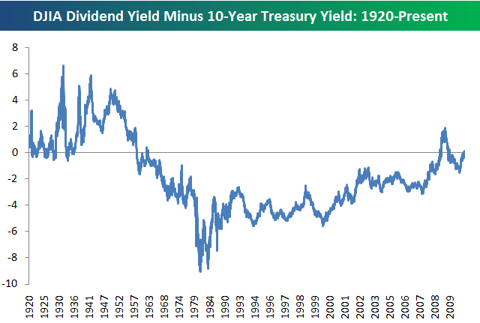
- iniziamo con due post di Bespoke: nel primo si contesta (senza un riferimento esplicito) l'affermazione che the Dow's dividend yield is now greater than the 10-Year Treasury yield (...and...) that this is the first time this has happened in decades, but in actuality, the Dow's yield got much higher than the 10-Year yield as recently as late 2008 and early 2009. La differenza oggi aumenta ancora con il calo del Dow e dello yield dei bond decennali dopo la pubblicazione dei dati economici U.S.A. così deludenti. Nel secondo, dedicato all'Hindenburg Omen, si fa osservare come
A closer look at the list of new highs, however, shows that the "stocks" hitting new highs last Thursday were hardly stocks at all. The WSJ provides a list of NYSE listed stocks hitting new highs and new lows on a daily basis, and looking at last Thursday's list of new highs shows that practically all of them were closed-end fixed income securities, preferred stocks, or some other form of fixed income product masquerading as an equity. In fact, of the 92 issues that hit new highs on Thursday (8/12), less than ten were common stocks.
Se si limita l'analisi del segnale alle azioni, escludendo quindi le obbligazioni scambiate sul NYSE e travestite da azioni, per esempio limitandosi ad analizzare le azioni che costituiscono l'indice S&P500 si scopre che il 12 agosto scorso only 0.2% of the stocks in the S&P 500 hit new highs while 5.6% of the stocks in the index hit new lows. A day when 5.6% of the stocks in the S&P 500 hit new lows is hardly a sign of strength, but it also doesn't reflect the indecision and confusion that the Hindenburg Omen is supposed to convey. Call us crazy, but an indicator that measures the internals of the equity market should probably avoid using fixed income securities in its analysis. On a side note, the Hindenburg Omen was last triggered in June 2008, and back then the indicator would have been triggered using either the NYSE or the S&P 500.
Insomma: non solo il fondamento statistico dell'Omen è perlomeno discutibile ma anche la sua definizione ha forse bisogno di qualche piccolo aggiustamento. - Brad De Long contesta l'analisi dei monetaristi osservando come la velocità del denaro abbia oscillazioni sempre più ampie rispetto alla trendline e in questo post interviene nel dibattito sulla bolla nel mercato delle obbligazioni del Tesoro U.S.A., rispondendo all'articolo di Siegel e Schwartz sul WSJ e raccontato ieri da Alfaobeta. Secondo De Long in questo caso parlare di una bolla è fuorviante poichè A bubble--I thought--is when those holding an asset do so because they expect its price to rise more-or-less indefinitely, and such a price rise is impossible. Such a bubble is very prone to rapid collapse when people realize that their expectations are very wrong. Do holders of U.S. Treasury bonds expect the prices of the assets they own to rise more-or-less indefinitely? No, they do not. They expect their holdings of Treasury bonds to be and to continue to be safe places to park their money, and they expect other asset classes to be risky.
Over time, I think, the fear of other asset collapses will ebb--but this is highly likely to produce a gradual rise in the prices of other asset classes and a gradual fall in Treasury prices, but a gradual fall does not make Treasury bonds unsafe.
Those who hold Treasuries to maturity will get the returns they expect: for holders-to-maturity, Treasury bonds are indeed very safe absent a very unlikely upward leap in inflation.
So I cannot see any possibility of a bubble collapse at the short end of the Treasury market--less than ten years, seven.
Secondo De Long anche chi investe in obbligazioni con durata lunga, fino ai trenta anni, corre rischi molto limitati, specialmente se si tiene conto della situazione macroeconomica. La differenza di posizione con Siegel-Schwartz non è sorprendente perchè riflette anche visioni divergenti delle prospettive dell'economia U.S.A. come avevo osservato ieri nel commento al loro articolo. Ecco come conclude il suo post Brad De Long: Could there be a sudden large downward movement in Treasury bond prices that would convince holders of Treasuries that they are not safe at all and induce a wave of panicked selling that would look like the collapse of a bubble?
In asset prices, never say never: the only thing you can ever say with absolute certainty is J.P. Morgan's: "they will fluctuate."
But I don't think so. People today buy an on-the-run ten-year Treasury at a yield of 2.64%--the bond with a 2.65% coupon maturing on August 15, 2020 at a price of 100.07. Its price drops tomorrow to 88.96. Do they conclude that their long Treasury position is too risky to hold? Or do they conclude that the Treasury correction has come and gone, and that Treasuries are actually safer than ever?
To argue that there is a Treasury bond bubble going on, you have to believe that such a fall in Treasury bond prices would induce further selling. And I cannot see that--not with the current state of macroeconomic news.
martedì 22 giugno 2010
Brad De Long linkfest.
Oggi festeggiamo Brad De Long con una serie di link ai suoi post:
- sulla politica fiscale. Qui la discussione si centra sul problema dei deficit e la necessità di stimoli: Marginal costs of further stimulative macro policy in the G-5 economies are very low in every model anybody has written down or spoken out to me. Marginal benefits are uncertain but might well be quite high.
- sui costi dell'austerità fiscale: non uccidete la ripresa, please, i mercati non lo chiedono (almeno negli USA): I would add that we really should be taking steps now to significantly improve the long-term deficit picture: standby tax increases and spending caps and entenched via procedures in such a way that it would be very, very difficult to undo them. This congress could pass a VAT to be implemented in five years if the budget deficit then still exceeds some trigger value. That would do much more to actually improve the long-term budget position and in all likelihood do more to give markets confidence than pointless exercises in unemployment-creating austerity today.
- le differenze di un approccio micro e macro all'uscita dalla crisi: In our normal, microeconomic world it is not a big deal when excess demand emerges in one market and excess supply emerges in another--it is, in fact, a good thing, because it induces shifts in production that make the structure of what is made correspond more closely to what people want (or perhaps to what the people with money want).(...) But in macroeconomics things are different. The excess supply is economy-wide--throughout all commodity markets, producing supply in excess of demand for goods, services, labor, and capacity. Producers and entrepreneurs respond to an aggregate demand shortfall just as individual producers respond to a particular shortfall of demand for their products: they hold sales to liquidate inventories, they cut prices, they cut wages to try to preserve margins, they fire workers. In the macroeconomic case, the dynamic process that leads to the elimination of excess supply and its counterbalancing excess demand in the microeconomic case gets underway--or, rather, half of it gets underway.
- sette approcci diversi della teoria economica alle depressioni!
- Mr Keynes and the classics, ovvero come unificare i punti di vista monetaristi di Irving Fisher, le analisi dei mercati finanziari di Knut Wicksell, e le analisi dei moltiplicatori di Richard Kahn.
giovedì 10 giugno 2010
Ora è il momento di decidere: più debito, più stimolo, più occupazione?
Brad De Long prosegue dalle colonne di Seekingalpha la sua battaglia a favore degli stimoli all'economia e contro la depression economics: nel suo ultimo post dal titolo We need bigger deficits now sostiene senza mezzi termini che il momento è propizio anche grazie ai bassissimi tassi di interesse che il mercato richiede per finanziare il debito USA: De Long usa un moltiplicatore di 1.5 (!!) per il denaro impiegato dal governo, cioè sostiene che ogni dollaro di ulteriore debito governativo produce 1.5 dollari di aumento del GDP. Non sono competente per sollevare un'obiezione qualificata ma mi sento in dovere di avvertire i lettori meno navigati che si tratta di un punto controverso e politicamente molto sensibile. Un economista meno liberal di De Long abbasserebbe notevolmente questo valore (i libertari più estremisti sostengono addirittura che il moltiplicatore è negativo!). Ciò premesso ecco le conclusioni di De Long:
Each dollar of missing production and each unemployed worker right now is much, much more painful to the country and a much greater loss to human welfare than a dollar of missed production and an unemployed worker in normal times.
The argument for more spending is airtight as long as the arithmetic holds out. That is, until:
Right now, bad politics is undermining good policy, hurting the American economy and legions of unemployed workers. It is long past time for another stimulus package.
Per un'analisi della situazione del mercato del lavoro negli Stati Uniti aggiornata con i dati di venerdì scorso potete leggere questo articolo su Marketwatch: l'incipit dice già tutto...
...
The news on jobs isn't as bad as it seemed on Friday.
It's worse.
President Obama and Treasury Secretary Geithner were trying to putting on a happy face, but the markets weren't buying. They have tumbled worldwide since the latest payroll data.
But instead of overreacting, the markets may only just be waking up to the real bad news
Ma se volete una nota di ottimismo...eccola. Divertente il riferimento all'opacità della BCE.
Each dollar of missing production and each unemployed worker right now is much, much more painful to the country and a much greater loss to human welfare than a dollar of missed production and an unemployed worker in normal times.
The argument for more spending is airtight as long as the arithmetic holds out. That is, until:
- further increases in the deficit lead to rising expectations of inflation, leading the Federal Reserve to raise short-term interest rates, which then crowds out private-sector investment spending;
- further increases in the deficit lead to pressure on the federal government’s debt capacity, so that we can no longer finance additional federal government debt at such extraordinarily advantageous interest rates.
Right now, bad politics is undermining good policy, hurting the American economy and legions of unemployed workers. It is long past time for another stimulus package.
Per un'analisi della situazione del mercato del lavoro negli Stati Uniti aggiornata con i dati di venerdì scorso potete leggere questo articolo su Marketwatch: l'incipit dice già tutto...
...
The news on jobs isn't as bad as it seemed on Friday.
It's worse.
President Obama and Treasury Secretary Geithner were trying to putting on a happy face, but the markets weren't buying. They have tumbled worldwide since the latest payroll data.
But instead of overreacting, the markets may only just be waking up to the real bad news
Ma se volete una nota di ottimismo...eccola. Divertente il riferimento all'opacità della BCE.
martedì 8 giugno 2010
Ancora un po' di incentivi, please. I rating dei CDOs: sbagliati per caso?
Su Seekingalpha Brad De Long difende con caparbietà la necessità di nuovi incentivi per l'economia USA contro i fautori dell'austerità di bilancio fin da subito.
Vi segnalo da Econotwist un post al vetriolo dedicato al rapporto preliminare della commissione del congresso USA sulla crisi finanziaria: se non vi basta il titolo del post How To Create A 3 Trillion Dollar Bubble And Burst It eccovi un assaggio dei contenuti che chiamano in cause senza mezzi termini le agenzie di rating:
The U.S. Financial Crisis Inquiry Commission have released a preliminary report on its findings after investigating the rating agencies role in the financial crisis. Inflated initial ratings, and later rapid
downgrades, on mortgage-related securities by the agencies have contributed to the financial crises through a number of channels, the commission concludes.
“In total, $2.5 trillion worth of RMBS and $564 billion worth of CDOs have been downgraded since January 2007.”
In other words; the rating agencies have erased more than 3 trillion dollars from investors accounts by correcting their own initial mistakes, triggering the biggest financial crisis since the 1930′s. The preliminary report explains what happened and how, but leaves the questions on why open to more speculations. (...)
1. They had no clue what so ever about what they were doing.
Or
2. They purposely tried to manipulate the market.
The commission don’t make any conclusive statements at this point, but the last word have definitely not been said in this matter.
But its beyond doubt that the rating mess was one of the main triggers behind today’s the financial crisis.
Vi segnalo da Econotwist un post al vetriolo dedicato al rapporto preliminare della commissione del congresso USA sulla crisi finanziaria: se non vi basta il titolo del post How To Create A 3 Trillion Dollar Bubble And Burst It eccovi un assaggio dei contenuti che chiamano in cause senza mezzi termini le agenzie di rating:
The U.S. Financial Crisis Inquiry Commission have released a preliminary report on its findings after investigating the rating agencies role in the financial crisis. Inflated initial ratings, and later rapid
downgrades, on mortgage-related securities by the agencies have contributed to the financial crises through a number of channels, the commission concludes.
“In total, $2.5 trillion worth of RMBS and $564 billion worth of CDOs have been downgraded since January 2007.”
In other words; the rating agencies have erased more than 3 trillion dollars from investors accounts by correcting their own initial mistakes, triggering the biggest financial crisis since the 1930′s. The preliminary report explains what happened and how, but leaves the questions on why open to more speculations. (...)
Stupidity Or Manipulation?
There are only two possible explanations for the rating agencies handling of the credit derivatives:1. They had no clue what so ever about what they were doing.
Or
2. They purposely tried to manipulate the market.
The commission don’t make any conclusive statements at this point, but the last word have definitely not been said in this matter.
But its beyond doubt that the rating mess was one of the main triggers behind today’s the financial crisis.
sabato 5 giugno 2010
Addio al lavoro, alle borse, all'euro. Aggiornamento al 4 giugno 2010
Ahi ahi...ahi...che male....ci mancavano l'Ungheria e l'occupazione nell'USA che non cresce (se si escludono i lavoratori a tempo determinato assunti per fare il censimento). Così venerdì se ne sono andati tutti i guadagni che le borse avevano faticosamente messo insieme durante la settimana. Se poi il finesettimana leggete la newsletter di John Mauldin allora vi viene voglia di investire tutti i vostri risparmi in oro, fucili e cibo in scatola...Infatti metà della lettera di questa settimana è dedicata alla possibilità che l'economia USA si contragga nel terzo trimestre del 2010...Scrive Mauldin:
If we go back into recession, the market on average drops 40%. This is NOT a buy-and-hold market. It is a buy-and-trade or, for those with the skills, sell-and-short. (If you are not experienced at short selling, this is not the time to jump in "whole hog." Short selling is a craft. An art form. A dangerous thing for rookies. Trade gently, gentle reader.)
There is a slow train coming. Between December of 2007 and through April of this year disposable personal income would have been DOWN just over $900 billion without the stimulus money (Gary Shilling). It would have been a far more serious recession. And now we are getting ready to find out whether we can make it without the intravenous infusion of government (borrowed taxpayer) money. I fear the train is going to slow down.
Restando su queste note di ottimismo sfrenato vi segnalo anche:
Ecco l'aggiornamento al 4 giugno 2010

If we go back into recession, the market on average drops 40%. This is NOT a buy-and-hold market. It is a buy-and-trade or, for those with the skills, sell-and-short. (If you are not experienced at short selling, this is not the time to jump in "whole hog." Short selling is a craft. An art form. A dangerous thing for rookies. Trade gently, gentle reader.)
There is a slow train coming. Between December of 2007 and through April of this year disposable personal income would have been DOWN just over $900 billion without the stimulus money (Gary Shilling). It would have been a far more serious recession. And now we are getting ready to find out whether we can make it without the intravenous infusion of government (borrowed taxpayer) money. I fear the train is going to slow down.
Restando su queste note di ottimismo sfrenato vi segnalo anche:
- un'analisi lucida e impietosa delle prospettive di medio termine per la Grecia e gli altri PIIGS;
- chi si ricorda della pizza di fango del Camerun? Che sia il momento di rispolverarla...per l'euro?
- Gli economisti si dividono e dibattono: inflazione o deflazione nel nostro futuro? Ecco al riguardo l'opinione di Brad De Long:
I AM going to turn my microphone over to one of my teachers who I think has the very best answer to this question. I never met, him, however: he died three years before I first set foot into an economics classroom, because he has what I think is the best answer to this question.
Here is British economist R.G. Hawtrey*, writing about the coming of the Great Depression to Europe:
The [United Kingdom's] National Government which came into office at the end of Auguest, 1931, made strenuous efforst to balance the budget, but it was too late to stem the flight from the pount. On the 21st September the convertibility of the currency into gold was suspended. On that day Bank Rate [i.e., the Bank of England's discount rate *and* the overnight interbank rate] was raised to 6 per cent [per year]. Once the gold standard was suspended, there could be no doubt of the purpose of that step. In the face of the exchange risk [created by abandoning the peg to gold] the high rate could not possibly attract foreign money. It could only be intended as a safeguard against inflation. Fantastic fears of inflation were expressed. That was to cry "Fire! Fire!" in Noah's Flood. It is *after* depression and unemployment have subsided that inflation becomes dangerous...
It looks alarmingly as if those many of us who do not remember history are, as Jorge Agustin Nicolas Ruiz de Santayana y Borras warned, condemned to repeat it. And it looks, even more alarmingly, like those of us who do remember history are as well condemned to repeat it with them.
* R. G. Hawtrey (1938), "A Century of Bank Rat - Purtroppo le divisioni e la confusione che regnano la politica europea si fanno sempre più sentire: secondo il Wall Street Journal: Europe's national governments have become their own biggest systemic risk. The ECB's Financial Stability Review is a twice-yearly look at the condition of Europe's banking sector. According to the report, European banks need to roll over some €800 billion in long-term debt in the next two and a half years, and to do so they'll have to compete with European governments that last year borrowed some €811 billion among them. This competition for capital between the private and public domains could drive up interest rates, or even lead to a liquidity squeeze for the banks or the public fisc, or both.
The situation is made more dangerous by the rules on how bank capital is calculated. Under regulatory capital requirements, highly rated government debt owned by banks is generally considered nearly risk free, giving financial institutions a strong incentive to hold sovereign debt. According to the Bank of International Settlements, its member banks have some $2.1 trillion in total exposure to European sovereign debt. So a pan-European sovereign debt crisis would not only affect the ability of European capitals to pay their bills. It would pose a threat to the solvency of the private banking system itself.
In the fall of 2008, the worry around the world was that a crisis in bank solvency would drag down the global economy. Today, the risk has shifted. A looming crisis in national solvency could threaten the same banks that Europe and the U.S. so recently saved. Only this time, the lender of last resort could itself be bankrupt. The ECB calls this "adverse feedback between the financial sector and public finance." We call it a recipe for disaster unless governments get their finances under control.
- Cosa deciderà il G20 sugli stress test per le banche?
Ecco l'aggiornamento al 4 giugno 2010

lunedì 31 maggio 2010
Gli investitori a caccia di un po' di sicurezza
Il Wall Street Journal osserva come in Europa il mercato interbancario in dollari si sia fondamentalmente paralizzato sulle scadenze superiori a un mese. La situazione sta creando un po' di imbarazzo e sottolinea la necessità di procedere con una certa decisione nell'opera di ristabilimento della fiducia nel sistema bancario europeo: But Europe still needs to act aggressively to restore confidence in its banking system and reduce stress in funding markets.
First, the euro zone needs to approve the €750 billion ($927 billion) bail-out package agreed three weeks ago. Second, individual countries must press ahead with austerity packages and, equally important, initiate the labor-market reforms vital to improving competitiveness. Finally, the European Union should commit to a full stress-test of its banking system and, where necessary, commit to further recapitalizations, as U.S. Treasury Secretary Timothy Geithner recommended this week. That might just bring U.S. investors back on board.
Intanto sul New York Times di oggi si discute sul rischio che l'Europa finisca in deflazione:
(...) some economists say it has become a driving obsession that has blinded the bank to a potentially bigger threat to Europe: deflation.
The central bank’s doubters grew louder after it made a big show of taking measures to cancel out the supposed inflationary impact of the government bond purchases it began on May 10 to help keep Greece and several other euro zone countries from defaulting on their debts.
“It’s nuts: how can they be concerned about the inflationary impact of this?” said Carl B. Weinberg, chief economist of High Frequency Economics in Valhalla, N.Y. “If I were the head of the E.C.B., I would be printing money to avert the decline in the money supply.”
Many economists regard deflation as more dangerous than inflation, because it prompts consumers to delay purchases as they wait for lower prices, creating a downward spiral of lower demand and production. Deflation is also bad for debtors like Greece, because they may have to pay back money that would be worth more than it was when they borrowed it.
Economists like Mr. Weinberg — and a few policy makers as well — are beginning to worry that a danger of deflation in Europe, similar to the one that strangled Japanese growth for most of the 1990s, is a bigger threat than inflation.
Prices fell in Ireland in April, while inflation was below 1 percent in five other euro zone countries. The problem also extends outside the euro zone.
“We all share some risks and problems in common with Japan circa 1995,” Adam S. Posen, a member of the Bank of England’s monetary policy committee, told an audience at the London School of Economics on May 2.
The United States is also at risk, Mr. Posen said, though he rated the chances of deflation there as low. But just as Japan did in the 1990s, the European Central Bank and the United States Federal Reserve have cut interest rates close to zero while pumping huge amounts of credit into their economies. That means the two central banks would have limited policy tools left with which to combat a collapse in prices and demand.
The downward pressure on prices has its roots in the economic decline that followed the 2008 financial crisis, but Europe’s sovereign debt problems are likely to add extra impetus. Governments, including those of Spain and Germany, are sharply reducing spending to lower their deficits, which will inevitably curb consumer demand and employment, hindering growth.(...)
Spanish core inflation already turned negative in April.
A mild decline in prices in a few euro zone countries can be managed, economists say, but it will add to the risks of deflation. And the central bank will face more difficulty than usual in devising a monetary policy that fits both the ailing countries and the faster-growing economies like Germany and France.(...)
The recent decline of the euro against the dollar could create some inflation. Oil and other commodities are priced in dollars and could become more expensive in euros.
Still, few economists see prices rising. “There is no reason to fear high inflation for the time being,” Simon Junker, a Commerzbank analyst, said in a note.
Vi segnalo tre post di Brad De Long:
First, the euro zone needs to approve the €750 billion ($927 billion) bail-out package agreed three weeks ago. Second, individual countries must press ahead with austerity packages and, equally important, initiate the labor-market reforms vital to improving competitiveness. Finally, the European Union should commit to a full stress-test of its banking system and, where necessary, commit to further recapitalizations, as U.S. Treasury Secretary Timothy Geithner recommended this week. That might just bring U.S. investors back on board.
Intanto sul New York Times di oggi si discute sul rischio che l'Europa finisca in deflazione:
(...) some economists say it has become a driving obsession that has blinded the bank to a potentially bigger threat to Europe: deflation.
The central bank’s doubters grew louder after it made a big show of taking measures to cancel out the supposed inflationary impact of the government bond purchases it began on May 10 to help keep Greece and several other euro zone countries from defaulting on their debts.
“It’s nuts: how can they be concerned about the inflationary impact of this?” said Carl B. Weinberg, chief economist of High Frequency Economics in Valhalla, N.Y. “If I were the head of the E.C.B., I would be printing money to avert the decline in the money supply.”
Many economists regard deflation as more dangerous than inflation, because it prompts consumers to delay purchases as they wait for lower prices, creating a downward spiral of lower demand and production. Deflation is also bad for debtors like Greece, because they may have to pay back money that would be worth more than it was when they borrowed it.
Economists like Mr. Weinberg — and a few policy makers as well — are beginning to worry that a danger of deflation in Europe, similar to the one that strangled Japanese growth for most of the 1990s, is a bigger threat than inflation.
Prices fell in Ireland in April, while inflation was below 1 percent in five other euro zone countries. The problem also extends outside the euro zone.
“We all share some risks and problems in common with Japan circa 1995,” Adam S. Posen, a member of the Bank of England’s monetary policy committee, told an audience at the London School of Economics on May 2.
The United States is also at risk, Mr. Posen said, though he rated the chances of deflation there as low. But just as Japan did in the 1990s, the European Central Bank and the United States Federal Reserve have cut interest rates close to zero while pumping huge amounts of credit into their economies. That means the two central banks would have limited policy tools left with which to combat a collapse in prices and demand.
The downward pressure on prices has its roots in the economic decline that followed the 2008 financial crisis, but Europe’s sovereign debt problems are likely to add extra impetus. Governments, including those of Spain and Germany, are sharply reducing spending to lower their deficits, which will inevitably curb consumer demand and employment, hindering growth.(...)
Spanish core inflation already turned negative in April.
A mild decline in prices in a few euro zone countries can be managed, economists say, but it will add to the risks of deflation. And the central bank will face more difficulty than usual in devising a monetary policy that fits both the ailing countries and the faster-growing economies like Germany and France.(...)
The recent decline of the euro against the dollar could create some inflation. Oil and other commodities are priced in dollars and could become more expensive in euros.
Still, few economists see prices rising. “There is no reason to fear high inflation for the time being,” Simon Junker, a Commerzbank analyst, said in a note.
Vi segnalo tre post di Brad De Long:
- Come prevedere i rendimenti futuri delle azioni USA? La conclusione è moderatamente ottimista: It's hard to see there being a large, permanent wedge between average real stock returns on the one hand and average earnings yields on the other. With trend earnings on the DJIA somewhere around 600 and with Treasury rates as low as they are, it's hard to argue that U.S. stocks will be outperformed by other asset classes over any even moderately long horizon. Vorrei dedicare un post all'argomento appena trovo un po' di tempo.
- La legge di Walras in azione: ma dove sono le obbligazioni sicure?...
- ...e infatti gli investitori a caccia di titoli di alta qualità fanno volare le obbligazioni trentennali del Tesoro USA, con rendimenti ormai appena superiori al 4%. Scrive De Long: In late May, the yield to maturity of the 30-year United States Treasury bond was 4.07% per year – down a full half a percentage point since the start of the month. That means that a 30-year Treasury bond had jumped in price by more than 15%. So a marginal investor was willing to pay more than 15% more cash and more than 30% more equities for US Treasury bonds at the end of the month than at the beginning. This signals a remarkable shift in relative demand for high-quality and liquid financial assets – an extraordinary rise in market-wide excess demand for such assets.
 Why does this matter? Because, as economist John Stuart Mill wrote in the first half of the nineteenth century, excess demand for cash (or for some broader range of high-quality and liquid assets) is excess supply of everything else. What economists three generations later were to call Walras’s Law is the principle that any market in which people are planning to buy more than is for sale must be counterbalanced by a market or markets in which people are planning to buy less.We have seen this principle in action since the early fall of 2007, as growing excess demand for safe, liquid, high-quality financial assets has carried with it growing excess supply for the goods and services that are the products of ongoing human labor. This is true to such an extent that there is now a 10% gap between the global economy’s current output and what it would be producing if it were in its normal relatively healthy state of near-balance.And global financial markets are now telling us that this excess demand for safe, liquid, high-quality financial assets has just gotten bigger.To some small degree, a change in investor sentiment has induced the rise in excess demand for such assets. After all, we can assume that the animal spirits of investors and financiers has been further depressed as a psychological reaction to the exuberant belief just a few years ago in the powers of financial engineering.But most of the recent shift has come not from an increase in demand for safe, liquid, high-quality financial assets, but from a decrease in supply: six months ago, bonds issued by the governments of southern Europe were regarded as among the high-quality assets in the world economy that one could safely and securely hold; now they are not.

martedì 18 maggio 2010
Brad De Long sui CDS nudi, sul futuro della social security negli USA e una lezione sulla crisi finanziaria.
Vi segnalo tre post di Brad De Long:
il primo analizza la questione della regolamentazione dei credit default swaps (CDS), soffermandosi sul dibattito in corso relativo all'opportunità (o meno) di vietare i CDS "nudi";
il secondo è una analisi del futuro della social security negli USA,
il terzo è semplicemente un'illustrazione della ripresa in corso nell'economia USA attraverso cinque grafici
(GDP e occupazione)
Infine vi ripropongo qui sotto una sua breve lezione sulla crisi finanziaria.
il primo analizza la questione della regolamentazione dei credit default swaps (CDS), soffermandosi sul dibattito in corso relativo all'opportunità (o meno) di vietare i CDS "nudi";
il secondo è una analisi del futuro della social security negli USA,
il terzo è semplicemente un'illustrazione della ripresa in corso nell'economia USA attraverso cinque grafici
(GDP e occupazione)
Infine vi ripropongo qui sotto una sua breve lezione sulla crisi finanziaria.
Iscriviti a:
Post (Atom)


 Post
Post


